

Steven Bartlett dethrones Joe Rogan in UK as self-improvement podcasts capture 25% of top listening

This piece is freely available to read. Become a paid subscriber today and help keep Podwires financially afloat so that we can continue to pay our writers for their insight and expertise.
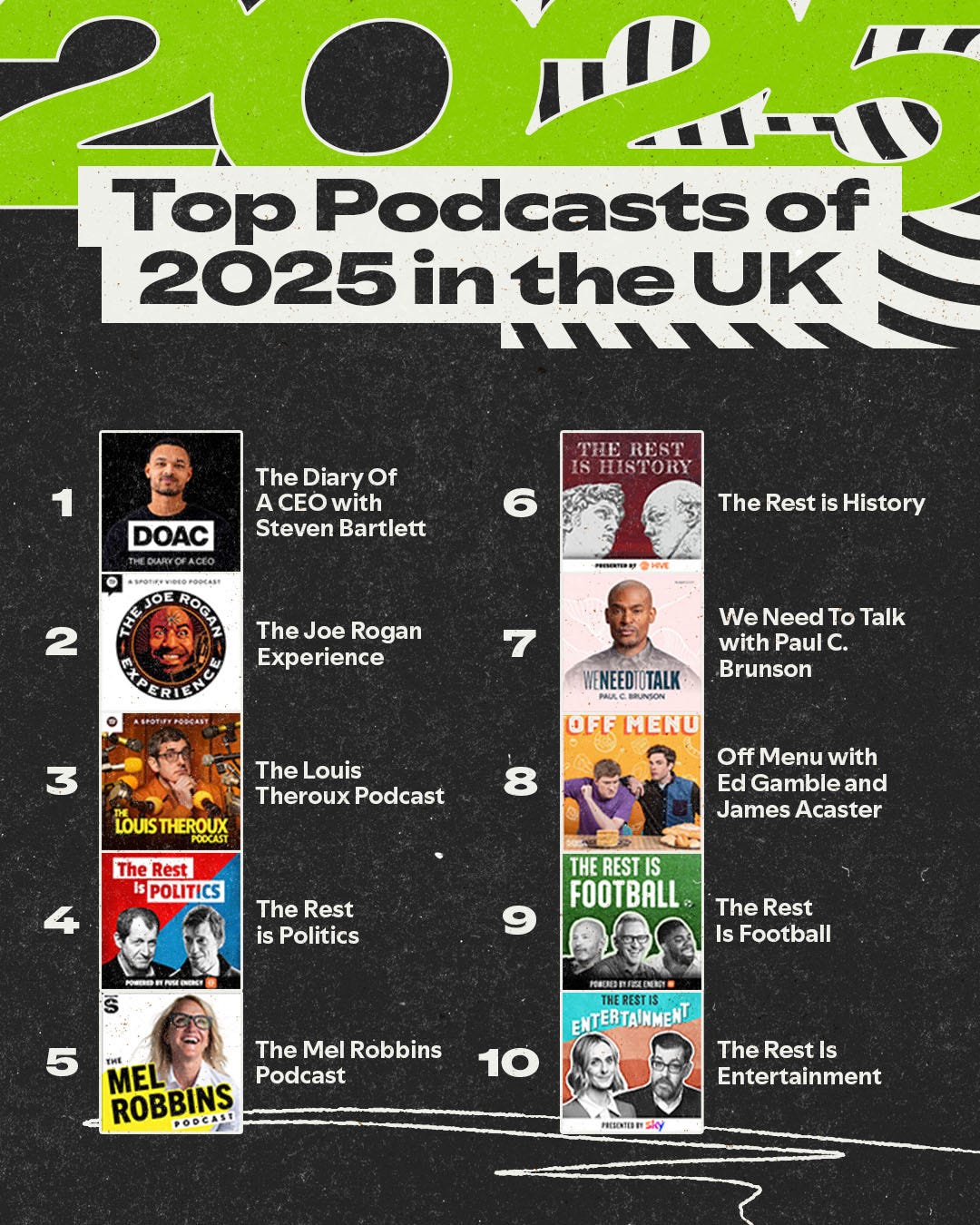
Podwires Rundown : Spotify dropped their 2025 Wrapped data, and the podcasting industry is treating platform-specific charts like they’re Nielsen ratings. Steven Bartlett’s The Diary of a CEO dethroned Joe Rogan in the UK for the first time, self-improvement content captured over 25% of UK Top 50 listening, and Taylor Swift’s New Heights appearance became “one of audio’s biggest stories of 2025.” But here’s the part nobody’s saying out loud: these aren’t industry charts. They’re Spotify charts. When one platform controls 700 million listeners and defines cultural moments through proprietary data releases, “the UK’s favorite podcast” really means “the UK’s favorite podcast that Spotify’s algorithm surfaced most effectively.” Let that sink in.
Spotify released comprehensive Wrapped 2025 data for UK and global podcast listening, shared through PR communications from Sacha (Spotify UK team), revealing consumption patterns, breakout shows, and category dominance across the platform’s 700 million users. The data provides insight into both UK-specific trends and global listening behavior, highlighting shifts in chart positions, genre performance, and creator trajectories throughout 2025.
The Key Points:
The Diary of a CEO with Steven Bartlett surpassed The Joe Rogan Experience to become the UK’s #1 podcast for the first time, while Rogan maintained global #1 position, demonstrating geographic variation in content preferences
Self-improvement podcasts accounted for over 25% of all listening across the UK Top 50, with Mel Robbins jumping from outside the Top 25 in 2024 to #5 in the UK and #3 globally in 2025, representing one of the year’s fastest chart ascents
Gary Lineker’s Goalhanger “Rest Is...” podcast universe placed seven shows in the UK Top 50 with four in the Top 10, spanning politics, history, football and entertainment to cement their position as Britain’s dominant podcast network
Taylor Swift’s first-ever podcast interview on New Heights with Jason & Travis Kelce pushed the sports show into the Global Top 50, triggering spikes in new listeners and female audiences in what press coverage labeled the “Taylor Swift effect”
Digital-native creators now represent nearly a third of the UK Top 50, sitting alongside legacy broadcasters like BBC Radio 4’s Desert Island Discs and The Guardian’s Today in Focus, signaling the format’s “maturation”
Why It Matters: These charts determine how the entire industry measures success, influences advertiser spending decisions, and shapes creator strategies – but they’re measuring Spotify’s ecosystem, not podcasting’s actual performance. When self-improvement captures 25% of top listening, that doesn’t just reflect audience demand. It reflects what Spotify’s recommendation algorithm prioritizes, what appears in Spotify’s playlists, and what content gets featured in Spotify’s editorial curation. The “maturation” narrative sounds compelling until you realize mature markets typically have diverse measurement standards, not one platform controlling both distribution and the scoreboard.
The Big Picture: For podcasters and producers, this data exposes an uncomfortable reality about platform dependence disguised as industry achievement. Steven Bartlett beating Joe Rogan in the UK isn’t just about interview quality or audience preference – it’s about which show Spotify’s algorithm served to more listeners. Fair play to Bartlett for building something that works in Spotify’s ecosystem, but here’s what the charts don’t tell you: how many UK listeners would have discovered The Diary of a CEO without Spotify’s recommendation engine? How much of that 25% self-improvement dominance comes from organic discovery versus algorithmic amplification?
The Taylor Swift story is particularly revealing. New Heights didn’t just benefit from Swift’s appearance – it benefited from being the exclusive platform where that interview happened, driving listeners to Spotify specifically. That’s not podcast growth. That’s platform lock-in with celebrity leverage. The “Taylor Swift effect” isn’t proving podcast power; it’s proving that star power drives platform adoption when content is exclusive.
The actionable reality for independent podcasters: these charts mean nothing for your show unless you’re optimizing for Spotify’s specific preferences. The “Rest Is...” universe placing four shows in the UK Top 10 demonstrates network advantage and production consistency, but it also shows what it takes to compete in a platform-controlled discovery environment. You need scale, regular publishing cadence, professional production, and ideally backing from established media entities like Goalhanger.
For podcast producers, notice what’s NOT in these charts: independent creators without networks, experimental formats, regional shows serving specific communities. The “digital-native creators sitting alongside legacy broadcasters” narrative sounds like democratization until you realize those digital-native creators typically have significant backing, marketing budgets, and production teams. Podcasting’s “maturation” apparently means looking more like traditional media with better distribution technology.
Here’s the part that should terrify anyone who cares about open podcasting: Spotify Wrapped is now the annual cultural moment that defines podcasting success. Not Download numbers across all apps. Not RSS subscription growth. Not audience engagement measured across the open ecosystem. One platform’s year-end marketing campaign has become the industry’s report card, and we’re all celebrating like this represents the medium’s health rather than one company’s market dominance.
The self-improvement genre dominating both UK and global charts tells you exactly what Spotify’s algorithm prioritizes: accessible, evergreen content with broad appeal and high replay value. Nothing wrong with that content, but when one category captures a quarter of top listening, that’s not organic diversity – that’s algorithmic convergence. The industry keeps talking about “thousands of niche podcasts for every interest,” but the actual listening behavior Spotify reports looks increasingly homogeneous.
For advertisers reading this: remember that these charts measure Spotify consumption, not podcast consumption. If you’re allocating budgets based on Wrapped rankings without understanding how much of that listening came from algorithmic recommendation versus organic discovery, you’re making strategic decisions on incomplete data. The shows in these charts benefit from Spotify’s distribution infrastructure – which is valuable, but it’s not the same as measuring actual brand loyalty or audience engagement across the entire podcast ecosystem.
The uncomfortable truth? Podcasting didn’t mature in 2025. One platform’s grip on the medium tightened enough that their charts now define industry success. There’s a difference, and pretending otherwise is how you wake up one day discovering that “podcasting” has become synonymous with “content that performs well in Spotify’s recommendation algorithm.”
REALLY? Yes. Really.
Not ready to be paid subscribe, but appreciate the newsletter ? Grab us a beer or snag the exclusive ad spot at the top of next week's newsletter.


