

🎙Women Aren't Leaving Podcasting. They're Never Starting; 92% of Your "Video Podcast" Audience Isn't Watching

Did someone forward this to you?
Become one of the more than 1000 valued email subscribers. Find Out More 👈


👋 Hi, Podsky!
We are thrilled to present the latest edition of Podcast In Brief! And don’t worry, our loyal listeners — you’ll still get the occasional real-time update!
Thank you to all our free and paid subscribers for continuing to support us. As an independent media organisation, we can only continue our work with the support of readers like you, unlike others who are supported by well-funded organisations.
Your subscription to Podwires will help to fund our operations as an independent media organisation. Becoming a paid subscriber
First time reading? We would be delighted if you would join us – after all, we have over 1,000 intellectually curious readers already! Sign up here.
We want everyone to know about this, so please spread the word by sharing the email with your friends! (copy URL here)
And, as always, send us feedback at editor@podwires.com
Today’s reading time is 5 minutes. - Miko Santos (13 December 2025)
🎙️Today, we’ve got the inside scoop on:
Women Aren’t Leaving Podcasting. They’re Never Starting.
92% of Your “Video Podcast” Audience Isn’t Watching
WaPo Bets on AI Podcasts to Win Young Listeners—Who Don’t Trust AI to Connect Them
Podcast Insight: The Podcasts You’ve Never Heard Of Are Crushing the Ones You Have
PodBusiness : Audacy just dropped their 2026 predictions, and buried in the promotional copy are some genuinely useful signals about where audio advertising is headed.
Job Board : Magellan AI - Measurement Success Manager

SOUNDS PROFITABLE
Women Aren’t Leaving Podcasting. They’re Never Starting

Podwires Rundown : The podcasting industry loves to obsess over retention. Podfade rates. Churn metrics. The slow bleed of creators who burn out after twenty episodes. But what if we’ve been measuring the wrong problem entirely?
New data from Sounds Profitable’s The Creators 2025 study reveals a startling asymmetry: 15% of male podcast consumers are active creators. For women, it’s 8%. Nearly half. And here’s the uncomfortable part—this isn’t about women abandoning the medium. Women who start podcasts actually have higher retention rates than men (69% vs 67%). The problem is upstream. They’re not showing up to the starting line.
Tom Webster, Partner at Sounds Profitable, analyzed creator demographics in The Creators 2025 study and found a persistent gender gap that predates the video podcasting era. The research suggests the industry’s failure to cultivate visible female role models—combined with the rising pressure of video production—may be raising barriers to entry that don’t affect everyone equally.
The Key Points
15% of male podcast consumers are active creators vs. just 8% of women—a gap that persists across all creators (active or lapsed) at 23% vs 12%
Women who do create podcasts have a 69% retention rate, outpacing men at 67%—the issue is entry, not exit
Among active creators, video adoption is virtually identical: 71% of women use video vs 70% of men
The gender gap existed before the “video or die” narrative—but video expectations may be accelerating the problem
Webster argues the industry hasn’t been intentional about showcasing female success stories as aspirational models
Why It Matters: The podcasting industry has spent years celebrating its low barrier to entry. Record in your closet. Launch with a USB mic. Build something meaningful in the margins of a busy life. But if that promise only resonates with half the population, we’ve been telling ourselves a convenient fiction. The data suggests potential creators are self-selecting out before they ever hit record—and the rising expectation of being “camera-ready” may be narrowing those margins further. This isn’t a retention problem to optimize. It’s a pipeline problem to fix.
The Big Picture For podcasters and producers, this research demands honest self-reflection. Are your panels, guest rosters, and recommended listens reinforcing a narrow vision of what a successful podcaster looks like? For networks and platforms, the question is whether your creator programs and marketing materials reflect the full range of people who could build something here—or just the people who already have.
The actionable path forward isn’t complicated. Celebrate audio-first creators. Feature diverse success stories in trade coverage and conference lineups. And maybe stop pretending that “you need video to succeed” is universally true advice. It’s true for some creators. For others, it’s a barrier disguised as wisdom.
Here’s what the data actually tells us: women who create podcasts are committed. They’re not dabbling. They’re not more likely to quit. The industry’s job is to stop losing them before they ever begin.
The microphone is ready. The question is who we’re inviting to use it.

TOGETHER WITH MENCARI NEWS (AU)
The News Powerful People Don’t Want You to Read
Between meetings, emails, and deadlines, who has time to stay properly informed? The Mencari News Australia solves this. Five minutes each morning gives you everything you need about Australian politics, technology, and finance.
No endless scrolling. No clickbait. Just the essential insights that impact your work and life. Smart professionals choose efficiency. Join hundreds of subscribers.
This section is a paid advertisement. If you are interested in advertising, let’s talk.
OXFORD ROAD
The Podcasts You’ve Never Heard Of Are Crushing the Ones You Have
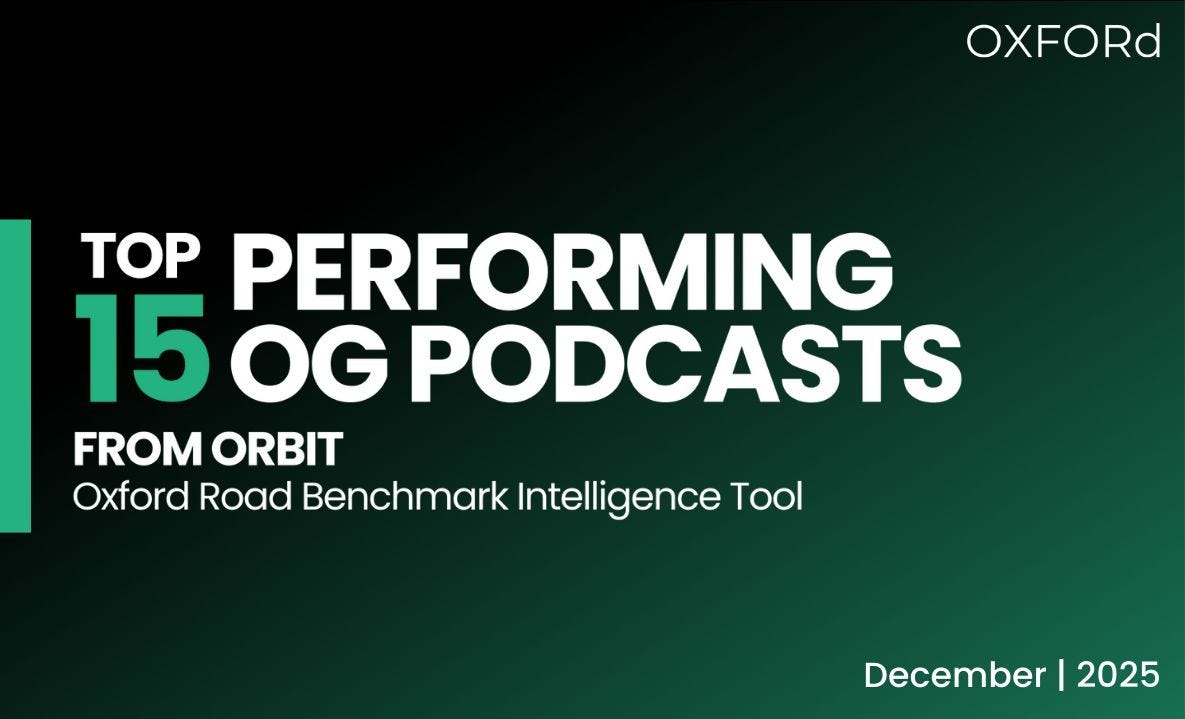
Podwires Rundown : The advertising industry has a crush on celebrity podcasts. Every time a famous face launches a show, media buyers trip over themselves to secure inventory. The PR machine cranks up. CPMs skyrocket. And somewhere, a show that’s been quietly converting listeners into customers for eight years gets passed over for the hot new thing.
Oxford Road just dropped a reality check.
Their latest ORBIT rankings—built on $1.6 billion in actual campaign performance data—reveal that “OG” podcasts (shows launched before March 2020) aren’t just competitive with the new class. They’re wiping the floor with them. The data is unambiguous: 75% of today’s top advertising performers launched before the pandemic. These aren’t legacy shows coasting on name recognition. They’re conversion machines, honed by years of audience trust that no celebrity launch can replicate overnight.
Here’s the uncomfortable part: Oxford Road specifically calls out the “brand tax” advertisers pay for famous names. One unnamed celebrity podcast costs nearly 19 times more per drop than Critical Role—yet the gaming show delivers superior conversion results. Let that sink in. You’re paying a 1,900% premium for... what, exactly? The privilege of saying you’re on a famous show? Cool story. How’s your ROAS looking?
Summary: Oxford Road, the world’s largest podcast advertising agency, released new ORBIT rankings analyzing 12 months of campaign outcomes across hundreds of advertisers. The findings, drawn from the industry’s largest index of podcast advertising performance data, demonstrate that established “OG” podcasts consistently outperform newer entrants on actual sales metrics—not downloads, not impressions, but customer acquisition and return on ad spend.
The Key Points:
75% of top-performing podcasts launched before March 2020—longevity signals execution quality, not genre heat
OG shows deliver a 12% efficiency premium over newer entrants, thanks to compounding listener loyalty
The “brand tax” is quantifiable: one celebrity podcast costs 19x more per drop than Critical Role while delivering worse conversions
Genre doesn’t predict performance: the Top 15 spans 9 categories from Leisure to True Crime to Alternative Health
Multi-year listener relationships create defensive moats that new shows cannot replicate quickly, lowering discovery costs
Why It Matters: The podcast advertising market has been chasing the wrong metrics. Buyers prioritize chart positions, celebrity names, and download numbers—vanity metrics that don’t necessarily translate to sales. Oxford Road’s data suggests the industry systematically overpays for “heat” while undervaluing the compounding returns of trust built over years. For advertisers working with finite budgets, this isn’t an academic distinction. It’s the difference between efficient customer acquisition and lighting money on fire for bragging rights.
The Big Picture: For podcasters, this data is a permission slip to stop chasing trends. Your show doesn’t need a celebrity host or a viral TikTok moment to command advertiser attention. What it needs is time—time to build trust, time to develop host-listener intimacy, time to prove you can actually move product. That’s not a sexy narrative. But it’s the one that pays.
For podcast producers and ad sales teams, the actionable insight is clear: stop underselling your catalog. Those mid-tier shows that have been publishing consistently since 2017? They may be worth more than the flashy new acquisition. Build your pitch around conversion data, not downloads.
For advertisers and media buyers, the ORBIT rankings suggest a simple due diligence step: ask for performance data, not just audience data. A show’s ability to drive action is not correlated with its position on the charts. And that celebrity podcast eating 40% of your budget? You might get better results—and lower CPAs—from shows you’ve never heard of.
The industry loves new. The data loves old. Choose accordingly.
PRESENTED BY PODWIRES MARKETPLACE
Hire Top Independent Podcast Producers for Your Business
Podcasting is a powerful way to grow business, and Marketplace Podwires is here to assist you in the easy hiring of top-rated independent podcast producers. Be it branded podcasts that share your products with the entire world or internal series aimed at engaging and energizing your teams, our expert producers can craft stories that meet any brief and bring more personality to your brand’s voice. Begin with Marketplace Podwires, and find a dream producer for your project today!
THE PODCAST HOST
92% of Your “Video Podcast” Audience Isn’t Watching

Podwires Rundown : The podcasting industry spent the last two years telling creators they had to pivot to video or die. Conference stages filled with panels on camera setups. Newsletter after newsletter declared audio-only podcasting a relic. Creators who’d built loyal audiences over a decade were told their format was obsolete.
The data tells a different story.
New analysis from Sounds Profitable, surveying 5,000 American podcast consumers, found that 47% of people who use YouTube as their primary podcast platform consume most content as audio-only. They’re pressing play and immediately looking away—to drive, to clean, to scroll another app. The video is playing. Nobody’s watching it.
A separate study from Cumulus Media and Signal Hill Insights quantified the behavior more precisely: only 8% of podcast consumers “just watch video.” That leaves 92% who are listening at least some of the time. REALLY? Yes. Really.
Let that sink in. The industry’s dominant narrative—that video is now table stakes for podcast success—rests on a fundamental misunderstanding of how audiences actually behave. YouTube’s rise as a podcast platform does not equal video consumption. It equals distribution through a video platform. Those are not the same thing.
Summary: Katie Paterson at The Podcast Host synthesized findings from Sounds Profitable’s 5,000-person survey and Cumulus Media/Signal Hill research to document a significant gap between video podcast production trends and actual consumption behavior. The data reveals that the majority of podcast consumers—even those using YouTube—continue to engage primarily through audio, raising questions about the industry’s push toward video-first content strategies.
The Key Points
47% of YouTube podcast users consume content as audio-only, according to Sounds Profitable’s survey of 5,000 Americans
Only 8% of podcast consumers “just watch video”, per Cumulus Media and Signal Hill Insights research
92% of the audience is listening at least partially, meaning video-dependent content fails the majority of consumers
The most common way indie creators use YouTube is publishing audio with a static image or audiogram—not full video production
Peak podcast consumption times (commuting, chores, workouts) are incompatible with active video viewing
Why It Matters: Creators have been told to invest in cameras, lighting, studio setups, and video editing workflows based on the assumption that audiences demand visual content. The documented consumption patterns suggest this advice may be systematically misdirected. A creator who spends $5,000 on video production equipment to reach an audience that’s 92% audio-first has made a resource allocation decision based on industry narrative rather than audience behavior. For independent podcasters operating with limited budgets, the stakes of this miscalculation are significant.
The Big Picture: For podcasters and producers, the actionable takeaway is what Paterson calls the “look-away test”: if someone can press play and understand everything without watching the screen, your podcast works. If it doesn’t, you’ve built something that fails 92% of your potential audience.
This doesn’t mean video has no value. YouTube remains the largest podcast discovery platform in the United States. Clips drive social media engagement. But the data suggests video should enhance audio content, not replace it. The moment an episode requires watching to follow—pointing at things, reacting silently, showing graphics without description—you’ve lost the majority of listeners.
For the industry, these findings demand a harder look at who benefits from the “video or die” narrative. Camera companies? Studio rental services? Platforms that monetize video ads at higher CPMs than audio? The push toward video production has costs that fall disproportionately on independent creators. The benefits accrue elsewhere.
The audience has been clear about what they want. They want to listen. The question is whether the industry is willing to hear them.
AUDACY
Audio Advertising’s 2026 Playbook: Measurement, AI, and the Creator Effect

Podwires Rundown: Look, I’ll be honest with you. When a major audio company publishes a “trends” piece in Ad Age, your skepticism meter should be running. But here’s the thing—Audacy’s 2026 forecast actually contains some insights worth unpacking for podcast executives.
The throughline? Measurement is finally catching up to reach. For years, audio has been the medium everyone knows works but struggles to prove works. That narrative is shifting, and if you’re not paying attention to what that means for your advertising strategy, you’re leaving money on the table.
The Summary: In a recent Ad Age piece, Audacy’s leadership outlined six trends they believe will define audio advertising in 2026: breakthrough broadcast measurement capabilities, AI-driven personalization, hybrid audio-video content strategies, creator-led performance marketing, hyper-local targeting, and the enduring power of sports audio. The company points to attribution tools from Claritas, Podscribe, and Magellan AI as game-changers finally connecting on-air exposure to tangible business outcomes. Audio already reaches 96% of Americans daily—now advertisers can prove what that reach actually delivers.
The Key Points:
Advanced attribution tools are finally closing the measurement gap for broadcast audio, connecting exposure to brand lift, web traffic, store visits, and conversions
AI’s role in audio isn’t replacing hosts—it’s increasing ad relevance, enabling programmatic buys, and automating campaign optimization behind the scenes
Three-quarters of listeners feel connected to businesses their favorite hosts recommend, making creator-voiced ads the highest-performing format
Sports audio fans are 4X more likely to purchase from advertisers and 6X more likely to download brand apps—and 2026’s calendar includes the World Cup and Winter Olympics
Hyper-local targeting now enables zip-by-zip, behavior-by-behavior audience buys while maintaining mass reach when needed
Why It Matters: For years, podcasters and audio creators have known something advertisers couldn’t quite quantify: audio builds trust in ways other media can’t replicate. The measurement revolution Audacy describes isn’t just good news for broadcast radio—it’s validation for the entire spoken-word ecosystem. When attribution tools prove that creator endorsements drive action, it shifts budget conversations from “audio is nice to have” to “audio is essential.” The 96% daily reach stat isn’t new. What’s new is proving that reach converts.
The Big Picture: Here’s the uncomfortable part for podcasters: most of these trends advantage larger players with sophisticated ad tech stacks. But the creator economy insight cuts both ways. If creator-voiced, story-driven ads outperform scripted spots—and the data says they do—then independent podcasters with genuine audience relationships hold leverage they might not realize they have. The actionable play? Stop reading scripts. Give sponsors experiences, not talking points. Let them hear you actually use the product. Audacy’s own advice: “Give creators experiences instead of scripts. Let them talk like fans, instead of spokespeople.”
The measurement tools mentioned—Podscribe, Magellan AI—aren’t exclusive to broadcast. Podcasters should be demanding attribution data from their ad partners and using that proof to justify higher CPMs. The days of “trust us, it works” are ending. That’s good news if you can prove performance. Not so good if you can’t.
THE WASHINGTON POST | EDISON RESEARCH
WaPo Bets on AI Podcasts to Win Young Listeners—Who Don’t Trust AI to Connect Them

Podwires Rundown: So here’s a fun one for you.
The Washington Post rolled out “Your Personal Podcast” this week—an AI-powered audio experience where algorithm-selected news stories get summarized by two synthetic hosts chatting back and forth. Users can customize topics, duration, even pick their preferred AI voice personas. The whole pitch? Meet younger, more diverse audiences where they are. Give them fast, personalized, engaging news consumption.
Sounds reasonable. Except.
Edison Research dropped findings this week showing 61% of 18-29 year olds believe increased AI use will hurt people’s ability to form meaningful relationships. That’s not a typo. The demographic the Post is chasing with robot hosts? They’re the most concerned AI damages human connection.
REALLY? Yes. Really.
The Summary: The Washington Post, partnering with Eleven Labs, launched an AI-generated audio product letting users customize news briefings by topic, length, and AI host personality. The product lives exclusively in the Post’s app—no RSS feed—and will soon allow users to pause and ask questions out loud. Meanwhile, Edison Research and SSRS found that while 56% of all Americans believe AI negatively impacts relationship-building, concern runs highest among young adults, with 61% saying AI hurts meaningful human connection versus just 12% who see benefit.
The Key Points:
WaPo’s “Your Personal Podcast” uses AI hosts to summarize roughly four stories in 4-8 minute episodes, updating throughout the day based on user behavior
61% of Americans aged 18-29 believe AI will negatively impact people’s ability to form meaningful relationships—the highest concern of any age group
The Post explicitly frames the product as targeting “younger, more diverse audiences” seeking faster news consumption
An upcoming feature will let users interrupt AI hosts mid-episode to ask questions—what the Post calls “a podcast you can talk back to”
Qualitative research from Edison found young people expressing concern that AI reliance makes it “harder for you to interact with other people”
Why It Matters: Here’s the tension nobody’s talking about: The Washington Post is betting that younger audiences want algorithmic, personalized, AI-delivered content. Edison’s research suggests those same audiences are deeply skeptical that AI can deliver genuine connection—the very thing that makes podcasting work. The Post’s product chief even admitted they’re measuring “habit-based metrics rather than volume.” Translation: they want daily check-ins, not deep engagement. But if young listeners don’t trust AI to connect them with anything meaningful, why would they form habits around synthetic hosts?
The Big Picture: What’s the political calculation here? I’ll tell you.
Legacy publishers see declining attention spans and think the answer is removing humans from content delivery. Faster. Shorter. Customized. No host to wait for, no schedule to follow. But podcasting’s entire value proposition is built on parasocial relationships—the trust listeners place in real humans who show up consistently. The Post is essentially asking: what if we stripped that out entirely?
The Edison data suggests younger audiences aren’t buying it. One 27-year-old respondent put it plainly: “I think people are social by nature and we need other people.”
For podcasters, the actionable insight is almost too obvious: Your humanity is your moat. While publishers race toward synthetic content, the audience most comfortable with technology is also the most aware of what it can’t replace. The Post may capture some casual news briefing minutes. But deep listener loyalty? The kind that drives purchases, downloads, and advertiser ROI?
That still requires a pulse.
JOIN PODWIRES MARKETPLACE
If you’re building a podcast team, Join Podwires Marketplace to access monthly curated lists of experienced podcast professionals—producers, audio engineers, scriptwriters, and hosts—actively seeking new opportunities in news, storytelling, and audio journalism.

If you’re a podcast professional seeking your next opportunity, join the PodWires talent directory to connect with podcast companies and media organizations.
📣 Featured job opportunities 📣
Wondery - Producer, Pop Culture Video Podcast
Spotify - Director of Spotify Advertising International Business Marketing
Magellan AI - Measurement Success Manager
🚨 Stay on top of your deadlines with our weekly-updated calendar of fellowships, grants, training opportunities and podcasting events. If your organisation has a fellowship, grant or event to share, just 👉 fill out this form or want to contribute an article 👉 click here or reply to this message.
THAT’S WRAP
SPONSOR US
Reach over 1000 podcast producers with your product.
Thousands of podcast producers, audio/video editors, podcasters, executives, and business owners worldwide read our newsletter. Contact us now.

📖 I appreciate you taking the time to read! See you in the next issue. Got a question or criticism? Just click on Reply. We can talk while we are here.
✍️ Give us a press release and a good-sized landscape photo. Make sure it’s newsworthy. Send press releases to editor@podwires.com or click here. Editorially, we may rewrite headlines and descriptions.
📬 Sponsor us and get your brand in front of thousands of Independent Podcast Producers and podcasters. Email us at sales@podwires.com for more information or as personal supporters via Patreon, as your contributions help us enhance the experiences of all our users.
🖊️We are delighted to hear from our subscribers! We would be happy to publish your testimonial if you have found our newsletter to be helpful or if you have a success story to share. 👉 Post a Testimonial: https://testimonial.to/podwires
🚀 We are here to help you succeed! Fill out a 5 minute survey and tell us more about your business and yourself. These questions will help us better understand you and promote your business as part of our mission. It’s a win-win!
🚨 Did someone forward this to you?
Become one of the more than 1000 valued email subscribers. Find Out More 👈
We’d love to share what our Podwires readers have been saying!

We’re so grateful to our previous Podwires advertisers!

Podwires is here because of our incredible partners’ unwavering support. The Podwires readers receive journalism free of financial and political influence. If you found this valuable, consider Restacking so more people can see it. Get together with them today.