

🎙When the Community Builders Can’t Afford to Stay, When the Rankings Don't Agree, Nobody's Actually Winning

Did someone forward this to you?
Become one of the more than 1000 valued email subscribers. Find Out More 👈


👋 Hi, Podsky!
Today we’re sharing difficult news from the independent podcasting community.
BIPOC Podcast Creators, a network that has connected 2,150 creators over five years, is seeking new leadership as its co-founders step back to focus on their growing businesses and families.
This announcement reflects a reality many independent podcast producers face: sustaining community infrastructure while building sustainable creative careers requires resources, time, and support that often stretch beyond individual capacity.
At Podwires, we exist precisely to address this challenge. Our mission is to amplify and support independent podcast producers—creators like those at BIPOC Podcast Creators who build vital spaces for underrepresented voices, who refuse to remain invisible in an industry that often overlooks them, and who create the content and community the mainstream podcast ecosystem fails to provide.
The work of independent creators matters. The connections they build matter. And ensuring these voices have platforms and support systems matters.
Co-founders Tangia R. Al-awaji Estrada and Maribel Quezada Smith share their announcement about BIPOC Podcast Creators’ future and the opportunity for someone to carry this community forward.
We’re asking our readers: continue supporting independent podcast creators. Subscribe, share their work, and help ensure vital community spaces like this one can thrive.
Your subscription to Podwires will help to fund our operations as an independent media organisation. Becoming a paid subscriber
First time reading? We would be delighted if you would join us – after all, we have over 1,000 intellectually curious readers already! Sign up here.
We want everyone to know about this, so please spread the word by sharing the email with your friends! (copy URL here)
And, as always, send us feedback at editor@podwires.com
Today’s reading time is 5 minutes. - Miko Santos (February 7 2026)
🎙️Today, we’ve got the inside scoop on:
January's Rankings Tell a Story About Who's Not Growing
When the Rankings Don't Agree, Nobody's Actually Winning
Spotify Just Became Your Landlord
Podcast Insight: While You Were Chasing Clips, Trust Became a Relationship Problem
PodBusiness : When the Community Builders Can’t Afford to Stay
Job Board : ACAST - Ad Operations Director, Americas

PODTRAC | PODSCRIBE
When the Rankings Don't Agree, Nobody's Actually Winning
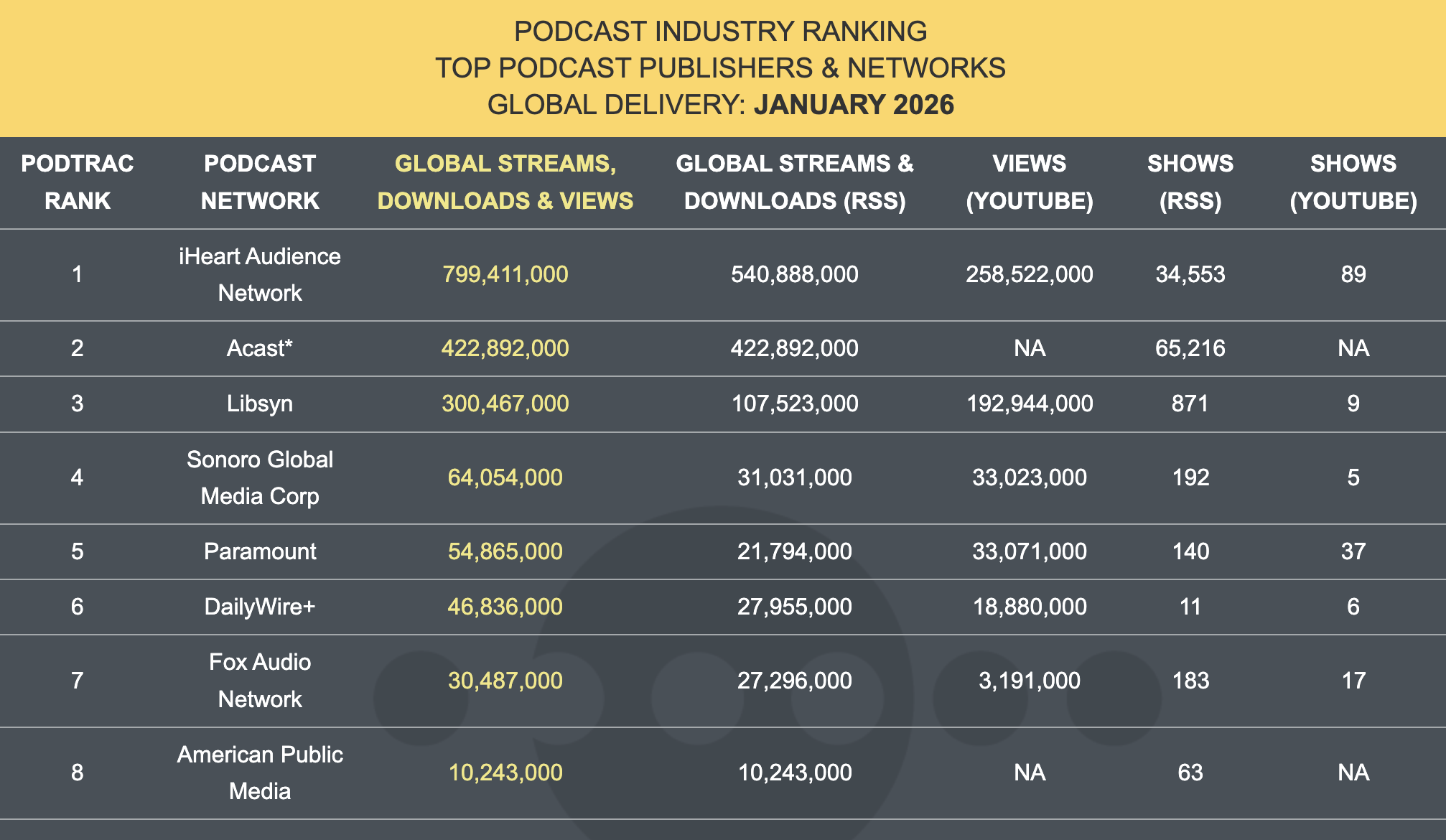
Podwires Rundown : January 2026 podcast rankings dropped from both Podscribe and Podtrac, and they’re telling contradictory stories. Podscribe reports that 9 of the top 10 publishers saw audio reach decline in January, with only Red Seat Ventures posting gains. Podtrac counters that 14 US publishers increased their Unique Monthly Audience over December. So which is it – growth or decline? Here’s what nobody’s saying: both datasets can be technically accurate while proving the same uncomfortable point. The rankings are consolidating around a shrinking number of shows within publishers, and measurement fragmentation means nobody actually knows what’s happening.
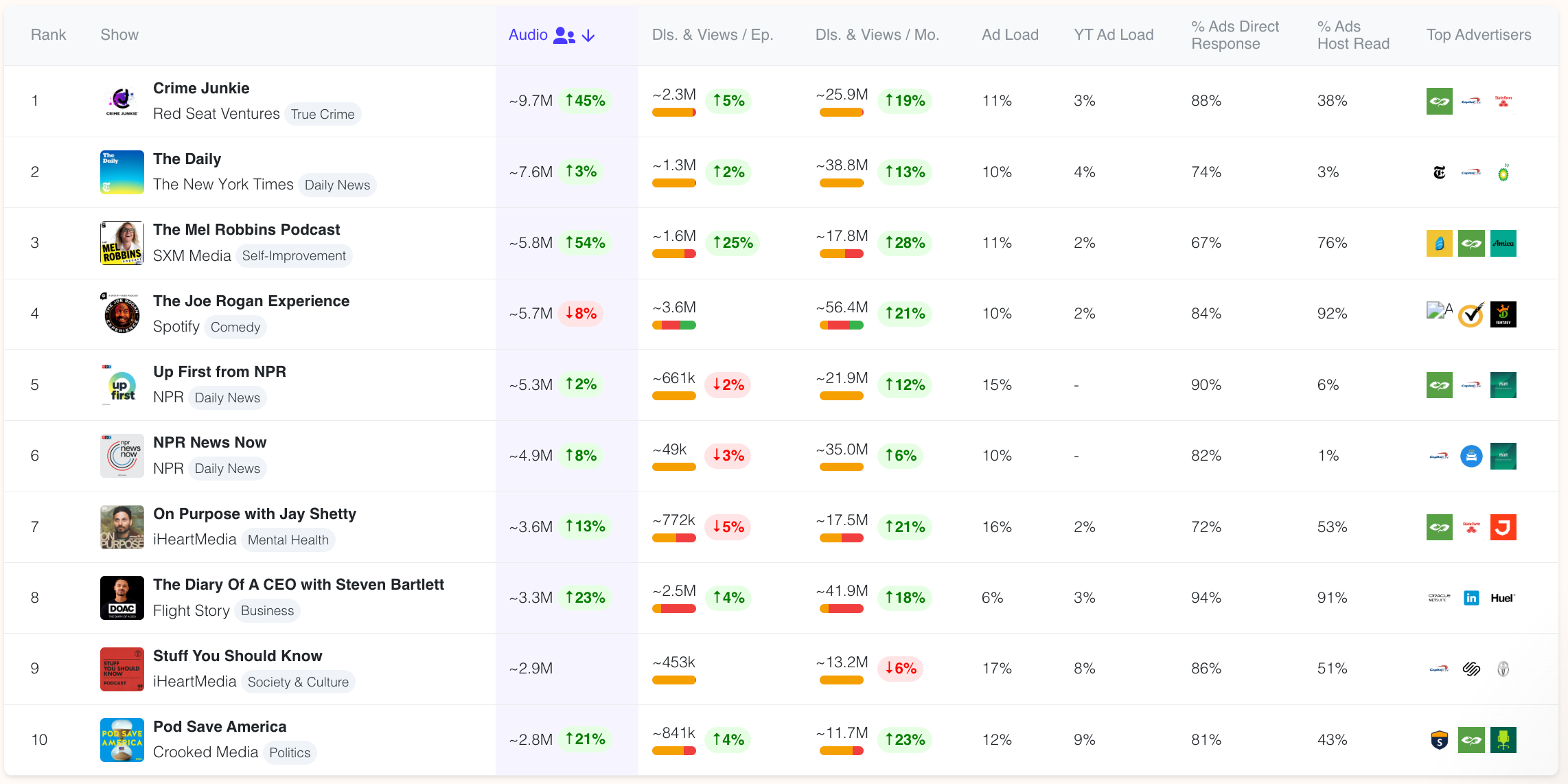
Two separate ranking systems released January 2026 data with apparently conflicting findings. Podscribe’s Industry Ranker tracks audio reach, downloads, views per episode, and advertising spend across top shows and publishers. Podtrac measures Unique Monthly Audience (UMA) and download metrics for US and global publishers.
Podscribe reports Crime Junkie claiming the #1 audio reach position, The Daily dropping to #2 despite slight reach increases, and Pod Save America entering the top 10. Publisher-level data from Podscribe shows 9 of the top 10 declining in audio reach. Podtrac’s data indicates 14 US publishers grew UMA month-over-month, though only 12 increased downloads, with significantly weaker global performance (6 publishers up in UMA, 4 up in downloads).
The Key Points:
Crime Junkie overtakes The Daily for #1 audio reach despite The Daily posting slight reach increases, while Pod Save America enters the top 10 for the first time
Podscribe reports 9 of top 10 publishers declining in audio reach with only Red Seat Ventures gaining, suggesting consolidation at the publisher level
Podtrac contradicts with 14 US publishers increasing UMA but only 12 increasing downloads, revealing a gap between audience reach and actual consumption
BetterHelp returns to #1 advertiser by spend with just 6% month-over-month growth, while Progressive Insurance, Rocket, and DraftKings enter top advertiser rankings
Global performance significantly weaker than US metrics – only 6 global publishers increased UMA and just 4 increased downloads, compared to 14 and 12 respectively in the US
Why It Matters:
When two major industry ranking systems report contradictory trends using different methodologies, it exposes a measurement crisis that affects everyone making business decisions based on rankings data. Podscribe and Podtrac aren’t measuring the same things the same ways, which means publishers promoting “growth” and advertisers evaluating reach are working from incompatible datasets. The contradiction reveals something more troubling than measurement differences: individual hit shows can drive publisher UMA increases even as overall publisher audio reach declines, suggesting audiences are consolidating around fewer shows rather than expanding across catalogs. That’s not growth. That’s concentration.
The Big Picture:
For podcast creators and producers, these contradictory rankings expose the industry’s dirty secret about measurement. You’re making production decisions, pricing advertising, and pitching sponsors based on ranking systems that can’t agree on basic directional trends. Podscribe says publishers are declining. Podtrac says publishers are growing. Both can’t be right – unless they’re measuring different enough things that the contradiction doesn’t matter, which is worse.
The practical implication: if 9 of the top 10 publishers are declining in audio reach (Podscribe) but 14 publishers are increasing UMA (Podtrac), then one of two things is happening. Either the measurement methodologies are so different that they’re functionally tracking separate realities, or the metrics are revealing a concentration effect where a few hit shows drive UMA gains while overall publisher reach shrinks.
The second explanation is more likely and more concerning. It suggests Crime Junkie can hit #1 while its publisher’s overall reach potentially declines. Smosh Reads Reddit Stories can jump rankings while the broader publisher catalog struggles.
For advertisers trying to allocate podcast budgets, this data fragmentation is expensive. When you’re evaluating which shows or publishers to buy, do you trust Podscribe’s reach metrics or Podtrac’s UMA numbers? The industry hasn’t standardized measurement, which means you’re comparing incompatible datasets and hoping your attribution models catch the difference. BetterHelp returning to #1 advertiser position with only 6% month-over-month growth suggests either overall ad spend is weak (making 6% gains enough for #1) or that advertiser concentration is intensifying. Neither interpretation is optimistic.
The show-level movements tell their own story. Crime Junkie overtaking The Daily for #1 audio reach is notable – true crime beating news in a news-heavy environment. Pod Save America entering the top 10 reflects either political content surging or measurement capturing audience that was always there but undercounted. Smosh Reads Reddit Stories jumping ahead of Candace suggests audience preference for entertainment format over personality-driven commentary, or possibly that video podcast metrics (where Smosh likely dominates) are weighted differently across ranking systems.
The global versus US performance gap is stark. Only 6 global publishers increased UMA compared to 14 in the US. Only 4 global publishers grew downloads compared to 12 domestically. That’s a 2.3x difference in growth rates between markets, suggesting either international podcast growth has stalled or that US measurement is capturing audience that global metrics miss. For publishers betting on international expansion to offset domestic saturation, this data suggests the playbook isn’t working.
The advertiser shifts – Progressive Insurance, Rocket, and DraftKings entering top spenders – could indicate healthy category diversification. Or it could mean existing advertisers reduced spend enough that lower-commitment brands reached top rankings. Without absolute spend numbers, we can’t distinguish between “new advertisers increasing budgets” and “existing advertisers cutting back.”
Here’s the uncomfortable truth: when ranking systems contradict each other this directly, it means the industry lacks measurement consensus sophisticated enough to support the business decisions being made on top of it. Publishers are raising rates based on rankings they’re climbing. Advertisers are reducing spend on publishers showing decline. Creators are changing formats to chase ranking positions. And nobody actually knows if the rankings reflect reality or measurement artifacts.
The only consensus between both datasets: whatever’s happening isn’t uniform growth. Publishers are winning or losing based on factors both rankers can’t fully capture. Shows are consolidating audience even as total listening may or may not expand. Advertisers are shifting spend between categories without clear growth indicators.
Fair play to both Podscribe and Podtrac for publishing monthly data. But the contradiction between their January reports proves the podcast industry still hasn’t solved the measurement standardization problem that’s haunted it for years. Until we do, every ranking is simultaneously true and useless.

TOGETHER WITH MENCARI NEWS (AU)
The News Powerful People Don’t Want You to Read
Between meetings, emails, and deadlines, who has time to stay properly informed? The Mencari News Australia solves this. Five minutes each morning gives you everything you need about Australian politics, technology, and finance.
No endless scrolling. No clickbait. Just the essential insights that impact your work and life. Smart professionals choose efficiency. Join hundreds of subscribers.
This section is a paid advertisement. If you are interested in advertising, let’s talk.
PODTRAC
While You Were Chasing Clips, Trust Became a Relationship Problem
Podwires Rundown : JAR Podcast Solutions just published an analysis of the 2026 Edelman Trust Barometer that should make every podcaster rethink their content strategy. Here’s the part nobody’s saying out loud: while the industry keeps pushing you toward short-form clips and TikTok strategy, trust is collapsing everywhere except in long-form relationships. The data shows 70% of people are now hesitant to trust anyone who differs from them in values or information sources. You know what doesn’t build trust? Twelve-second clips optimized for impressions.
Roger Nairn, CEO of JAR Podcast Solutions, connects the 2026 Edelman Trust Barometer findings to podcasting strategy in a detailed analysis. The Trust Barometer reveals that global trust is fragmenting as people retreat into “insularity” – trusting their immediate circle while institutional trust erodes. The report shows developed countries sitting at a trust index of just 49, with only employers (78) and business broadly (64) clearing the “trusted” threshold. Meanwhile, trust in national government leaders dropped 16 points and major news organizations fell 11 points.
The Key Points:
70% of people globally are “generally hesitant or unwilling” to trust someone who differs from them in values, facts/sources, problem-solving approaches, or lifestyle – making trust conditional and relationship-dependent
Trust gains are strongest for immediate circles: “my neighbors” (+11), “my coworkers” (+11), and “my family and friends” (+11) while institutional trust plummets
Only 39% consume information from politically different sources weekly or more, down 6 points year-over-year, creating under-exposed audiences rather than just misinformed ones
“My employer” (78 trust score) is the most trusted institution globally – higher than NGOs (58), media (54), and government (53) – making employee-facing podcasts strategically valuable
Trust transfers through influencers audiences already trust: 57-62% would trust or consider trusting a distrusted company after endorsement by a trusted influencer, proving long-form relationship-building matters
Why It Matters:
The fragmentation of trust fundamentally changes what podcasting success looks like in 2026. When people trust their immediate circle more than institutions, and when 70% won’t trust people different from them, your content strategy can’t be about reach anymore – it has to be about relationship depth. Short-form clips optimize for impressions while trust quietly dies. Long-form podcasting is the only format that gives you enough time to do what the data says matters: show consistency, reveal decision-making, rebuild context, and feature the humans who make your brand real. The industry keeps telling podcasters to atomize everything for social platforms. The trust data says that’s backwards.
The Big Picture:
For podcast creators, this research exposes an uncomfortable gap between platform incentives and audience needs. YouTube, TikTok, and Instagram reward short-form clips that generate impressions. But the Edelman data reveals that trust – the thing that turns casual listeners into committed audiences – requires relationship time that short-form can’t provide. You’re being optimized for the wrong metric.
The practical implication: if you’re spending 80% of your production effort on clips and 20% on the flagship show, you’ve got it inverted. The flagship long-form content is where parasocial relationships form, where trust compounds, where listeners decide you’re worth their time long-term. The clips are trailers, not the movie. Yet most creators are making trailers and hoping someone cares.
For podcast producers working with brands, the employer trust advantage (78 vs. 54 for media broadly) is a massive strategic opportunity that nobody’s capitalizing on. Internal podcasts aren’t just “nice-to-have comms tools” – they’re trust infrastructure in the only institution people still trust. If you’re pitching brands on external shows but ignoring their employee audiences, you’re leaving the highest-trust channel untapped.
The industry implication is darker. Podcasting’s growth story depends on discovery, and discovery increasingly happens on platforms optimizing for short-form engagement. But if trust formation requires long-form relationship building, we’ve got a structural problem: the discovery layer optimizes for impressions while the monetization layer requires trust. Platforms win either way. Creators get stuck in the middle, making content for algorithms that don’t value what audiences actually need to commit.
JAR’s analysis calls this out directly: “You are not just competing with other brands. You’re competing with distrust, fatigue, and a collapsing shared reality.” That’s the 2026 podcast market. Most creators are still optimizing for 2019’s playbook – make good content, clip it for social, hope the algorithm delivers. The trust data says that playbook builds awareness, not relationships. And in a market where 70% won’t trust people different from them, awareness without relationship is worthless.
Here’s the part that should terrify you: if podcasting becomes just another content format optimized for platform distribution rather than relationship depth, we become disposable. We turn into what JAR warns against – “content” instead of “premium content.” The medium’s advantage has always been intimacy and trust. The moment we sacrifice that for clip performance metrics, we’re just slower, less visual TikTok.
The strategic move isn’t abandoning short-form entirely. It’s inverting the priority. Make long-form flagship content that earns trust and builds relationships. Then atomize it for discovery. Not the other way around. The trust data gives you permission to stop chasing every platform trend and focus on what actually compounds: showing up consistently, in long form, as yourself.
PRESENTED BY PODWIRES MARKETPLACE
Hire Top Independent Podcast Producers for Your Business
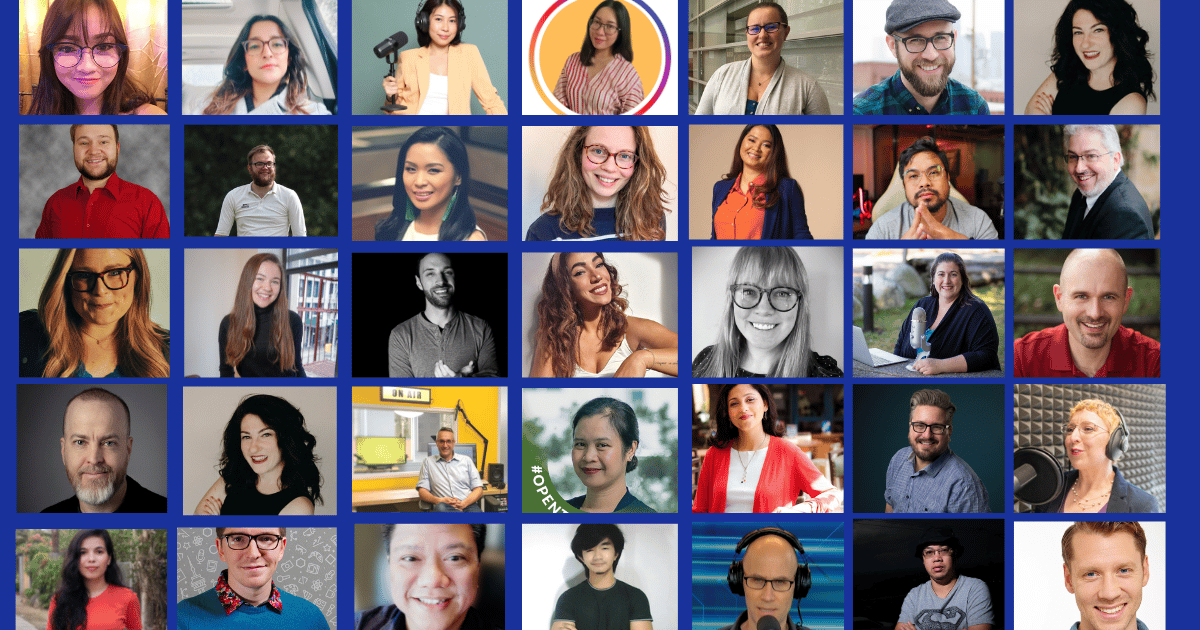
Podcasting is a powerful way to grow business, and Marketplace Podwires is here to assist you in the easy hiring of top-rated independent podcast producers. Be it branded podcasts that share your products with the entire world or internal series aimed at engaging and energizing your teams, our expert producers can craft stories that meet any brief and bring more personality to your brand’s voice. Begin with Marketplace Podwires, and find a dream producer for your project today!
BIPOC
When the Community Builders Can’t Afford to Stay

Podwires Rundown : BIPOC Podcast Creators is closing its doors. After five years of building a 2,150-member community, co-founders Tangia R. Al-awaji Estrada and Maribel Quezada Smith announced they’re offering the organization for acquisition within 30 days. If no one steps forward, operations wind down. They’re not leaving podcasting – they’re leaving the volunteer work of building infrastructure the industry should have funded.
Co-founders Tangia R. Al-awaji Estrada (Audacious Strategies) and Maribel Quezada Smith (Diferente Creative) publicly announced the decision via community message, citing the need to focus on scaling their individual businesses while raising young children. The acquisition opportunity includes the LLC, brand assets, website, social platforms, Discord community, email list, content library, and an established revenue model through sponsorships and events. Interested parties have 30 days to contact the founders before operations close permanently.
The Key Points:
BIPOC Podcast Creators built a 2,150-member community over five years, creating infrastructure for marginalized creators that the broader podcast industry failed to provide
Founders are offering acquisition within 30 days – including all assets, community platforms, content library, and proven sponsorship/event revenue model – before permanent closure
The closure isn’t about failure – it’s about founders needing to prioritize their profitable businesses (Audacious Strategies and Diferente Creative) over volunteer community leadership
No replacement leadership has emerged despite five years of community building, revealing the difficulty of sustaining creator-led organizations without institutional support
The pattern repeats across podcast communities – volunteer-led organizations serving underrepresented creators consistently struggle to convert community value into sustainable business models
Why It Matters:
This closure exposes an uncomfortable truth about podcast industry economics: the people doing essential community infrastructure work can’t afford to keep doing it. BIPOC Podcast Creators didn’t fail – it succeeded at building community, making connections, and amplifying voices the industry ignores. But success at community building doesn’t pay the bills, especially when you’re simultaneously trying to scale your actual business and raise children. The founders are making the rational economic choice. The industry that benefited from their work – platforms, networks, advertisers who got access to diverse creator talent through this community – never funded it properly.
The Big Picture:
For podcast creators, especially those from marginalized communities, this announcement should trigger a reckoning about volunteer labor economics. Community infrastructure work – the kind that creates networking opportunities, provides resources, builds support systems – is real work that generates real value. But it typically falls to people with the least resources to sustain it. The founders spent five years building something the industry needed, and now they’re offering it for acquisition because building it didn’t build their businesses.
Here’s the uncomfortable part: nobody’s stepping up. Five years of community building, 2,150 members, proven revenue model, and they’re giving 30 days notice for acquisition. If this were a revenue-generating media property with equivalent reach, there’d be multiple offers. But a community organization serving underrepresented creators? The silence is deafening. This isn’t about BIPOC Podcast Creators specifically – it’s about what the industry values and what it merely appreciates.
For podcast industry executives and platforms, this closure is a mirror. Every diversity initiative, every “we need more diverse voices” statement, every panel about representation in podcasting depended on organizations like this doing the actual work of building community infrastructure. The platforms didn’t fund it. The networks didn’t sustain it. The advertisers chasing diverse audiences didn’t invest in the communities that aggregated those creators. Instead, two founders did it themselves while building separate businesses and raising kids. Now they’re stopping, and the industry response is... what, exactly?
The practical reality: if you’re running a volunteer creator community right now, watch this closely. BIPOC Podcast Creators had everything – engaged membership, proven model, five years of momentum, respected founders. And it still couldn’t convert community value into sustainable operations that compensated leadership fairly. That’s not a management failure. That’s a market failure. The industry takes the community benefits without paying for community infrastructure.
The acquisition opportunity is real – someone could step in with proper funding and institutional support and turn this into sustainable infrastructure. But that requires recognizing community building as actual work worth paying for, not volunteer labor to exploit. If no one acquires it in 30 days, the industry loses infrastructure it never properly valued while it existed.
For creators currently benefiting from similar communities, the message is clear: these organizations are fragile because the industry makes them fragile. They run on founder dedication until founders can’t afford to anymore. Then they close. And everyone acts surprised that volunteer labor has limits.
The founders will be fine – they’re focusing on profitable businesses they actually own. Their community members lose infrastructure. The industry loses aggregated access to diverse creator talent. And in six months, someone will host another panel asking “why don’t we have more diverse voices in podcasting?” while ignoring that we just watched essential infrastructure close because nobody would fund it.
Fair play to the founders for building something meaningful and for making the economically rational choice to focus on their businesses. But the industry that benefited from their work? It should be ashamed it’s watching this close without stepping up.
EDISON RESEARCH
Spotify Just Became Your Landlord

Podwires Rundown: Edison Research’s latest Share of Ear data dropped a milestone: 25% of Americans 13+ now use Spotify daily. That’s a 317% increase since 2015, making Spotify the second most popular streaming audio brand behind only YouTube’s audio offerings.
Impressive growth story, right?
Here’s what the celebration misses: one platform now controls a quarter of American audio consumption on any given day. That’s not market competition. That’s market consolidation. And if you’re a podcast creator banking on open RSS to save you, this data should terrify you.
Edison Research’s Q4 2025 Share of Ear study tracks Spotify’s rise from 6% daily reach in 2015 to 25% in 2025. The growth spans both ad-supported and ad-free tiers, positioning Spotify as the second-largest streaming audio platform by daily reach, trailing only YouTube’s audio-centered offerings. The study measures consumption across “an incredibly full and competitive landscape of other audio options,” making Spotify’s gains even more significant given the crowded market.
The Key Points:
One-quarter of Americans 13+ listen to Spotify daily as of Q4 2025, representing 25% daily reach across all demographics
317% growth from 2015 to 2025 – Spotify jumped from 6% daily reach to 25% over a decade, significantly outpacing other streaming audio platforms
Second only to YouTube for daily reach among streaming audio brands, creating a two-platform dominance in the audio streaming market
Growth occurred across both tiers – ad-supported and ad-free subscribers both contributed to Spotify’s expansion, indicating strength across different monetization models
Edison tracks this through Share of Ear subscription data – the full competitive analysis and tier-specific performance is available only to paid subscribers of Edison’s research
Why It Matters:
When one platform reaches a quarter of American audio listeners on any given day, that platform stops being a distribution option and starts being distribution infrastructure. Creators don’t negotiate with infrastructure – they pay rent to access it. Spotify’s 317% growth over a decade means they’ve successfully moved from “one option among many” to “the place where a quarter of all daily audio consumption happens.” That gives them pricing power over creators, control over discovery algorithms, and leverage over advertising rates. The “competitive landscape” Edison mentions is increasingly theoretical – if 25% of listeners are on Spotify daily and YouTube controls another massive chunk, you’re not operating in a competitive market. You’re operating in a duopoly.
The Big Picture:
For podcast creators, this data exposes the gap between RSS idealism and listener reality. You can publish to open RSS all you want, but if a quarter of your potential audience is on Spotify daily, you’re playing by their rules whether you like it or not. That means accepting their payment terms, their advertising split, their discovery algorithm, their monetization features, their exclusive windowing options. Edison’s phrasing – “one of the most popular audio streaming platforms” – undersells what 25% daily reach actually means. That’s not popularity. That’s power.
The practical implication for podcasters: platform dependency just became more expensive. When Spotify had 6% daily reach in 2015, you could afford to skip them or negotiate harder. At 25% daily reach, skipping Spotify means skipping a quarter of potential listeners. That’s not a viable strategy for most creators trying to build sustainable audiences. You’re not choosing between platforms anymore. You’re choosing how much control to surrender to access the audience that’s already there.
For podcast producers and agencies, the two-platform dominance (Spotify and YouTube) should reshape how you think about production investment. If those two platforms control the majority of daily audio consumption, then producing content optimized for their specific requirements isn’t just good strategy – it’s survival. But here’s the uncomfortable part: optimizing for platform requirements means sacrificing format flexibility, creative control, and often the very elements that made podcasting feel different from traditional media in the first place.
For the podcast industry broadly, Edison’s data reveals how quickly “open podcasting” became a technical truth without practical relevance. Yes, RSS distribution still exists. Yes, independent podcast apps still function. But when 25% of listeners are on Spotify and YouTube dominates video podcasting consumption, the open ecosystem is dying by audience attrition, not by force. Nobody’s being banned from RSS. They’re just choosing platforms that offer better experience, better discovery, better integration. That’s a market loss, not a regulatory fight, which makes it much harder to reverse.
The advertising implications are particularly dark. If Spotify controls 25% of daily audio reach, they control 25% of audio advertising inventory access. Advertisers following audiences don’t care about your principles around open RSS – they care about reaching listeners efficiently. That gives Spotify (and YouTube) leverage over advertising rates, measurement standards, and attribution requirements that the rest of the podcast industry has to accept or ignore. When Edison notes growth “across both ad-free and ad-supported tiers,” they’re describing a platform that’s winning regardless of which monetization model succeeds. Spotify wins either way.
Fair play to Spotify for executing growth at scale in a competitive market. But let’s not pretend this is healthy market competition. This is consolidation. When one platform reaches a quarter of Americans daily and the industry celebrates it as a “milestone,” we’re celebrating our own increasing dependence on infrastructure we don’t control. The open podcasting advocates can keep arguing about RSS features and discovery improvements, but Edison’s data shows the battle’s already lost. A quarter of the audience is gone. They’re not coming back.
IAB
While Publishers Fight AI, Podcasting Isn’t Even at the Table
Podwires Rundown: The Interactive Advertising Bureau just released draft legislation targeting AI scraping – the “AI Accountability for Publishers Act” announced at their Annual Leadership Meeting. IAB President David Cohen didn’t mince words: AI companies are “free riding” on publisher content, and without immediate legislative action, “the ad-supported publishing industry, as we know it, will be a shell of itself” within years. The proposal centers on “unjust enrichment” – if AI companies use your content, they pay for it. Here’s what nobody’s saying: podcasting runs on the exact same ad-supported model that’s about to get destroyed, and we’re not even part of this fight yet.
IAB President and CEO David Cohen announced proposed draft legislation titled the “AI Accountability for Publishers Act” at the organization’s Annual Leadership Meeting in Palm Springs. The legislation addresses large-scale scraping of publisher content by AI systems to train large language models and provide AI-driven summaries, often without compensation.
Cohen frames this as an “existential crisis” for the ad-supported publishing ecosystem, comparing the current situation to the collapse of local news publishers in the mid-2000s when ad revenues shifted to technology platforms. The proposed legislation builds around the legal concept of “unjust enrichment” – a principle requiring payment when someone receives a benefit at another’s expense.
The Key Points:
AI companies are scraping publisher content to train language models and generate summaries without paying for it, threatening the ad-supported economic model that makes free content possible
IAB warns the ad-supported publishing industry will be “a shell of itself” within years without immediate legislative action, as litigation would take too long to prevent industry collapse
The legislation uses “unjust enrichment” as its legal foundation – a straightforward fairness principle requiring AI companies to pay for content they benefit from using
Cohen compares this to the mid-2000s local news collapse when thousands of outlets closed as ad revenues shifted to tech platforms, creating “news deserts” with accountability and information access losses
The proposal aims to protect publishers before courts can resolve the issue – Cohen explicitly states “we simply don’t have the time for litigation to play out” before irreversible industry damage occurs
Why It Matters:
Podcasting is conspicuously absent from this conversation, despite running on the identical economic model the IAB is trying to save. Ad-supported publishers create content, make it available online, and fund operations through advertising revenue. Ad-supported podcasters create content, distribute it via RSS, and fund operations through advertising revenue. When AI companies scrape publisher websites to train models and generate summaries without compensation, they undermine the revenue model funding content creation. When AI companies scrape podcast transcripts, show notes, and audio content to train models and generate podcast summaries without compensation, they undermine the exact same model. But only publishers are drafting legislation. Podcasters aren’t even at the table yet, despite facing identical economic threats from AI scraping.
The Big Picture:
For podcast creators and producers, the IAB’s proposed legislation exposes how unprepared podcasting is for the AI extraction economy. Publishers recognized the threat and mobilized legislative response. Podcasters are still debating whether video podcasting matters more than audio quality. The gap isn’t just about political sophistication – it’s about recognizing existential threats before they destroy your business model.
Here’s the uncomfortable part: podcast content is arguably more valuable for AI training than text-based publisher content. Conversational audio contains natural language patterns, emotional tone, pacing, humor, storytelling structure – exactly what language models need to sound human. Podcast transcripts provide training data for voice AI systems. Show notes and descriptions teach summary generation. Your podcast is training the AI that will replace your podcast. And you’re not getting paid for it.
The practical implication for podcasters: you’re about to face the same unjust enrichment problem publishers are fighting, but without legislative protection. When AI-generated podcast summaries start appearing in search results, reducing listener traffic to your actual show, you won’t have legal recourse under current law. When AI voice agents start reading your show notes and key points instead of sending listeners to your episodes, you won’t have compensation mechanisms. Publishers saw this coming and drafted legislation. Podcasters are still optimizing for platform algorithms.
For podcast industry organizations and trade groups, the IAB’s action should trigger immediate mobilization. Where’s the podcast industry equivalent of this legislative push? IAB represents 700+ media companies with resources to draft legislation, lobby lawmakers, and coordinate industry response. Podcast industry groups are fragmented across multiple organizations with competing priorities and limited political infrastructure. That fragmentation means podcasting won’t get included in publisher protections unless someone specifically advocates for inclusion. Nobody’s advocating.
The revenue dynamics make this particularly urgent for podcasting. Publishers have subscription models as backup monetization when ad revenues decline. Premium publications can survive behind paywalls. Podcasters are overwhelmingly dependent on advertising revenue with minimal subscription adoption outside a few successful creators. If AI scraping undermines the ad-supported model, podcasting has fewer fallback options than text publishing. The IAB warns publishers will become “a shell” of themselves within years. Podcasting would hollow out faster.
Cohen’s comparison to mid-2000s local news collapse is instructive. Technology platforms shifted ad revenues away from local publishers, creating “news deserts” where accountability and information access disappeared. Nobody stopped it because the economic shift happened gradually, then suddenly. AI scraping of podcast content follows the same pattern – gradual extraction of value through training data and summaries, then sudden collapse when the ad-supported model can’t sustain creator economics anymore. By the time podcasters mobilize legislative response, the business model will already be destroyed.
The legislation’s “unjust enrichment” framework is strategically smart because it’s politically neutral and legally established. You don’t need to convince lawmakers that AI is bad or that copyright law needs updating. You just need to demonstrate that one party is receiving uncompensated benefits at another party’s expense. That’s a Roman legal principle that predates digital technology entirely. Podcasters could adopt the same framework – if they moved quickly enough to get included before legislation advances without them.
Fair play to the IAB for recognizing the threat and taking legislative action. But the fact that podcasting isn’t part of this conversation yet reveals how politically immature the podcast industry remains. We’re still arguing about RSS versus platform distribution while publishers are drafting federal legislation to protect their economic model. The grown-ups are in the room fighting for survival. Podcasters weren’t invited because nobody knows we exist as a legislative priority.
The irony Cohen notes is perfect: if AI companies destroy the ad-supported publishing ecosystem, “there will be little quality content left to summarize and poorer data to train on.” The same applies to podcasting. Destroy the ad-supported podcast model and AI companies lose access to the conversational audio data that makes their voice systems sound natural. But by the time they realize they killed their training data source, it’s too late to restore creator economics.
If you’re a podcast creator reading this and thinking “this doesn’t affect me,” you’re wrong. You’re just not paying attention to how your business model is about to get extracted by AI systems you can’t control or negotiate with. Publishers woke up and drafted legislation. Podcasters are still asleep.
JOIN PODWIRES MARKETPLACE
If you’re building a podcast team, Join Podwires Marketplace to access monthly curated lists of experienced podcast professionals—producers, audio engineers, scriptwriters, and hosts—actively seeking new opportunities in news, storytelling, and audio journalism.
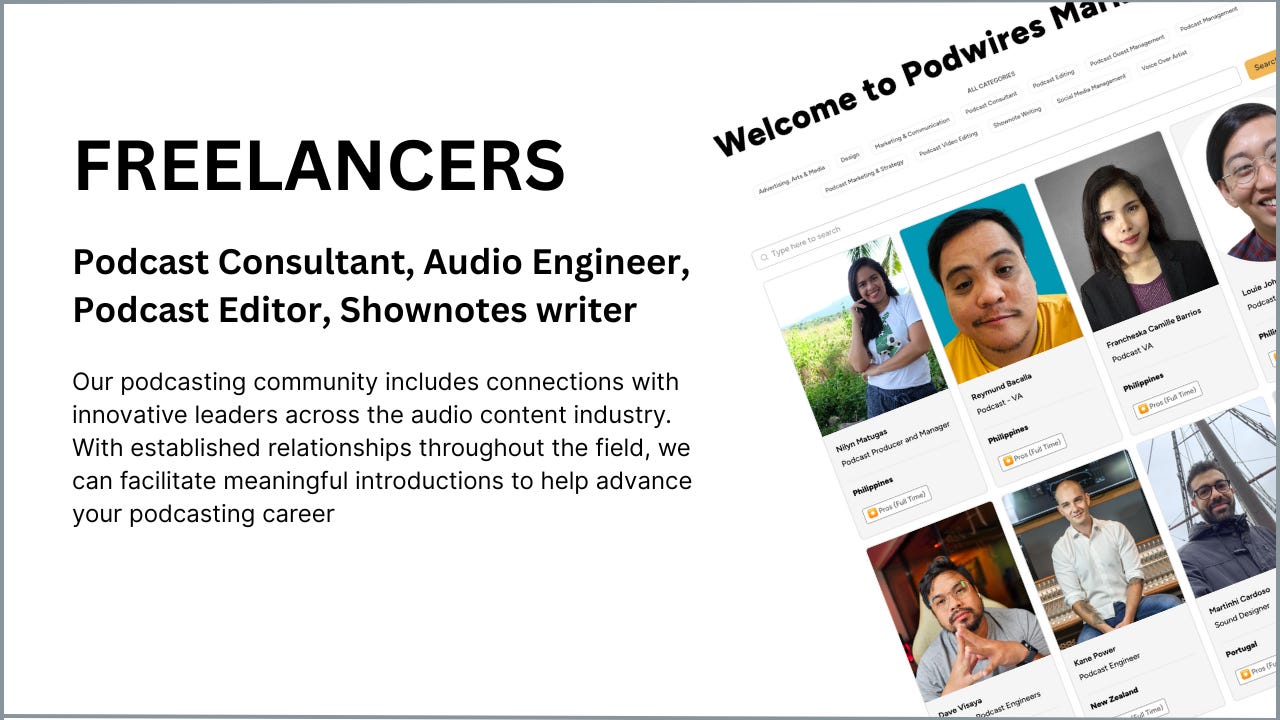
If you’re a podcast professional seeking your next opportunity, join the PodWires talent directory to connect with podcast companies and media organizations.
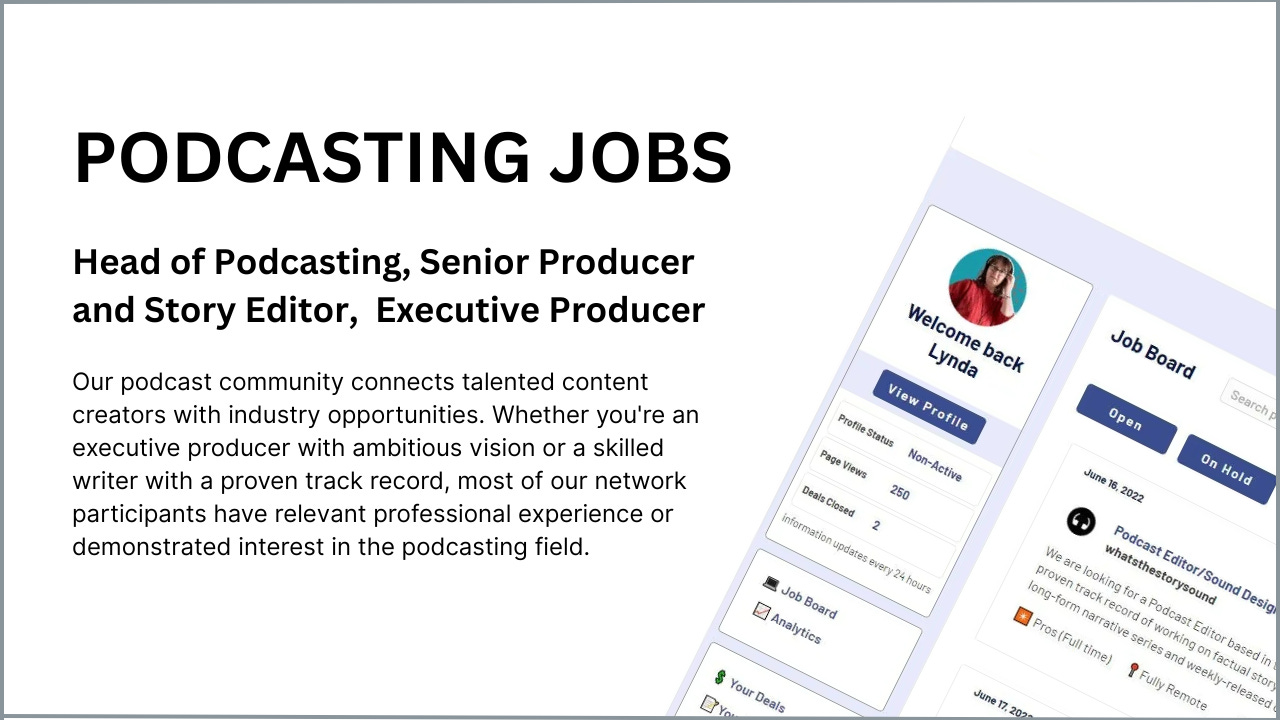
📣 Featured job opportunities 📣
Audible - Head of Production, North America
ACAST - Ad Operations Director, Americas
Magellan AI - Quality Assurance Analyst
🚨 Stay on top of your deadlines with our weekly-updated calendar of fellowships, grants, training opportunities and podcasting events. If your organisation has a fellowship, grant or event to share, just 👉 fill out this form or want to contribute an article 👉 click here or reply to this message.
THAT’S WRAP
SPONSOR US
Reach over 1000 podcast producers with your product.
Thousands of podcast producers, audio/video editors, podcasters, executives, and business owners worldwide read our newsletter. Contact us now.

📖 I appreciate you taking the time to read! See you in the next issue. Got a question or criticism? Just click on Reply. We can talk while we are here.
✍️ Give us a press release and a good-sized landscape photo. Make sure it’s newsworthy. Send press releases to editor@podwires.com or click here. Editorially, we may rewrite headlines and descriptions.
📬 Sponsor us and get your brand in front of thousands of Independent Podcast Producers and podcasters. Email us at sales@podwires.com for more information or as personal supporters via Patreon, as your contributions help us enhance the experiences of all our users.
🖊️We are delighted to hear from our subscribers! We would be happy to publish your testimonial if you have found our newsletter to be helpful or if you have a success story to share. 👉 Post a Testimonial: https://testimonial.to/podwires
🚀 We are here to help you succeed! Fill out a 5 minute survey and tell us more about your business and yourself. These questions will help us better understand you and promote your business as part of our mission. It’s a win-win!
🚨 Did someone forward this to you?
Become one of the more than 1000 valued email subscribers. Find Out More 👈
We’d love to share what our Podwires readers have been saying!

We’re so grateful to our previous Podwires advertisers!

Podwires is here because of our incredible partners’ unwavering support. The Podwires readers receive journalism free of financial and political influence. If you found this valuable, consider Restacking so more people can see it. Get together with them today.