


Did someone forward this to you?
Become one of the more than 1000 valued email subscribers. Find Out More 👈


If you love travel, check out our sister publication “Mencari’s Travel Wire”
👋 Hi, Podsky!
We’re asking our readers: continue supporting independent podcast creators. Subscribe, share their work, and help ensure vital community spaces like this one can thrive.
Your subscription to Podwires will help to fund our operations as an independent media organisation. Becoming a paid subscriber
First time reading? We would be delighted if you would join us – after all, we have over 1,000 intellectually curious readers already! Sign up here.
We want everyone to know about this, so please spread the word by sharing the email with your friends! (copy URL here)
And, as always, send us feedback at editor@podwires.com
Today’s reading time is 5 minutes. - Miko Santos (March 1, 2026 )
🎙️Today, we’ve got the inside scoop on:
The Numbers Don't Lie: Video Is Winning at the Top, Audio Holds the Middle
The Couch Is the New Headphone: Sounds Profitable Data Reveals Podcasting's Shared Screen Moment
Podcast Insight: The Magic Number Is 11: New Data Shows Audio Doesn't Just Work — It Multiplies Everything Else
PodBusiness : 158 Million Monthly Listeners and Counting: iHeart Makes the Case That Podcasting Has Entered a New Era
Job Board : LAUNCH - Full-Time Editor/Producer — Remote

PODTRAC
The Numbers Don’t Lie: Video Is Winning at the Top, Audio Holds the Middle
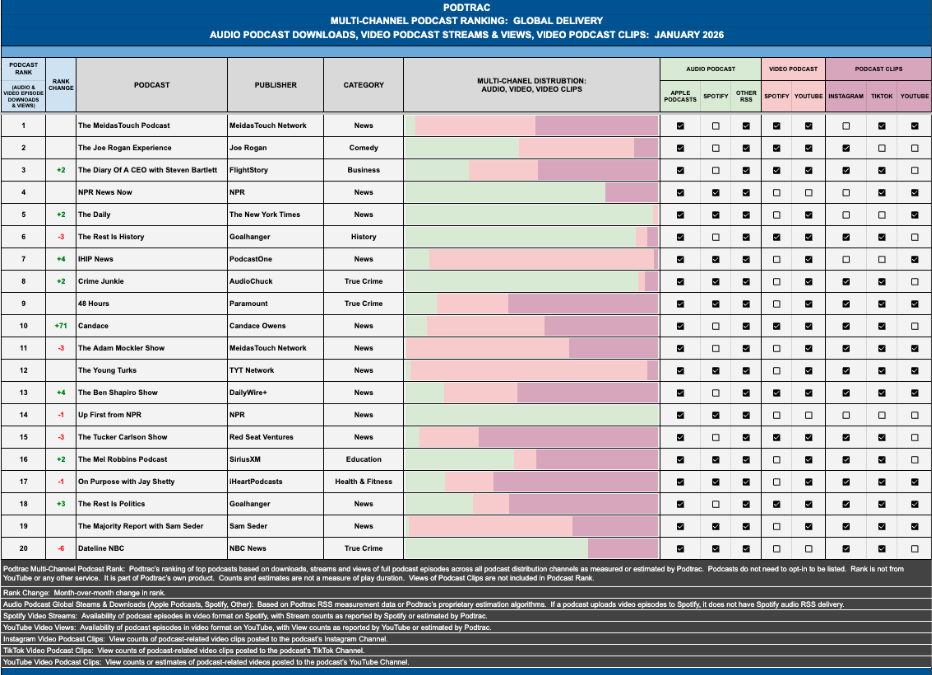
Podwires Rundown : The latest data from Podtrac is out, and it tells a story the industry keeps dancing around but rarely says out loud. Video isn’t coming for podcasting. It’s already here — and it’s taking the premium real estate first.
Podtrac’s January 2026 Top 200 Multi-Channel Podcast Ranking — the industry’s most comprehensive cross-platform measurement — captures how the top 200 podcasts actually deliver content across audio and video channels. Every show in the ranking posts audio to RSS. But what happens after that tells you everything about where power is consolidating.
The Key Points:
Top 50 podcasts lean video: Among the highest-ranked shows, 52% of total delivery is video and 48% is audio — a near-inversion of what most in the industry still assume.
The long tail is still audio’s domain: For shows ranked 51–200, 74% of delivery is audio and just 26% video — suggesting video dominance is concentrated at the very top.
YouTube is the dominant video platform: 66% of the Top 200 post full video episodes to YouTube, while only 23% post to Spotify Video — a gap that should make Spotify executives uncomfortable.
Clips are the dark horse: 71 podcasts (36%) receive more clip delivery than full episode delivery — meaning for more than a third of major shows, short-form is outperforming longform.
YouTube is split almost evenly between episodes and clips: 52% of YouTube podcast delivery is full episodes, 48% is clips — neither format has decisively won on the platform.
Why It Matters
Here’s the uncomfortable part. If you’re a top-50 podcast and you’re not prioritizing video, the data says your competitors are eating your lunch — on delivery, on reach, and almost certainly on ad revenue. But if you’re ranked 51–200? Audio is still your workhorse. The mistake would be abandoning what’s working to chase a video strategy built for shows with production budgets you don’t have. The Podtrac data isn’t a mandate for everyone to go video. It’s a map. Read it carefully before you move.
The Big Picture
For podcasters, this ranking is a strategic mirror. The bifurcation between Top 50 video dominance and mid-tier audio strength means there’s no one-size-fits-all distribution playbook anymore. Know your tier, then build your format strategy accordingly — not the other way around.
For podcast producers, the clip economy is the buried headline here. Thirty-six percent of major shows now get more clip delivery than episode delivery. If you’re not building a clip production workflow into every recording session, you’re leaving reach — and likely revenue — on the table.
For the broader industry, the YouTube-Spotify gap is a warning sign worth watching. YouTube commands the video podcast space with two-thirds of top shows posting there. Spotify’s 23% penetration on video, despite aggressive investment, suggests creator adoption hasn’t followed platform ambition. That gap either closes in 2026 — or it starts to look permanent.
Let that sink in.
Source: Podtrac, January 2026 Top 200 Multi-Channel Podcast Ranking, published February 26, 2026.

TOGETHER WITH MENCARI NEWS (AU)
The News Powerful People Don’t Want You to Read
Between meetings, emails, and deadlines, who has time to stay properly informed? The Mencari News Australia solves this. Five minutes each morning gives you everything you need about Australian politics, technology, and finance.
No endless scrolling. No clickbait. Just the essential insights that impact your work and life. Smart professionals choose efficiency. Join hundreds of subscribers.
This section is a paid advertisement. If you are interested in advertising, let’s talk.
ACA
The Magic Number Is 11: New Data Shows Audio Doesn't Just Work — It Multiplies Everything Else
Podwires Rundown : The advertising industry has been sitting on one of the most compelling budget arguments in modern media, and most brands are still ignoring it. New research from the Advertising Council of Australia makes the case with eight years of real campaign data: allocate just 11% of your media budget to audio, and something remarkable happens. Not to your audio results.
To your entire campaign. Every metric — short-term sales, long-term market share, new customer acquisition, brand emotional appeal — moves measurably higher than campaigns that skip audio entirely. As marketing strategist Mark Ritson summarizes it, you’re not spending more. You’re making everything you already spend work significantly harder.
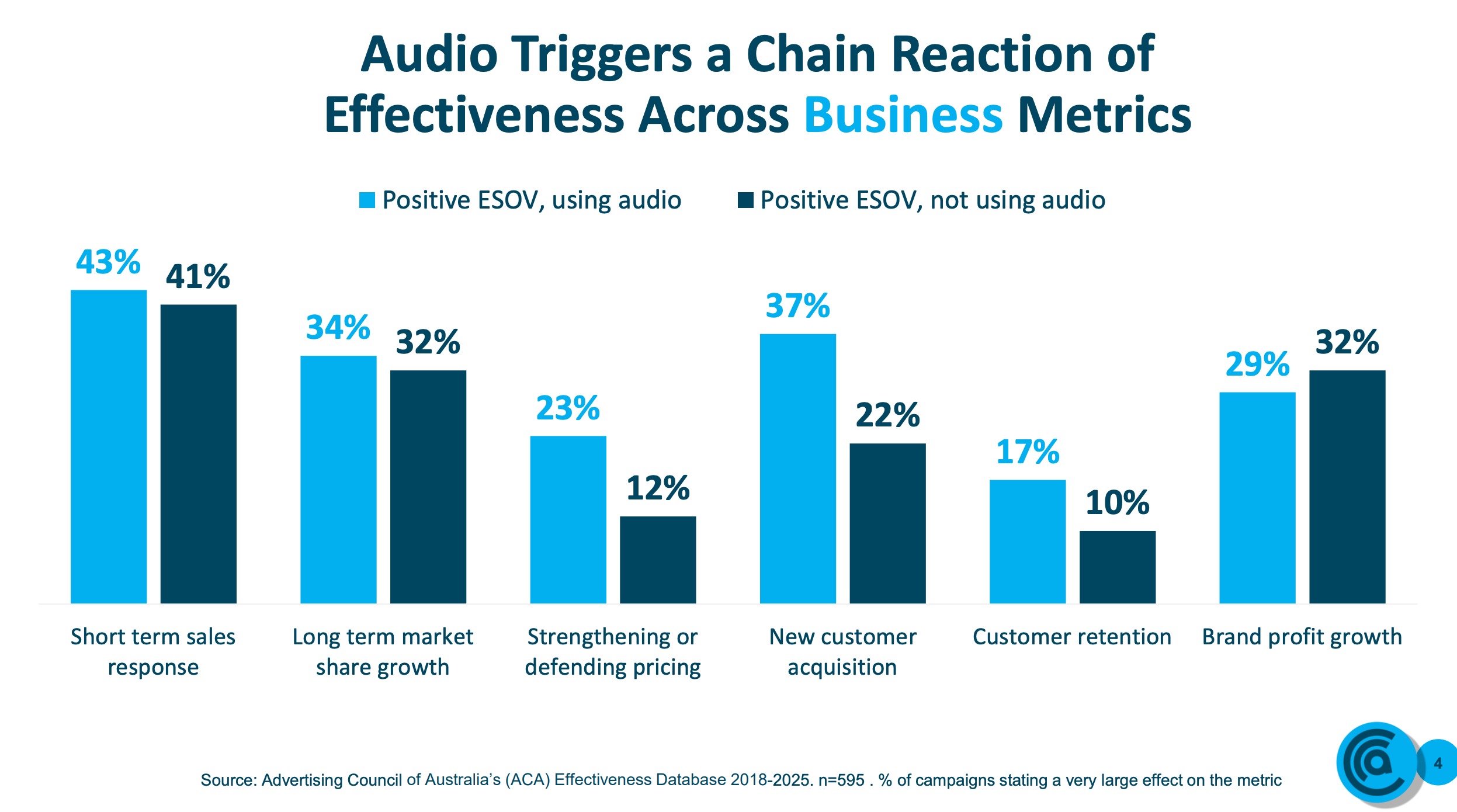
“Audio: The Campaign Catalyst,” published by the Advertising Council of Australia (ACA), draws from the ACA Effectiveness Database spanning 2018–2025 across 595 campaigns. The findings represent one of the most comprehensive longitudinal studies of audio’s role in media mix optimization, covering both brand and business outcomes across national and regional campaign categories.
The Key Points:
The 11% threshold is transformative: Campaigns with positive ESOV (Excess Share of Voice) allocating 11% to audio produced 168 average very large business effects — compared to just 108 for campaigns with positive ESOV that didn’t use audio at all. That’s a gap that should make every media planner uncomfortable.
Audio amplifies both brand and business metrics simultaneously: Campaigns using audio outperformed non-audio counterparts on new customer acquisition (37% vs. 22%), customer retention (17% vs. 10%), and the ability to strengthen or defend pricing (23% vs. 12%) — a metric most brands treat as untouchable.
Strong creative codification is the multiplier on the multiplier: When campaigns combined positive ESOV, audio, and strong codification, business effects jumped to 180 — an 80-point premium over the all-campaign baseline and well beyond audio alone.
Duration compounds audio’s effectiveness: Short audio campaigns (under 26 weeks) actually underperformed the all-campaign average. But campaigns running 27–52 weeks indexed at 119, and those exceeding a year reached 126. Audio isn’t a sprint. It’s infrastructure.
Regional campaigns face a 33% performance penalty without audio: Regional advertisers using audio scored 148 on business effects. Those without audio dropped to 111 — a gap the data explicitly calls a “performance penalty.” For any brand with a regional footprint, this is an urgent finding.
Why It Matters
For years, audio has been the medium that advertisers nod at respectfully before shifting budget to video and social. This data says that’s a strategic error — and a measurable one. Audio isn’t competing with the rest of your media mix. It’s catalyzing it. The research shows that the brands consistently outperforming their competitors aren’t necessarily outspending them. They’re out-allocating them, specifically toward audio, and holding those campaigns long enough for the compounding effects to kick in.
The Big Picture
For podcasters and podcast networks, this research is a gift — if you use it correctly. The argument for podcast advertising has historically leaned on audience quality and host trust. Both are true and both matter. But now there’s a third argument that speaks directly to the CFO: audio inclusion statistically produces better business outcomes across the entire campaign, not just the audio portion. That reframes podcast advertising from a line item to a strategic lever.
For podcast producers, the codification finding is the one to internalize. The data shows that audio paired with strong, consistent brand creative — distinctive sonic identity, recognizable characters, repeatable messaging — dramatically amplifies results. Producers advising clients on campaign development should be pushing for creative consistency and longer commitments, not one-off sponsorship reads.
For the broader podcast industry, the regional data is the sleeper insight. Regional and local advertisers represent a massively underpenetrated opportunity for podcasting. A 33% performance penalty for skipping audio in regional campaigns is the kind of number that regional sales teams should be leading every pitch with.
The uncomfortable truth here is that advertisers already knew audio worked. What they didn’t have was proof that skipping it actively hurt them everywhere else. Now they do.
Source: “Audio: The Campaign Catalyst,” Advertising Council of Australia (ACA) Effectiveness Database, 2018–2025. n=595 campaigns.
PRESENTED BY PODWIRES MARKETPLACE
Hire Top Independent Podcast Producers for Your Business

Podcasting is a powerful way to grow business, and Marketplace Podwires is here to assist you in the easy hiring of top-rated independent podcast producers. Be it branded podcasts that share your products with the entire world or internal series aimed at engaging and energizing your teams, our expert producers can craft stories that meet any brief and bring more personality to your brand’s voice. Begin with Marketplace Podwires, and find a dream producer for your project today!
IHEART MEDIA
158 Million Monthly Listeners and Counting: iHeart Makes the Case That Podcasting Has Entered a New Era

Podwires Rundown : The numbers are getting harder to argue with. More than half of all Americans now tune into podcasts every month, daily listening is climbing across every age demographic, and the medium has embedded itself into the kind of cultural moments that used to belong exclusively to television.
iHeartMedia’s editorial team isn’t shy about what that means: podcasting isn’t just growing — it’s consolidating its position as the dominant long-form audio medium in the country, and advertisers who haven’t made the move yet are running out of reasons to wait.
iHeartMedia’s “The State of Podcasting 2026,” published February 18, 2026, presents the company’s annual case for podcast advertising investment, drawing on audience consumption data, listener behavior research, and iHeart’s own platform performance across its network of chart-topping shows in all 19 Podtrac categories.
The Key Points:
158 million monthly podcast consumers now make up 55% of the American population — a milestone that fundamentally changes podcasting’s scale argument with advertisers who once treated it as a niche medium.
Trust is the differentiating asset: iHeart’s data shows podcast listeners rate the medium 23 times more trustworthy than social media — a gap that has direct implications for ad recall, brand credibility, and purchase intent in ways no algorithm-driven platform can replicate.
Time spent is shifting away from competing media: Average daily podcast listening has more than doubled over the past eight years and now approaches one hour per day — time that is coming directly out of social scrolling, music streaming, and television viewing.
Multicultural and Gen Z audiences are driving growth: Hispanic and Black listeners represent some of the fastest-growing audience segments in podcasting, and more than six in ten Gen Z consumers now listen monthly — demographics that traditional broadcast channels have long struggled to reach efficiently.
Measurement has matured to meet advertiser expectations: Podcast advertising now supports brand lift tracking, web traffic attribution, conversion measurement, and retail sales data — closing the accountability gap that kept performance marketers on the sidelines.
Why It Matters
Here’s the uncomfortable part for anyone still treating podcast advertising as a secondary budget line. The trust differential iHeart cites — 23 times more trustworthy than social media — isn’t a soft metric. It’s the structural advantage that explains why podcast ads consistently outperform platform equivalents on recall and action taken. Listeners who choose a show, commit to a full episode, and build a long-term relationship with a host are not the same audience that half-watches a pre-roll. Advertisers who understand that distinction are building competitive separation. Those who don’t are funding someone else’s advantage.
The Big Picture
For podcasters and independent creators, the iHeart report is a double-edged sword worth reading carefully. The trust and attention data validate what the medium has always delivered at the creator level — authentic, human connection that scales in ways synthetic content can’t match. But the consolidation story running underneath the headlines is also clear: iHeart reaches 180 million monthly downloads and dominates all 19 Podtrac categories. That kind of scale creates real pressure on independent shows competing for the same advertising dollars. The data makes the case for podcasting. The question is who captures the budget when brands finally commit.
For podcast producers, the measurement maturity finding changes the sales conversation. For years, the measurement gap was the objection that killed deals with performance-focused advertisers. That objection is gone. Producers advising clients or building shows for brand partnerships should be fluent in brand lift, attribution, and retail outcomes — not just download numbers and listener demographics.
For the broader industry, the Gen Z and multicultural growth data is the most strategically significant finding in the report. These are audiences that legacy media spent decades failing to reach. Podcasting reached them organically. Advertisers who recognize that early — and build genuine relationships with the creators those audiences already trust — are positioning for a long-term advantage that won’t be easy to replicate once the space matures further.
158 million monthly listeners. An hour a day. 23 times more trusted than social media.
The evidence isn’t the problem anymore.
Source: “The State of Podcasting 2026,” iHeartMedia Editorial Team, published February 18, 2026, iHeartMedia.com.
EDISON RESEARCH | BUMPER
Podcast Ad Skipping Less Prevalent Than Listeners Report as Medium Overtakes AM/FM Radio in Spoken-Word Listening
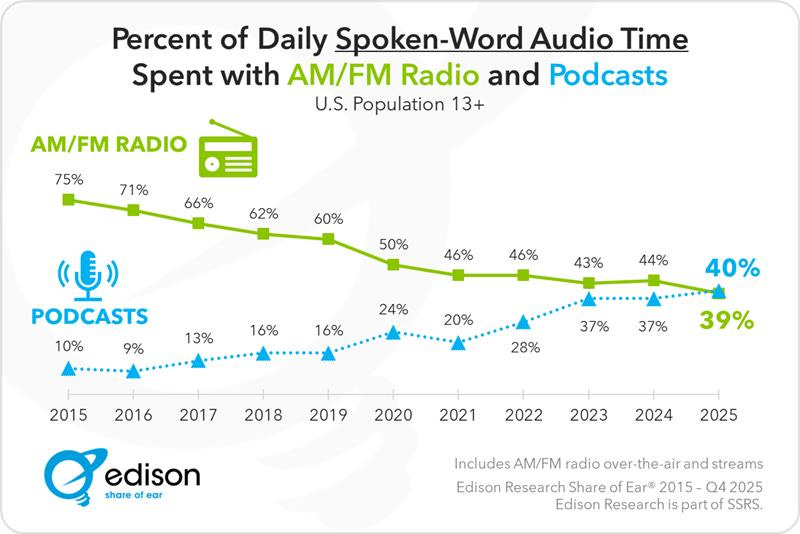
Podwires Rundown: Podcast listeners routinely overestimate how often they skip advertisements, and actual playback data reveals ad retention rates of 90% or greater on well-produced shows — a finding that challenges one of the most persistent objections advertisers raise against the medium. The data arrives alongside a separate but equally significant milestone: for the first time in recorded measurement history, podcasts have surpassed AM/FM radio as the dominant platform for spoken-word audio listening in America.
Taken together, the two findings paint a picture of a medium that is larger, more engaged, and more advertiser-friendly than the industry’s own conventional wisdom has acknowledged.
A new analysis by podcast analytics firm Bumper, published February 22, examined episode retention histograms from Apple, Spotify, and YouTube to quantify the gap between what listeners claim and what they actually do when an ad break begins. Separately, Edison Research’s Share of Ear® quarterly measurement, published February 24 as part of the firm’s Weekly Insights series, documented a decade-long structural shift in spoken-word audio consumption that reached its inflection point in Q4 2025.
The Key Points:
Podcasts now lead AM/FM radio in spoken-word listening — a historic first: As of Q4 2025, 40% of daily spoken-word listening time in the U.S. is spent with podcasts, compared to 39% with AM/FM radio. A decade ago, radio commanded 75% of spoken-word listening while podcasts held just 10% — a 65-point gap that has now fully reversed.
Self-reported ad skipping significantly overstates actual behavior: While 46% of listeners claim they “always or often” skip podcast ads according to Sounds Profitable’s 2024 research, Bumper’s playback data regularly shows ad retention rates of 90% or higher on well-executed episodes — attributed to the well-documented tendency of survey respondents to overstate avoidance behaviors.
Platform retention histograms provide a more reliable measurement framework: Apple, Spotify, and YouTube each provide episode-level retention charts to publishers, allowing show-level ad performance to be measured beyond the IAB “ad delivered” metric, which tracks delivery rather than actual playback.
Ad break length is the single strongest predictor of avoidance: Analysis of hundreds of ad breaks found a clear correlation between duration and skipping — the longer the break, the lower the retention. The 60- and 90-second marks represent the most common ad break lengths in the dataset.
Spoken-word audio accounts for 25% of all daily audio consumption: Edison’s Share of Ear® data shows that the spoken-word category itself remains a substantial and stable portion of the broader audio landscape, even as the platforms delivering that content have shifted dramatically.
Why It Matters
Here’s the uncomfortable part — for radio, for skeptical advertisers, and frankly for any podcaster still underselling their medium in pitch meetings. The Edison data confirms what quarterly trend lines have been signaling for years: this isn’t a temporary COVID-era listening spike or a pandemic-fueled anomaly. This is a decade-long structural migration that has now crossed the threshold. Podcasts are where Americans go for spoken-word audio. Full stop.
Layer Bumper’s ad retention data on top of that, and the advertiser argument becomes difficult to dismiss. The most common objection to podcast advertising — that listeners skip the ads — turns out to be significantly overstated by the listeners themselves. Actual playback data tells a measurably different story. Publishers who can demonstrate both audience scale and ad retention above 90% are holding a genuinely strong hand. Most of them just aren’t playing it.
The Big Picture
For podcasters and ad-supported publishers, these two reports arriving in the same week are not a coincidence to be acknowledged and moved past. They are a sales toolkit. The Edison milestone reframes podcasting’s position in the audio landscape with the credibility of decade-long longitudinal data. The Bumper retention analysis provides the episode-level evidence that turns a macro trend argument into a show-specific performance conversation. Used together, they address both the “is podcasting growing?” question and the “but do people actually hear the ads?” question — the two objections that appear most reliably in advertiser conversations.
For podcast producers, the ad break length correlation from Bumper’s analysis warrants direct attention in show architecture decisions. The data does not prescribe a single ideal duration, but the trend is consistent enough to elevate break length from an inherited convention to a deliberate production choice. Meanwhile, Edison’s regional and demographic breakdowns within Share of Ear® offer producers a richer audience composition argument than download numbers alone can provide.
For the broader industry, the AM/FM crossover is the kind of structural milestone that changes budget conversations at the planning level — not just at the line-item level. Radio’s 75% share of spoken-word listening in 2015 was the foundation on which an entire generation of audio advertising infrastructure was built: rate cards, audience guarantees, measurement standards, agency relationships. That foundation has shifted. Podcast advertising is no longer asking for a seat at the spoken-word audio table. It now owns the majority share of it.
The question is whether the industry’s commercial infrastructure catches up before the next inflection point arrives.
Sources: “Podcast ad skipping isn’t nearly as bad as I worried,” Dan Misener, Bumper Media Inc., published February 22, 2026; “Podcasts Lead AM/FM in Spoken-Word Listening, Marking a First,” Edison Research Weekly Insights, published February 24, 2026. Supporting research cited includes Sounds Profitable’s Ad Nauseam study (2024) and The Canadian Podcast Listener survey.
AMPLIFI MEDIA \ COLEMAN INSIGHTS
Apple’s Video Podcast Push Reshapes Platform Competition, but Key Questions Remain

Podwires Rundown: Apple’s decision to introduce native video capabilities inside Apple Podcasts this spring has redrawn the competitive map of podcast distribution — but industry analysts are divided on whether the technical upgrade alone is sufficient to reverse years of audience erosion among younger listeners, or meaningfully challenge YouTube’s dominant position in the video podcasting space.
Two separate analyses published the week of February 22 — one from Steven Goldstein at Amplifi Media and one from Jay Nachlis at Coleman Insights — arrive at broadly similar conclusions about the strategic significance of Apple’s move while raising sharply different questions about its ultimate impact.
Both pieces draw on data from the joint “State of Video Podcasting” research conducted by Amplifi Media and Coleman Insights, which tracked the rapid consumer redefinition of what a podcast is: in March 2025, 85% of podcast consumers defined podcasts as audio or video, compared to just 13% who described them as audio-only — a dramatic shift from the 2023 baseline when those figures were 75% and 22% respectively.
The Key Points:
Apple’s native video launch marks the first time every major distribution platform simultaneously treats video as core to podcasting — a consolidation of industry direction that Goldstein describes as the arrival of a “liquid content era” in which a show’s format is determined by where and how the audience encounters it, not by how the creator originally produced it.
Apple’s move into dynamic video ad monetization is a structural departure from its historical role in podcasting: For the first time, Apple will participate directly in podcast ad revenue sharing — taking a portion of dynamic video ad revenue alongside creators. For a company that helped build the modern podcast ecosystem while largely staying out of its advertising economics, Goldstein characterizes this as anything but a minor adjustment.
Consumer behavior has moved faster than platform infrastructure: According to Coleman Insights and Amplifi Media’s joint research, 77% of podcast consumers reported alternating between audio and video in the 2025 study — a behavioral reality Apple’s app had not yet been architected to accommodate, despite technically supporting video via RSS since 2005.
Apple Podcasts has a generational problem video alone may not solve: Nachlis, citing data from Transistor’s Justin Jackson drawn from the 2025 State of Video Podcasting study, notes that among 18–24 year olds, Apple Podcasts usage drops into single digits while YouTube and Spotify maintain dominant leads. Closing that gap requires more than a feature update — it requires a fundamental perception shift.
Video and audio reward structurally different behaviors: Goldstein identifies a critical distinction that podcasters accustomed to strong audio completion rates need to internalize. Video on YouTube operates on algorithmic recommendation, steep early drop-off curves, and seconds-long attention windows. “Audio is chosen,” Goldstein writes. “Video is recommended.” The performance expectations — and the production decisions that drive them — cannot simply be transferred from one format to the other.
Why It Matters
Apple’s announcement has been covered primarily as a technology story — HLS streaming, adaptive quality, dynamic ad insertion. Fair play. Those are real and meaningful technical advances. But Nachlis identifies the harder question that the technical coverage has largely avoided: will consumers care? YouTube’s dominance in video podcasting is not primarily a technical advantage. It is a perceptual one. Consumers use YouTube for video because they think of it for video. Satisfaction with that experience keeps them there. Matching Apple’s engineering to that kind of entrenched behavior is a different problem entirely — and one that Nachlis argues requires Apple to answer a question it has not yet clearly answered: why should a listener who already uses YouTube for video and Spotify for music open the Apple Podcasts app instead?
The Big Picture
For podcasters and independent creators, the Apple announcement accelerates a strategic decision that has been building for two years. The liquid content era — the framework Goldstein describes in which shows move between audio and video depending on where the audience encounters them — is now the operating reality on every major distribution platform simultaneously. That is not a trend to monitor. It is a condition to plan around. Creators who have been waiting for industry consensus before committing to a video strategy no longer have that luxury.
For podcast producers, Goldstein’s guidance on show openings is the most immediately actionable finding in either analysis. The first few seconds of a video episode determine algorithmic distribution and audience retention in ways that simply do not apply to audio. Producers who have built workflows around audio-first conventions — warm introductions, context-setting preamble, gradual episode construction — need to reconsider that architecture specifically for video distribution. The substance must arrive faster. The value proposition must be visible immediately.
For the broader industry, Nachlis flags a monetization complexity that has received insufficient attention in the Apple coverage: podcast audio buyers and video buyers frequently sit in different agency departments. A brand relationship built on premium host-read audio does not automatically translate into a video advertising buy for the same show on the same platform. As Apple’s video marketplace matures, publishers may find themselves navigating two entirely separate sales processes for what is effectively one piece of content.
Apple is back in the game. The debate about whether video belongs in podcasting is over. What remains unresolved is who captures the audience — and the revenue — in the era that follows.
Sources: “Apple Just Moved the Center of Gravity in Podcasting,” Steven Goldstein, Amplifi Media, February 22, 2026; “Apple Podcasts Is in on Video. Will Users Notice?” Jay Nachlis, Coleman Insights, February 24, 2026. Research referenced includes “The State of Video Podcasting,” Coleman Insights and Amplifi Media, March 2025.
SOUNDS PROFITABLE
The Couch Is the New Headphone: Sounds Profitable Data Reveals Podcasting’s Shared Screen Moment

Podwires Rundown: Tom Webster watched his first podcast on Hulu two weeks ago. He didn’t go looking for it. It found him — on his television, with his wife, at the exact moment he was already in the mood for it. Zero friction. And at no point did he listen to anything.
That experience sits at the center of a new Sounds Profitable analysis, published February 25, that challenges one of podcasting’s most foundational assumptions: that podcast consumption is a solitary, audio-first, earbuds-in activity. The data says something considerably more complicated — and considerably more interesting — is already happening, and the industry’s language hasn’t caught up with it yet.
Sounds Profitable partner Tom Webster, a 25-year veteran audio researcher and co-author of industry benchmarks including Edison Research’s Infinite Dial and Share of Ear series, draws on new audience research identifying 560 podcast consumers who report consuming podcasts with others “most of the time” or “always.” What that segment looks like — and what it expects — reframes several assumptions the industry has treated as settled.
The Key Points:
Co-consumption is a screen behavior, not a listening behavior: Among podcast consumers who regularly consume content with others, 61% spend more than half their podcast time watching video. YouTube is the dominant primary platform at 38%, while smart TVs rank as the third most-used primary device at 15% — significantly higher than in the broader podcast audience.
Mental models lag behind actual behavior: Despite consuming podcasts primarily through video on shared screens, this segment’s self-reported expectations still tilt audio. Only 15% expect podcasts to be primarily or exclusively video. 38% say podcasts are “usually audio-only, but may be video.” The behavior has outpaced the definition — and Webster argues the industry’s language has made the same mistake.
This audience is new, and the clay is still wet: 45% of this co-consumption segment have been listening to podcasts for less than a year. 17% started within the last 30 days. These are not listeners who have spent years developing strong feelings about the medium’s identity. They’re still forming them — which makes their genre preferences, platform choices, and content expectations more malleable than the existing podcast audience.
Brand involvement and AI voices skew positive with this segment: 67% say they’d be more likely to try a podcast if a company or brand were involved in making it. 54% say AI-generated voices would make them more likely to keep listening — figures that will make longtime podcasters deeply uncomfortable, but reflect an audience that arrived through YouTube rather than through RSS.
The shared-consumption genres are reactive by nature: Comedy leads at 39%, followed by sports at 34% and true crime at 31%. Webster’s observation here is sharp: these are formats where the other person’s reaction is half the experience. The screen didn’t create the behavior. It just got there first.
Why It Matters
The industry has spent considerable energy over the past two years debating whether video podcasting is “real” podcasting. Webster is asking a more productive question: what does a two-people-on-a-couch moment sound like for audio? Because the thing that makes this co-consumption segment valuable isn’t the screen. It’s the frictionlessness. It’s the shared experience. A smart speaker in the kitchen. A long car drive. A platform feature that doesn’t exist yet. Video captured this audience first because a television in a living room is an obvious shared surface and a pair of earbuds is not. That’s a distribution and discovery problem, not a format failure. If the industry can solve for shared, contextual, zero-friction audio discovery, this audience is still reachable. The clay, as Webster puts it, is still wet enough to shape.
The Big Picture
For podcasters and independent creators, the co-consumption data is a direct challenge to how shows are currently designed and positioned. If nearly half of this emerging audience segment has been listening for less than a year — and arrived through YouTube rather than through traditional podcast discovery — then the entry-point experience of your show matters more than it ever has. How does your show open? Does it reward a first-time viewer watching with someone else on a television? Does it give two people something to react to together? These are production questions, but they are also audience retention questions.
For podcast producers, the brand involvement finding warrants a closer look before it gets dismissed. That 67% of this segment would be more likely to try a branded podcast does not mean branded content is a shortcut to quality. It reflects an audience that came to podcasting through YouTube’s recommendation engine, where branded content is normalized, polished, and often indistinguishable from creator content. Producers advising brands on podcast strategy should understand that this incoming audience cohort may actually be more receptive to branded formats — not less — than the entrenched podcast listener base.
For the broader industry, Webster’s question about audio’s version of the couch moment is arguably the most strategically significant challenge the medium faces right now. Every major platform investment in 2025 and 2026 has been oriented toward video discovery — Apple’s HLS rollout, YouTube’s recommendation engine, Spotify’s video push. Nothing equivalent exists for shared, ambient, frictionless audio consumption. The smart speaker market gestured at this years ago and never fully delivered. Someone in the industry needs to take the question seriously, because this co-consumption audience is growing, it is young, and it has not yet decided what it thinks a podcast is.
That is either a problem or an opportunity. The difference is speed.
Source: “Two People On A Couch,” Tom Webster, Sounds Profitable, published February 25, 2026.
JOIN PODWIRES MARKETPLACE
If you’re building a podcast team, Join Podwires Marketplace to access monthly curated lists of experienced podcast professionals—producers, audio engineers, scriptwriters, and hosts—actively seeking new opportunities in news, storytelling, and audio journalism.
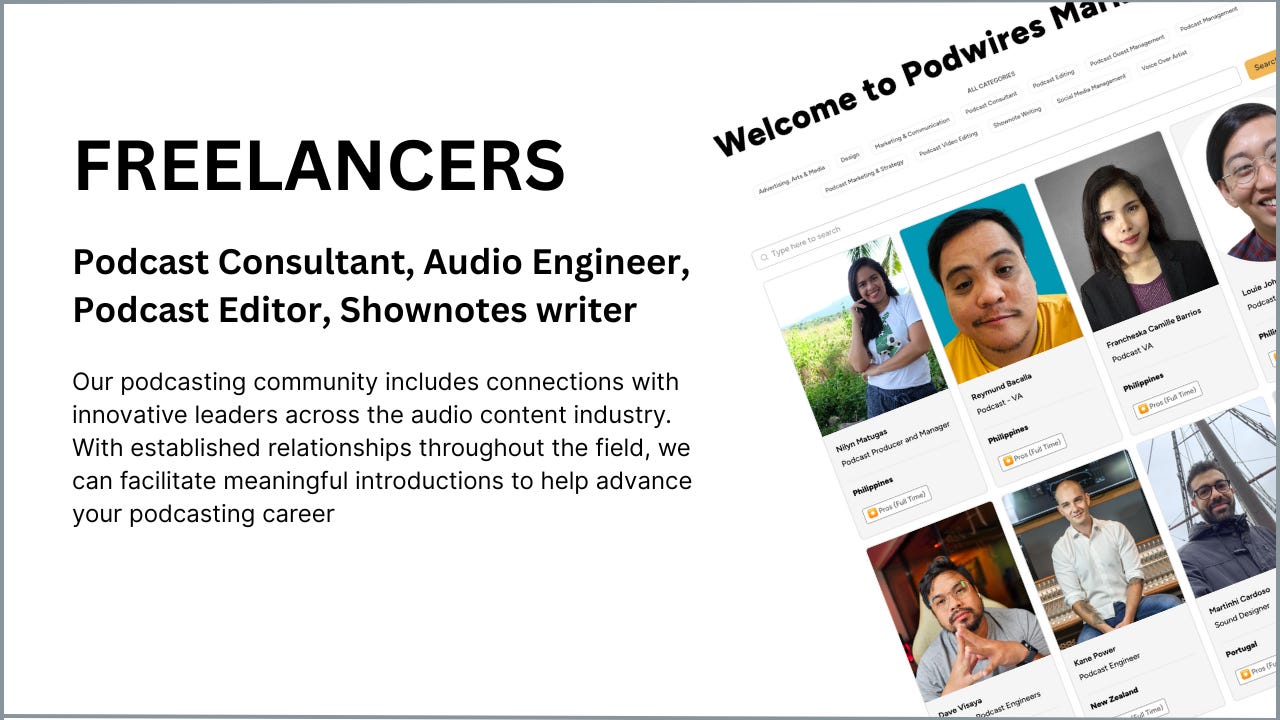
If you’re a podcast professional seeking your next opportunity, join the PodWires talent directory to connect with podcast companies and media organizations.
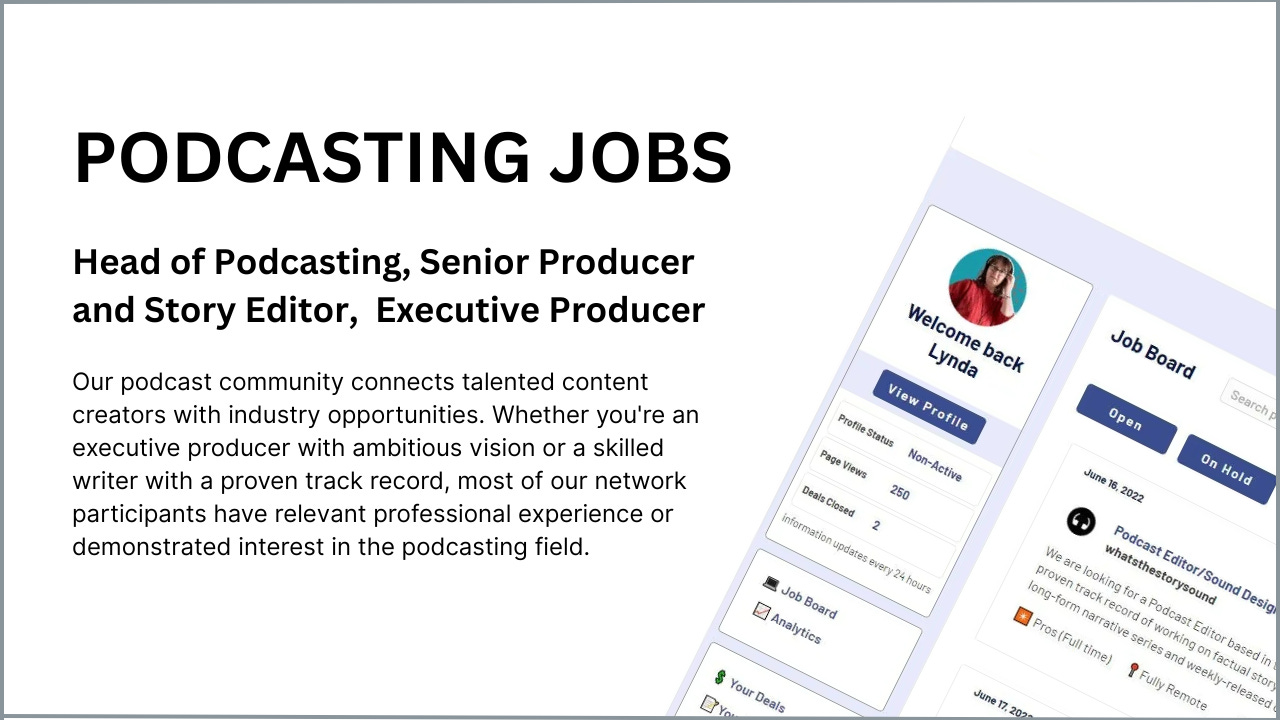
📣 Featured job opportunities 📣
NPR - Temporary Producer I, Programming & Promotion
LAUNCH - Full-Time Editor/Producer — Remote
Lemonada Media - Associate, Ad Operations
🚨 Stay on top of your deadlines with our weekly-updated calendar of fellowships, grants, training opportunities and podcasting events. If your organisation has a fellowship, grant or event to share, just 👉 fill out this form or want to contribute an article 👉 click here or reply to this message.
THAT’S WRAP
SPONSOR US
Reach over 1000 podcast producers with your product.
Thousands of podcast producers, audio/video editors, podcasters, executives, and business owners worldwide read our newsletter. Contact us now.

📖 I appreciate you taking the time to read! See you in the next issue. Got a question or criticism? Just click on Reply. We can talk while we are here.
✍️ Give us a press release and a good-sized landscape photo. Make sure it’s newsworthy. Send press releases to editor@podwires.com or click here. Editorially, we may rewrite headlines and descriptions.
📬 Sponsor us and get your brand in front of thousands of Independent Podcast Producers and podcasters. Email us at sales@podwires.com for more information or as personal supporters via Patreon, as your contributions help us enhance the experiences of all our users.
🖊️We are delighted to hear from our subscribers! We would be happy to publish your testimonial if you have found our newsletter to be helpful or if you have a success story to share. 👉 Post a Testimonial: https://testimonial.to/podwires
🚀 We are here to help you succeed! Fill out a 5 minute survey and tell us more about your business and yourself. These questions will help us better understand you and promote your business as part of our mission. It’s a win-win!
🚨 Did someone forward this to you?
Become one of the more than 1000 valued email subscribers. Find Out More 👈
We’d love to share what our Podwires readers have been saying!

We’re so grateful to our previous Podwires advertisers!

Podwires is here because of our incredible partners’ unwavering support. The Podwires readers receive journalism free of financial and political influence. If you found this valuable, consider Restacking so more people can see it. Get together with them today.