

🎙Spotify's New Video Controls Raise Fresh Questions About Podcast Video Measurement


Did someone forward this to you?
Become one of the more than 1000 valued email subscribers. Find Out More 👈


If you love travel, check out our sister publication “Mencari’s Travel Wire”
👋 Hi, Podsky!
From major platform moves to emerging industry trends, here are the key podcast stories you need to know today
If this is your first time here, welcome. Over 1,000 podcast industry readers already call Podwires home. Join them here.
Independent media only works when communities back it. Subscribe, share, and support the creators in your corner—starting with a Podwires paid subscription that keeps this newsroom running.
We want everyone to know about this initiative, so please spread the word by sharing the email with your friends! (copy URL here)
And, as always, send us feedback at editor@podwires.com
Now, let’s dive into the news.
Today’s reading time is 5 minutes. - Miko Santos (April 12, 2026)
🎙️ Today, we have exclusive insights on:
Sports Broadcasters Can No Longer Afford to Treat Podcasting as Filler Content
OpenAI Acquires Daily AI Broadcast TBPN, Raising Questions About Editorial Independence
Podcast Insight: Podcasting’s Natural Habitat Still Belongs to Radio, New Edison Research Data Shows
PodBusiness: Spotify's New Video Controls Raise Fresh Questions About Podcast Video Measurement

SOUNDS PROFITABLE
Sports Broadcasters Can No Longer Afford to Treat Podcasting as Filler Content

Podwires Rundown: Sports broadcasters have spent decades treating podcasts as supplementary content — filler between games, sidebar commentary for the truly obsessed. The data says it’s time to stop thinking that way.
A new analysis from Sounds Profitable, written by Jim Salveson of Sport Social Podcast Network, makes the case that podcasting has become structural to how modern sports fans process and sustain their fandom — not a nice-to-have, but a load-bearing pillar in the sports media stack.
Source note: This piece originates from Sounds Profitable, an industry organisation with commercial relationships across the podcast advertising ecosystem. That context doesn’t invalidate the argument, but it’s worth keeping in mind when weighing the commercial framing.
The Key Points
Sports podcast listeners are among the most avid live sports consumers overall — they don’t replace broadcast viewing; they stack on top of it, deepening engagement rather than fragmenting it
According to Edison Research, 76% of sports podcast listeners continue following athletes even after a trade, versus just 51% of general sports fans — a loyalty gap that speaks directly to podcasting’s relationship-building power
Podcasts fill the attention void that broadcast can’t — international breaks, transfer windows, off-seasons — precisely when traditional coverage has the least to offer
Netflix’s expanding podcast strategy (including its October 2025 deal with Spotify to bring The Ringer and Spotify Studios content to its streaming platform) signals that the biggest players in streaming now see podcasting as essential companion infrastructure
The 2026 FIFA World Cup is framed as a forcing function: as smart TVs become the primary gateway for World Cup viewing, broadcasters who don’t build podcast shoulder content risk losing audiences to competitors — without viewers ever changing devices
Why It Matters
Sports broadcasting has always been about owning fan attention. Podcasting has quietly colonised the hours that television can’t — the commute home after a match, the Tuesday morning debrief, the long off-season stretch where loyalty either deepens or drifts. The argument here isn’t that sports podcasting is growing. It’s that it’s already grown, and broadcasters who haven’t built deliberate podcast strategies are leaving audience depth — and advertiser dollars — on the table. Host-read sponsorships in a 45-minute episode hit differently than a 30-second ad break. That’s not a format preference. That’s a fundamentally different commercial product.
The Big Picture
For podcasters: sport is one of the few verticals where listener loyalty is identity-driven — fans don’t just follow shows, they follow teams, athletes, and narratives across years. If you’re producing sports content, lean into the moments broadcast ignores: the transfer window, the injury update, the tactical deep-dive. That’s your competitive advantage over TV, not your limitation.
For podcast producers: The Netflix/Spotify deal is worth watching closely. As visualised podcast content migrates to streaming platforms via connected TVs, production pipelines built solely for audio are going to feel the squeeze. The World Cup window in particular is a live brief — rights holders and broadcasters will be looking for production partners who can turn reactive, niche content around quickly. Build that capability now.
For the industry: The broader implication here is about where podcasting sits in the media stack. Salveson’s framing – podcasts as relationship infrastructure, not broadcast replacement – is the right lens for selling into sports partnerships. Advertisers in sport aren’t just buying reach. They’re buying association with fandom. Podcasting delivers that at a depth that no other format currently matches. The industry’s job is to make sure the measurement catches up with the story.

TOGETHER WITH MENCARI TRAVEL WIRE
Your Next Adventure Starts Here

Mencari Travel Wire is the go-to travel newsletter for Australia and New Zealand — delivering destination guides, travel intel, and trip-planning essentials curated for readers who move with purpose. Whether you're chasing weekend escapes or planning your next big journey across the Tasman, we've got you covered.
Subscribe Free → TRAVEL WIRE
This section is a paid advertisement. If you are interested in advertising, let’s talk.
TBPN| OPENAI
OpenAI Acquires Daily AI Broadcast TBPN, Raising Questions About Editorial Independence

Podwires Rundown: OpenAI has acquired TBPN, the daily live technology broadcast known for real-time coverage of AI developments, product launches, and industry news. The deal was announced April 3, 2026.
The acquisition positions OpenAI beyond model development and into media infrastructure — a significant strategic pivot for a company whose public communications have historically run through traditional press channels and Sam Altman’s social media presence.
Source note: The acquisition announcement came directly from TBPN via its Substack newsletter, written by co-founder Brandon Gorrell. The framing is expected to be promotional. The “Editorial Independence Covenant” referenced in the announcement has not been independently verified or detailed beyond the announcement itself.
The Key Points
OpenAI has acquired TBPN, a daily live show covering AI news, tools, and industry developments, with plans to scale it as an independent platform for product launches and real-time industry dialogue
Fidji Simo, CEO of AGI Deployment at OpenAI, will oversee the integration; the TBPN founding team retains editorial control under what the announcement calls an “Editorial Independence Covenant”
TBPN will continue operating as a platform open to companies across industries — not exclusively OpenAI content — maintaining its positioning as a neutral industry forum
The deal signals OpenAI’s intent to own more of the communications layer around AI adoption, not just the technology itself
Audience reaction has been mixed, with some observers questioning whether editorial independence is credible when the platform’s new owner is also one of its primary subjects
Why It Matters
This acquisition isn’t really about a podcast. It’s about narrative infrastructure. TBPN has built a daily habit among developers, founders, and operators trying to make sense of a rapidly moving AI landscape. OpenAI now owns that habit. The “Editorial Independence Covenant” may hold – contractual protections are real – but the structural reality is that the platform covering OpenAI daily is now an OpenAI asset. That’s a tension worth watching, regardless of how it resolves.
The Big Picture
For podcasters: The TBPN acquisition is a data point in a broader pattern — platforms that build genuine daily audience habits become acquisition targets. If you’re producing content in a vertical where major players have communications interests, you’re building something with strategic value beyond ad revenue. Know what you’re worth.
Tech platforms clearly value live, reactive formats with strong distribution as communications infrastructure for podcast producers. The production model TBPN runs – daily, low-overhead, high-frequency – is worth studying. It’s not premium audio. It’s utility audio, and apparently it is worth acquiring.
For the industry: OpenAI entering media ownership directly — not through advertising or sponsorship but through acquisition — raises questions the podcast industry will need to answer. When a major technology company owns a media platform that covers the same company, the advertiser-supported independence model that podcasting has relied on suddenly looks more fragile by comparison. The line between media and PR just got blurrier.
PRESENTED BY PODWIRES MARKETPLACE
Build Better Podcasts With Podwires

Every great podcast needs the right team behind it. Podwires is a dedicated marketplace where creators can connect with skilled podcast producers, editors, and audio professionals who understand how to shape strong, polished shows.
Built for the podcast industry, Podwires brings together talent, opportunity, and visibility in one clean platform. Whether you are launching a new show or improving an existing one, Podwires helps you find creative partners who can make your production stronger.
Podwires connects clients with top independent podcast producers and freelancers through a dedicated marketplace built for audio work.
SPOTIFY
Spotify's New Video Controls Raise Fresh Questions About Podcast Video Measurement
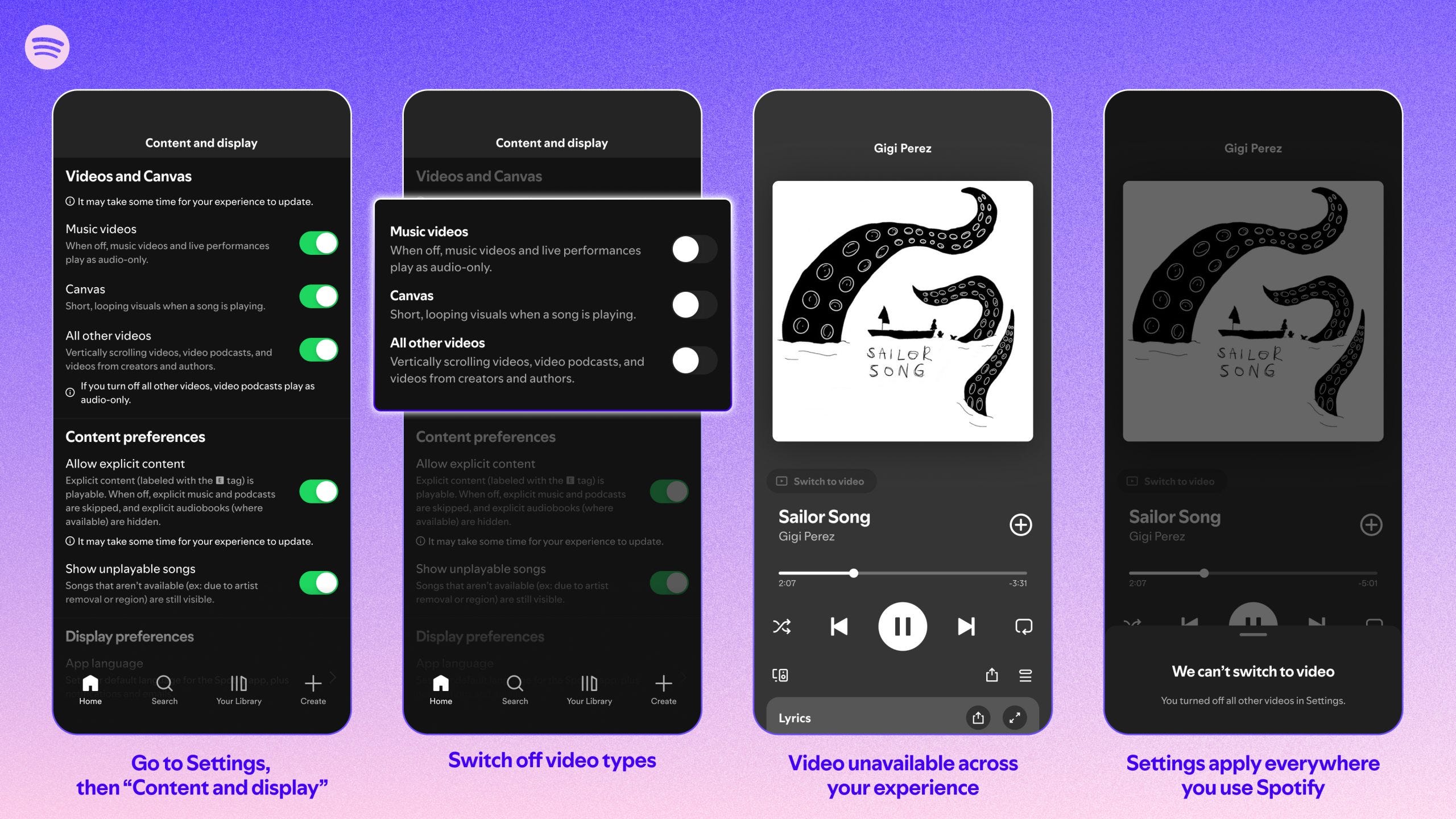
Podwires Rundown: Spotify is giving listeners more control over how video content appears across its platform — a quiet but strategically significant update that reveals how the company is managing the tension between its video ambitions and its audio-first user base.
Rolling out globally this month, the new settings allow all Spotify users—across premium, basic, and free tiers— to switch video on or off for music, podcasts, and audiobooks. Family Plan managers gain additional controls to toggle video settings for any member on their plan. Preferences apply across mobile, desktop, web, and TV.
Source note: This announcement comes directly from Spotify’s newsroom. Spotify commissioned a supporting survey through Burson across 19 markets, revealing that 93% of Spotify users are excited about control features. Treat those figures accordingly.
The Key Points
All Spotify users globally can now control whether video content appears in their app, with settings accessible under Content and Display in account preferences
Family Plan managers can toggle video on or off for any member account — expanding controls previously limited to accounts for users under 13
A Burson survey commissioned by Spotify found 93% of its users are excited about features that give them more control, and 92% say Spotify brings them closer to the things they love
Edison Research data cited in the announcement notes that 86% of Gen Z listens to music or podcasts to help boost their mood — framing audio as intentional, not passive
Users will continue to see video ads and Canvas-like visuals on some audio ads regardless of their video settings
Why It Matters
Spotify has spent several years pushing video podcasting as a growth lever — investing in studio production, signing video-first creators, and repositioning itself as a visual platform. These new controls complicate that narrative. Giving users an explicit off switch for video acknowledges something the platform hasn’t said plainly: a meaningful portion of its audience doesn’t want video, and pushing it anyway risks the intentional listening experience Spotify is simultaneously marketing as its core differentiator. This is a pragmatic move, but it creates a real measurement problem for podcast advertisers and creators who have invested in video on the assumption that Spotify’s platform was moving decisively in that direction.
The Big Picture
For podcasters: An opt-out video setting means your video podcast on Spotify may be seen by fewer listeners than platform growth figures suggest. Before investing further in video production for Spotify distribution, it’s worth asking what percentage of your audience is actually watching— and whether that data is accessible to you at all.
For podcast producers: The audio-first toggle validates what many producers have quietly known: audio quality and structure still carry the show. Video is additive for some audiences, not transformative for all. Production strategies that treat video as a layer on top of strong audio—rather than a replacement for it—are better positioned for a platform environment, where listeners can now opt out entirely.
For the industry: The video measurement gap just got wider. If Spotify users can disable video at the account level, aggregate video play counts become less reliable as a proxy for actual video engagement. Advertisers buying video podcast inventory on Spotify should be asking harder questions about what a video impression actually means on a platform where the video can be switched off.
EDISON RESEARCH
Edison Research Data Shows Radio's In-Car Dominance Remains Intact Despite Streaming Growth
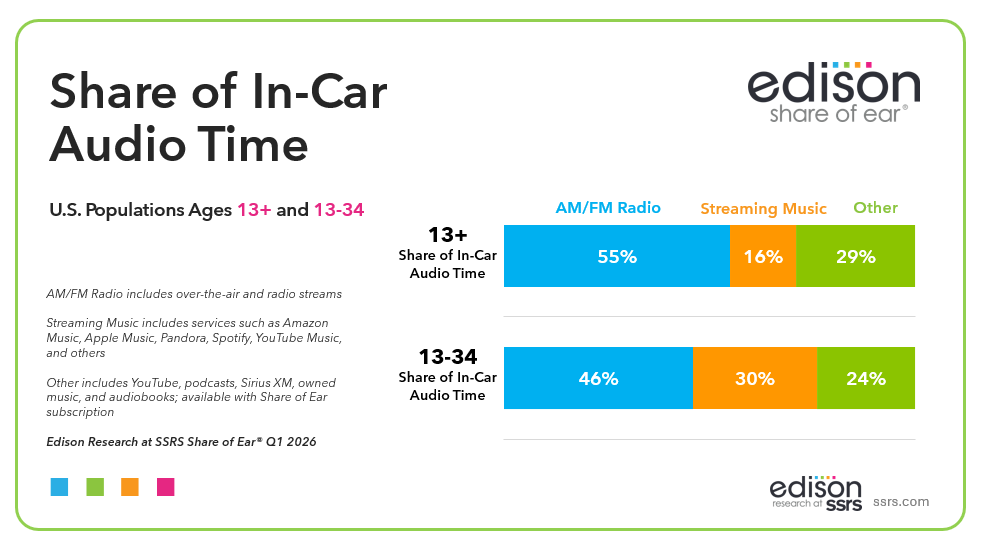
Podwires Rundown: AM/FM radio continues to hold a commanding lead over streaming audio and podcasts for in-car listening, according to newly released Q1 2026 data from Edison Research’s Share of Ear study – a finding that carries direct implications for how the podcast industry thinks about audience growth and platform competition.
The data shows that 55% of all in-car audio time among Americans 13 and older goes to AM/FM radio, either over-the-air or via streams. Streaming audio, which encompasses music platforms and podcast listening, only accounts for 16% of in-car audio time among the same population, despite years of sustained growth.
Source note: This data comes from Edison Research’s Share of Ear, a long-running quarterly study tracking audio consumption across platforms. Edison Research is an independent research firm; Share of Ear data requires a paid subscription for full access.
The Key Points
AM/FM radio captures 55% of in-car audio time among Americans 13 and older as of Q1 2026, maintaining a dominant lead over all competing platforms
Streaming audio has grown steadily over Share of Ear’s 12-year history but remains at just 16% of in-car listening time across the total 13-plus population
The generational gap is significant: among Americans 13-34, AM/FM radio’s share drops to 46% while streaming rises to 30% — a narrowing but not yet closed gap
The car remains one of radio’s most defensible environments, where habitual and passive listening patterns favour established platforms over on-demand alternatives
Full platform breakdowns by location and age group — including podcast-specific figures — require a paid Share of Ear subscription
Why It Matters
The car has long been framed as podcasting’s natural habitat — a captive listening environment where long-form audio should thrive. These numbers complicate that assumption. More than half of all in-car audio time still goes to a platform that predates the internet. For podcast executives making the case to advertisers that podcasting is capturing drive-time attention at scale, this data is a useful reality check. The generational trend is encouraging — 13-to-34-year-olds are shifting meaningfully toward streaming — but the overall picture is one of radio dominance that isn’t collapsing on any near-term timeline.
The Big Picture
For podcasters: The car is not yet yours. Discoverability in-vehicle remains a structural challenge — most in-car listening defaults to radio without active intent from the listener. If you’re not investing in strategies that reduce friction for in-car podcast access (smart speaker integration, CarPlay/Android Auto optimisation, short-form content designed for commute windows), you’re ceding the environment where radio is strongest.
For podcast producers: The 13-34 age bracket is where the competitive window is opening. Younger listeners are already allocating 30% of their in-car time to streaming. Content built specifically for that demographic — in format, length, and topic — has a real pathway into the in-car environment that older-skewing content may not have.
For the industry: Podcast advertising has made a compelling case on attentiveness and host influence. However, the in-car environment still relies heavily on radio, which has a deeply entrenched advertising infrastructure. The industry’s long-term growth in drive-time ad spend depends on closing the discoverability gap in the vehicle – a product and platform problem as much as a content one.
EDISON RESEARCH
New Heights Leads U.S. Sports Podcasts as Celebrity-Anchored Shows Dominate Edison Rankings
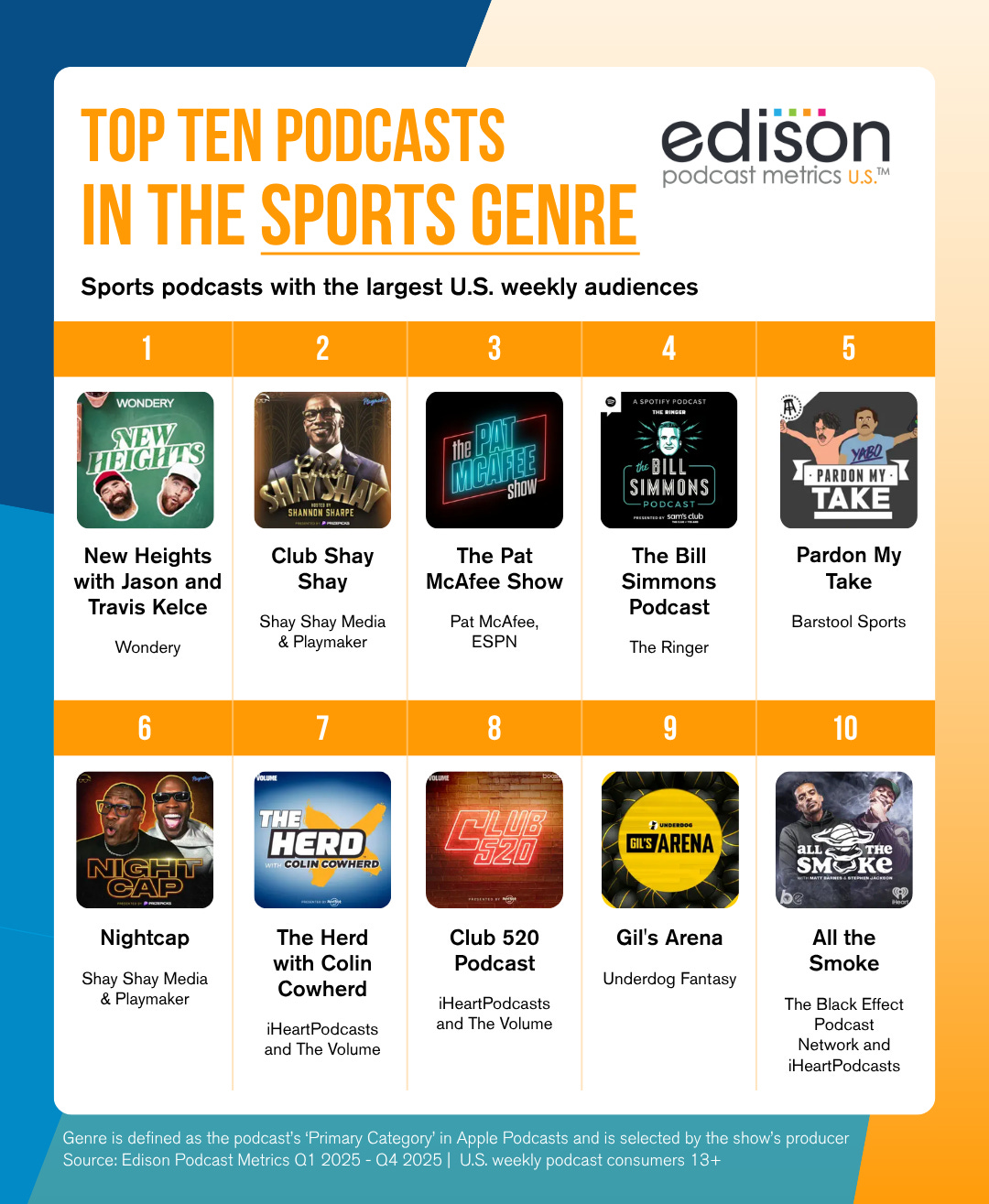
Podwires Rundown: Edison Research’s full-year 2025 sports podcast rankings — drawn from Edison Podcast Metrics and measuring weekly U.S. audiences 13+—show a genre that is popular in aggregate but heavily dependent on celebrity proximity at the top. New Heights with Jason and Travis Kelce holds the number one spot, a show that, by Edison’s own account, broke through in Q4 2023 when Travis Kelce’s relationship with Taylor Swift went public. The audience held. But the origin story is relevant for anyone trying to build the next sports podcast franchise without a Kelce or a Shannon Sharpe attached.
This data comes from Edison Research, published April 1 as part of their Weekly Insights series. Edison Podcast Metrics is a subscription measurement product with commercial relationships across the industry. Rankings include both audio and video podcast consumption.
The Key Points
New Heights with Jason and Travis Kelce leads all U.S. sports podcasts by weekly audience, maintaining consistent listenership after its Taylor Swift-driven breakout in late 2023
Shannon Sharpe’s Club Shay Shay (iHeartPodcasts) ranks second, followed by The Pat McAfee Show at third — both shows built around former athletes with established broadcast profiles
Sports ranks among the most popular podcast genres overall by weekly audience, according to Edison Podcast Metrics full-year 2025 data
Rankings include video podcast consumption alongside audio, reflecting Edison’s methodology shift to cross-platform measurement
Genre classification is producer-selected via Apple Podcasts Primary Category, meaning shows self-identify as Sports — a reminder that rankings reflect declared genre, not independent categorisation
Why It Matters
The top ten sports podcasts in the U.S. are, almost without exception, built around names that arrived with existing audiences. That’s not a criticism — it’s a structural observation about how sports podcast audiences are currently acquired. For independent creators and producers trying to build in the genre, the data suggests that sports podcasting rewards identity and access over format innovation. The Latin American sports podcast gap examined earlier this week looks different in this light: the U.S. market cracked open not through better formats, but through celebrity catalysts.
The Big Picture
For podcasters: The athlete and personality pipeline into sports podcasting is not slowing down. Competing on celebrity access is expensive and unreliable for independent creators. The strategic alternative is niche depth — team-specific, market-specific, or format-specific shows that serve avid audiences the generalist shows don’t reach. Edison’s own data on sports audio listeners supports that approach: avidity drives value more than raw reach in this genre.
For podcast producers: The inclusion of video consumption in Edison’s sports rankings is a quiet but significant methodological shift. Productions that lack a video strategy are now facing measurement against shows that do have one. The production brief for competitive sports podcasting has changed.
For the industry: Sports is a proven top-tier genre with a weekly audience. The concentration of that audience around a small number of celebrity-anchored shows creates both a vulnerability and an opportunity. If any of the top-ten anchors exit or reduce their output, they leave a significant audience available. Producers and networks that pay attention to that fragility are better positioned than those who treat the current rankings as stable.
JOIN PODWIRE’S MARKETPLACE
If you’re building a podcast team, join Podwires Marketplace to access monthly curated lists of experienced podcast professionals—producers, audio engineers, scriptwriters, and hosts—actively seeking new opportunities in news, storytelling, and audio journalism.

If you’re a podcast professional seeking your next opportunity, join the PodWires talent directory to connect with podcast companies and media organisations.

🚨 Stay on top of your deadlines with our weekly-updated calendar of fellowships, grants, training opportunities and podcasting events. If your organisation has a fellowship, grant or event to share, just 👉 fill out this form or 👉 reply to this message.
THAT’S WRAP
SPONSOR US
Reach over 1000 podcast producers with your product.
Thousands of podcast producers, audio/video editors, podcasters, executives, and business owners worldwide read our newsletter. Contact us now.

📖 I appreciate you taking the time to read! See you in the next issue. Got a question or criticism? Just click on Reply. We can talk while we are here.
Please provide a press release along with a suitable landscape photo. Make sure it’s newsworthy. Send press releases to editor@podwires.com or click here. Editorially, we may rewrite headlines and descriptions.
📬 Sponsor us and get your brand in front of thousands of independent podcast producers and podcasters. Email us at sales@podwires.com for more information or as personal supporters via Patreon, as your contributions help us enhance the experiences of all our users.
🖊️We are delighted to hear from our subscribers! If our newsletter helped you or you have a success story, we would love to publish your testimonial. 👉 Post a Testimonial: Click here
🚀 We are here to help you succeed! We kindly invite you to complete a brief 5-minute survey to share more about your business and yourself. These questions will help us better understand you and promote your business as part of our mission. It’s a win-win!
🚨 Did someone forward the information to you?
Become one of the more than 1000 valued email subscribers. Find Out More 👈
We’d love to share what our Podwires readers have been saying!

We’re so grateful to our previous Podwires advertisers!

Podwires is here because of our incredible partners’ unwavering support. The Podwires readers receive journalism free of financial and political influence. If you found this valuable, consider Restacking so more people can see it. Get together with them today.