

🎙Sounds Profitable's Audio Primes Report Identifies the 22% Driving Podcasting's Word-of-Mouth Growth


Did someone forward this to you?
Become one of the more than 1000 valued email subscribers. Find Out More 👈


If you love travel, check out our sister publication “Mencari’s Travel Wire”
👋 Hi, Podsky!
From major platform moves to emerging industry trends, here are the key podcast stories you need to know today
If this is your first time here, welcome. Over 1,000 podcast industry readers already call Podwires home. Join them here.
Independent media only works when communities back it. Subscribe, share, and support the creators in your corner—starting with a Podwires paid subscription that keeps this newsroom running.
We want everyone to know about this initiative, so please spread the word by sharing the email with your friends! (copy URL here)
And, as always, send us feedback at editor@podwires.com
Now, let’s dive into the news.
Today’s reading time is 5 minutes. - Miko Santos (April 19, 2026)
🎙️ Today, we have exclusive insights on:
Sounds Profitable's Audio Primes Report Identifies the 22% Driving Podcasting's Word-of-Mouth Growth
From Gimlet to Goalhanger: Why the 2026 Podcast M&A Cycle Is Structurally Different
The Measurement Gap Is a Revenue Gap — APM's Attribution Story Shows What Premium Publishers Are Leaving Behind
Podcast Insight: Brand Safety Anxiety Is Suppressing True Crime Podcast Ad Rates — And Advertisers Are Paying for It in Efficiency
PodBusiness: Audioboom Posts 30% Revenue Growth in Q1 — But RPM Falls 26% as Video Scale Dilutes Yield

SOUNDS PROFITABLE
Sounds Profitable Study Finds Audio-First Listeners Twice as Resistant to AI Voices as Video Podcast Viewers
Podwires Rundown: The podcast industry has been debating AI voices for years. But a new study from Sounds Profitable suggests the more important question isn’t whether listeners accept AI—it’s which audience members do and why the gap between them is wider than anyone expected.
Source note: This piece draws from Tom Webster’s April 16, 2026 article for Sounds Profitable, published alongside the launch of the Audio Primes 2026 report. Sounds Profitable is a podcast industry research and media organization; the underlying data is drawn from The Podcast Landscape 2025, sponsored by American Public Media, BetterHelp, ESPN Podcasts, NPR, and SiriusXM.
The new Audio Primes framework splits podcast consumers into two camps: Audio Primes — those who consume at least 75% of their podcasts as audio — and Video Primes, who watch at least 75%. These aren’t demographic buckets. They’re behavioural ones. And Audio Primes, counterintuitively, skew slightly younger than the general podcasting base.
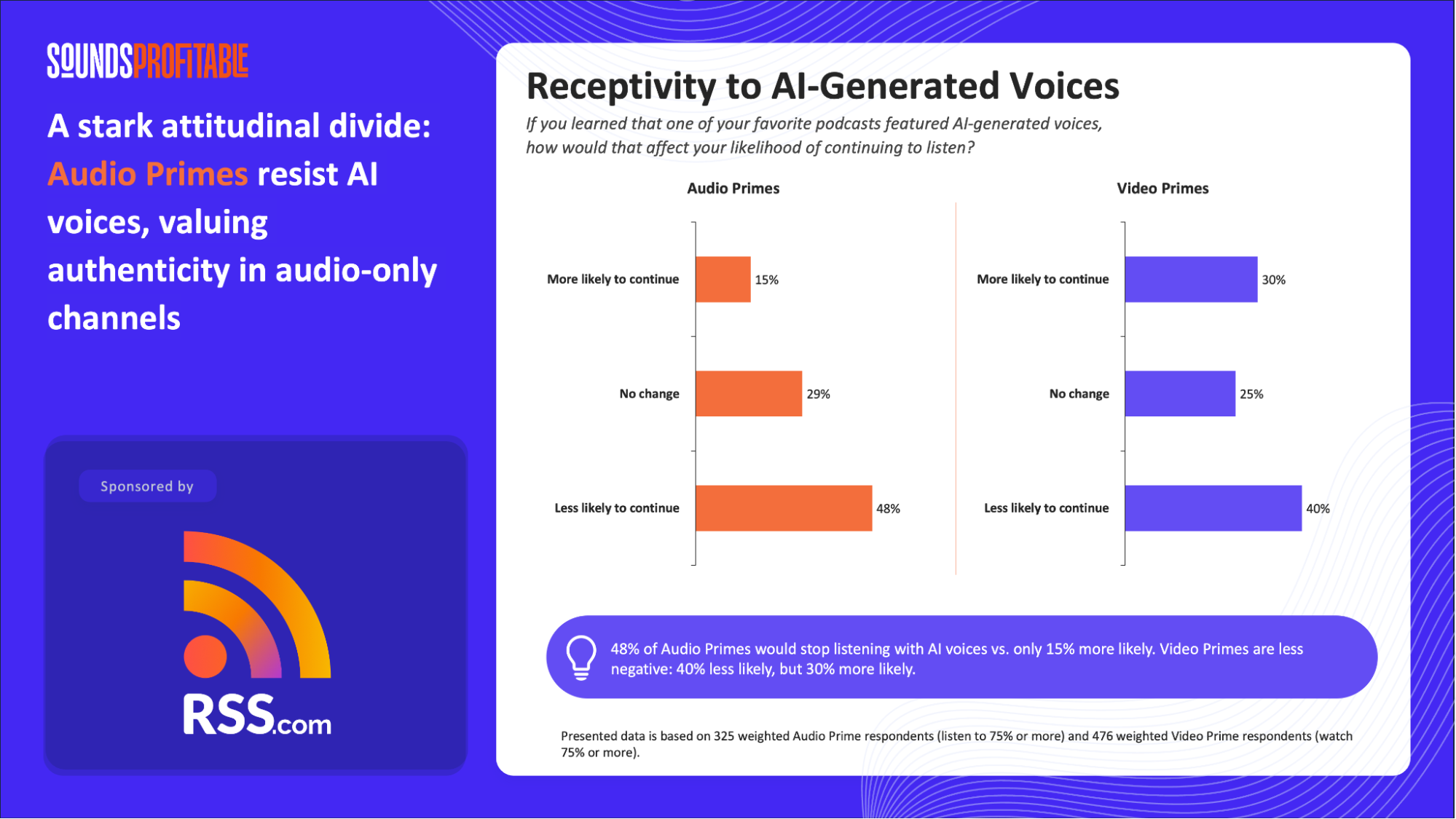
Here’s the uncomfortable part. When both groups were asked how they’d react to discovering a favorite podcast used AI-generated voices:
48% of Audio Primes said they’d be less likely to keep listening
Only 15% of Audio Primes said they’d be more likely
40% of Video Primes said less likely — but 30% said more likely
That’s double the AI enthusiasm among Video Primes. Let that sink in.
Why It Matters
The split reveals something structural about how different audiences have been conditioned by the platforms they use. Video Primes have spent years inside TikTok and YouTube ecosystems saturated with AI avatars, synthetic narrators, and deepfake influencers. They’ve already made their peace with artificial voices. Audio Primes haven’t — and the reason is almost architectural: for audio-first listeners, the voice is the medium. There’s nothing else there. Swapping it for a synthetic version isn’t a production decision. It’s a substitution of the core product.
For anyone buying, selling, or producing podcast advertising, this framework matters immediately. An AI-narrated ad read lands very differently depending on which audience is consuming it.
The Big Picture
For podcasters: Before experimenting with AI-generated voices—for intros, ad reads, narrations, or episode productions— know your audience’s consumption mode. If your show skews audio prime, AI voice is a trust issue, not a production efficiency. If you’re building for a video-first audience, the calculus is different. Segment before you decide.
For podcast producers: The Audio Primes / Video Primes distinction should inform every AI tool evaluation you do in 2026. Producers working with audio-first talent and audio-first audiences need to treat voice authenticity as a non-negotiable. Producers building video-first or hybrid shows have more room to experiment – and may actually benefit from the novelty signal AI voice creates with that audience.
For the industry: The AI voice debate has been too binary. The real story isn’t “listeners hate AI” — it’s that a meaningful and growing segment of podcast consumers is actively open to it, and that segment correlates with video platform behaviour. As podcast consumption continues fragmenting across YouTube, Spotify, and audio-native apps, AI tools won’t land uniformly across the audience. Advertisers, networks, and platforms need measurement frameworks that account for this split – not just consumption format, but the expectations and tolerance levels that come with it.

TOGETHER WITH MENCARI TRAVEL WIRE
Your Next Adventure Starts Here

Mencari Travel Wire is the go-to travel newsletter for Australia and New Zealand — delivering destination guides, travel intel, and trip-planning essentials curated for readers who move with purpose. Whether you're chasing weekend escapes or planning your next big journey across the Tasman, we've got you covered.
Subscribe Free → TRAVEL WIRE
This section is a paid advertisement. If you are interested in advertising, let’s talk.
MEDIA BUILT
Podcast M&A Is Back — and None of the Buyers Have Ever Published a Feed

Podwires Rundown: The podcast acquisition market is heating up again, but this cycle looks fundamentally different from the last one. The buyers aren’t podcast companies anymore.
Source note: This analysis is drawn from Steve Raizes’ April 14, 2026 newsletter “Media, Built,” which covers media distribution and business strategy. Raizes writes from operating experience during the 2019 podcast acquisition cycle at Paramount. Commercial context: The publication is an independent newsletter with no disclosed financial relationship to the companies discussed.
The uncomfortable part? Not one of the major acquirers in the current wave has ever published a podcast feed. OpenAI purchased TBPN, a daily tech talk show with 74,000 YouTube subscribers. The Chernin Group took a minority stake in Goalhanger—the UK company behind The Rest Is History—and separately invested $40 million in Audiochuck, the home of Crime Junkie. Fox Entertainment acquired Red Seat Ventures. MeidasTouch raised from Soros Fund Management. Vox Media has been in conversations about selling its podcast network.
The Key Points
OpenAI paid low hundreds of millions for TBPN, a show that didn’t exist two years ago, generating approximately $5 million in ad revenue — and placed it under its chief political operative, not its content division
Goalhanger reported 750 million full-episode views across 14 shows in 2025, with more than 250,000 paying members at roughly £60 per year — subscription revenue that precedes any IP expansion
Monthly U.S. podcast reach has crossed 55% according to Sounds Profitable’s Podcast Landscape 2025, cited by Bryan Barletta as evidence the medium has arrived at the mainstream
The 2019 cycle saw podcast companies buying podcast companies — Spotify acquired Gimlet for ~$230 million, SiriusXM acquired Stitcher — acquirers who understood the medium because they operated in it
Raizes argues a show with 50,000 downloads and a community that converts is worth more in this market than one with 500,000 downloads and no mobilization proof
Why It Matters
The valuation logic has shifted from reach to conversion. In 2019, buyers were pricing content and hoping it would compound into a media business. In 2026, buyers are pricing audience infrastructure — specifically, whether a show can move its audience to a live event, a subscription product, or a new platform when asked. Goalhanger sold out the O2 Arena. Markiplier put a self-financed horror film into 3,000 theaters using his YouTube audience. These deals aren’t really about podcasting. They’re about using podcast-built audience relationships to solve problems in other businesses entirely — AI narrative control, cross-platform IP, political media distribution.
The Big Picture
For podcasters: The right question is no longer “what is my show worth?” It’s whether you’ve built something a buyer couldn’t simply replicate by hiring your talent directly. Download numbers don’t answer that. Subscriber conversion, live event attendance, and community mobility do. If your audience follows you across surfaces, you have leverage. If they don’t, the number on the spreadsheet is fragile.
For podcast producers: Two structural risks are embedded in every deal in this cycle. Editorial independence is a phrase included in every acquisition announcement, but TBPN operates under OpenAI’s political umbrella, and that promise will be tested the first time the show needs to cover an OpenAI controversy. And talent portability—every major property in this cycle is talent-driven; the 2019 cycle demonstrated that talent structures don’t hold. Producers building shows should be thinking about institutional audience infrastructure, not individual host equity.
For the industry: The medium has genuinely arrived — 55% monthly reach is a real number. But the acquisition heat is not a validation of the podcast business model as traditionally understood. These buyers are not trying to win the podcast industry. They’re extracting a specific asset—dense, convertible audience relationships— and deploying it elsewhere. This is a completely different thesis, and operators who misinterpret this M&A wave as a repetition of 2019 will be valuing their businesses based on an incorrect benchmark.
PRESENTED BY PODWIRES MARKETPLACE
Build Better Podcasts With Podwires

Every great podcast needs the right team behind it. Podwires is a dedicated marketplace where creators can connect with skilled podcast producers, editors, and audio professionals who understand how to shape strong, polished shows.
Built for the podcast industry, Podwires brings together talent, opportunity, and visibility in one clean platform. Whether you are launching a new show or improving an existing one, Podwires helps you find creative partners who can make your production stronger.
Podwires connects clients with top independent podcast producers and freelancers through a dedicated marketplace built for audio work.
AUDIOBOOM
Audioboom Q1 2026: Strong Financials, New Spotify and Apple Video Deals — and an RPM Story the Headlines Missed

Podwires Rundown: Record revenue. Record distribution. Record adjusted EBITDA growth. Additionally, the revenue-per-thousand metric dropped 26% year-on-year. Audioboom’s Q1 2026 trading update illustrates the consequences of a podcast company rapidly scaling through video, particularly the short-term costs in yield.
Source note: This piece is drawn from Audioboom’s Q1 2026 Trading Update, a regulatory filing submitted to the London Stock Exchange AIM market on April 14, 2026. As a publicly listed company, Audioboom is required to disclose material trading information; the information is not vendor-sourced marketing material.
Audioboom reported Q1 revenue of $22.5 million, up 30% from $17.3 million in Q1 2025. Gross profit reached $4.8 million, up 41%, with gross margin improving to 21.3% from 19.7%. Adjusted EBITDA hit $1.4 million — up 118% year-on-year — while monthly operating costs held flat at $1.1 million. The company ended the quarter with $5.5 million in cash.
The distribution headline is harder to ignore: 170 million average monthly downloads and video views, up 79% on Q1 2025’s 94.8 million. But the driver of that growth — the July 2025 acquisition of Adelicious, plus new video podcast signings — is also what pushed RPM down to $45.10 from $60.83. Video views yield less than audio downloads. Audioboom is betting that gap closes over time.
The Key Points
Q1 revenue of $22.5 million, up 30% year-on-year, with adjusted EBITDA up 118% to $1.4 million
Showcase — Audioboom’s higher-margin programmatic advertising marketplace — grew Q1 revenue 63% year-on-year, driven by inventory growth and advertiser demand
RPM dropped to $45.10 from $60.83 in Q1 2025, entirely attributable to the influx of lower-yield video views and UK downloads post-Adelicious acquisition
New signings include Crooked Media, RedHanded, and Hear Me Out, contributing more than 20 million combined monthly downloads and video views
Audioboom launched video monetisation partnerships with both Spotify and Apple during the quarter, expanding ad and subscription revenue pathways for video creators
Why It Matters
The RPM decline is the number that deserves scrutiny. A 26% drop in revenue per thousand impressions isn’t a rounding error — it reflects a deliberate strategic trade: Audioboom expanded its distribution footprint dramatically through video and UK acquisitions, accepting lower per-unit yield in exchange for inventory scale. The company’s own filing frames this as “significant upside opportunity through medium-term value creation in video podcast monetisation.” That may be true. But it also means Audioboom is carrying a yield deficit right now, and the Spotify and Apple video partnerships are the mechanism by which they intend to close it. Whether those platforms deliver meaningful video CPM improvement — or whether video podcast monetisation continues to lag audio — is the operational question that will define Audioboom’s next 12 months.
The Showcase growth story is the cleaner signal here. 63% year-on-year revenue growth from a tech-based, higher-margin ad marketplace suggests the platform business is working. If Audioboom can bring video inventory yield closer to audio yield through Showcase, the 79% distribution growth starts looking like genuine leverage rather than dilution.
The Big Picture
For podcasters: Audioboom’s Crooked Media and RedHanded signings confirm the company is competing aggressively for tier-one content in both political and true crime — two of podcasting’s most commercially durable genres. If you’re a show in those categories evaluating network options, Audioboom is signalling serious investment in UK and US premium content.
For podcast producers: The RPM gap between audio and video is a real number with real consequences for creator revenue. Audioboom’s 170 million distribution figure sounds impressive — but if video views are yielding significantly less than audio downloads, producers need to understand what unit their revenue deal is denominated in. Not all impressions are equal on Audioboom’s current inventory mix.
For the industry: The Spotify and Apple video monetisation partnerships are the most strategically significant detail in this filing, and they’ve received almost no attention. Audioboom is positioning itself as the infrastructure layer between premium podcast creators and the two dominant platforms for video podcast discovery. If that positioning holds, it’s a meaningful structural advantage in the emerging video podcast ad market — not just for Audioboom, but as a proof-of-concept for how independent podcast networks navigate platform dependency.
Podwires x PodRoo

Podwires is excited to welcome PodRoo as a new partner.
PodRoo is a free press release platform built specifically for the podcasting community, helping hosts, guests, agencies, and producers share their news with the right audience.
Whether you’re announcing a new show, a milestone episode, a guest appearance, or a sponsorship deal, PodRoo makes it easier to get in front of podcast listeners, industry insiders, and media outlets that follow the space.
We’re proud to partner with platforms that support podcast growth, visibility, and discovery.
Check out PodRoo at PodRoo.com.
SOUNDS PROFITABLE
Sounds Profitable's Audio Primes Report Identifies the 22% Driving Podcasting's Word-of-Mouth Growth
Podwires Rundown: Audio Primes are a minority of podcast consumers. They drive a disproportionate share of everything that makes podcasting work.
Source note: Audio Primes 2026 is a research report published by Sounds Profitable in partnership with Signal Hill Insights, based on an online survey of 5,034 Americans aged 18 and older conducted in June 2025 — the largest public study of podcasting in America, according to the researchers. The study is drawn from The Podcast Landscape 2025 dataset. Sponsors include RSS.com. Sounds Profitable is a podcast industry research and media organization; commercial relationships with sponsors should be noted when evaluating emphasis.
Sounds Profitable defines an Audio Prime as a podcast consumer who listens to at least 75% of their content as audio rather than video. That group represents 22% of all podcast consumers. What they do with that audio habit—and what it means for anyone trying to build a business around this medium— is what the full report unpacks.
The Key Points
Audio Primes skew younger than expected: the 35–54 cohort over-indexes by 6 points; the 55+ cohort — conventionally assumed to be the audio-first base — under-indexes by 9 points
77% of Audio Primes listen at least weekly, 18 points above the total podcast audience; only 11% are casual listeners, half the rate of the broader base
71% would recommend a podcast to someone else, 11 points above the total audience; only 5% would never recommend — half the average resistance rate
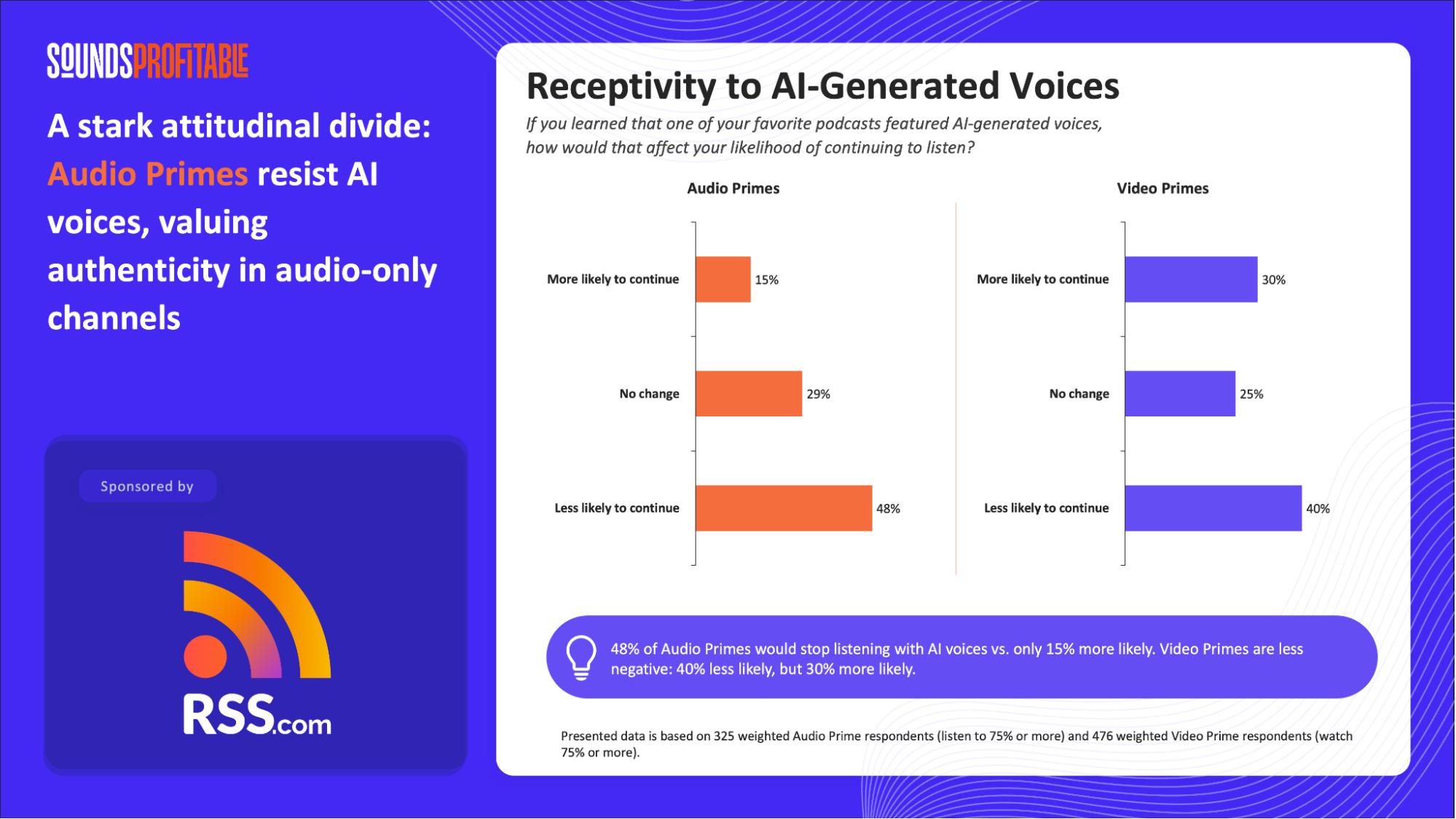
48% would be less likely to keep listening if a favorite show used AI-generated voices, versus only 15% who would be more likely — a stark authenticity premium that has direct implications for AI production tools
32% started a new podcast in the last month, 8 points above the total audience — a segment that is simultaneously loyal to existing shows and actively discovering new ones
Audio Primes over-index on Reddit (+10 points) and LinkedIn (+10 points) for social media use, and under-index on TikTok by 6 points for podcast discovery — discovery happens inside the ecosystem, not through short-form video feeds
72% use the same podcast platform every time, 8 points above total — once acquired, this audience stays
Why It Matters
The Audio Primes framework reframes a question the industry has been asking poorly. The debate around video versus audio podcasting has largely been framed as a format war — which distribution strategy wins. The Audio Primes data suggests a more useful lens: different consumption modes produce different audience relationships, and those relationships have different commercial values. Audio Primes are more likely to recommend shows, more likely to act on host endorsements, more likely to subscribe, and more likely to stay. The neuroscience section of the report, contributed by Alberto Betella from RSS.com, offers a structural explanation: audio without visual input activates deeper cognitive and emotional processing, strengthens parasocial bonds through oxytocin and mirror neuron mechanisms, and compounds familiarity into trust through repeated exposure. A screen makes you a spectator. A voice makes you a friend. That distinction matters to anyone pricing podcast advertising.
The Big Picture
For podcasters: Audio Primes discover shows primarily through host recommendations and in-app browsing — not TikTok clips or social media feeds. The highest-leverage growth strategy for reaching this audience is cross-promotion with other podcasters, not short-form video content. The AI voice finding deserves serious attention: 48% of your most loyal, highest-value listeners would leave if an AI-generated host voice is used. That is not a marginal risk.
For podcast producers: The format flexibility finding cuts against the assumption that longer is better for audio-first audiences. Audio Primes over-index on short-form content under 20 minutes by 6 points. They want the right fit for the content, not a fixed runtime. Producers who optimise episode length solely for algorithm performance may not align with the audience's actual rewards. Separately, the ad relevance finding is actionable: Audio Primes are 3 points more sensitive to irrelevant ads and 2 points less sensitive to ad volume than the total audience. Better targeting outperforms reduced load for this segment.
For the industry: The report’s most structurally significant finding may be the social network data. Audio Primes have denser podcast listener networks than average — 74% have friends who listen, 66% have family members who listen, 45% have co-workers who listen, all significantly above the total base. Reaching one Audio Prime has multiplier effects that reaching a casual listener does not. For platforms, advertisers, and networks trying to model the actual value of a podcast listener, the download number is the wrong unit. The Audio Prime is the right one.
OXFORD ROAD
Brand Safety Anxiety Is Suppressing True Crime Podcast Ad Rates — And Advertisers Are Paying for It in Efficiency

Podwires Rundown: Oxford Road’s latest ORBIT rankings reveal a persistent gap between True Crime’s ad efficiency and the advertising spend it actually attracts — and the data points to brand safety anxiety as the primary culprit keeping rates suppressed in one of podcasting’s best-performing genres.
Source note: This piece is drawn from a press release issued by Oxford Road in April 2026, announcing the “ORBIT Top Performing True Crime Podcasts” rankings. ORBIT (Oxford Road Benchmark Intelligence Tool) is a proprietary measurement platform built on Oxford Road’s own campaign database, which the agency claims encompasses $1.6 billion in campaign data across 500+ advertisers. Oxford Road is a commercial entity with a direct financial interest in podcast advertising spend. Data should be interpreted in that context.
True Crime is the second-highest genre by podcast ad spend, trailing only Comedy. But Oxford Road’s performance data tells a more complicated story: despite ranking in the top 20% of all genres for ad efficiency across more than 65 genres analyzed, the company argues brands are systematically under-investing — testing a handful of shows, drawing conclusions from limited data, and leaving efficient inventory on the table.
The more structurally interesting finding is the brand safety dynamic. True Crime’s reputation for dark content creates advertiser hesitation. That hesitation, Oxford Road argues, suppresses competition and keeps CPMs below what audience engagement levels would otherwise command. The result: a pricing gap that rewards advertisers willing to look past the genre stigma.
The Key Points
True Crime ranks second only to Comedy in podcast ad spend across 65+ genres analyzed, but sits in the top 20% for ad efficiency — suggesting the genre is punching above its weight in performance relative to investment
Legacy broadcast IP — Cold Case Files, 20/20, I Survived — tops the ORBIT True Crime rankings, offering lower brand safety risk and established audience trust; Oxford Road flags these shows may not stay affordable as more advertisers discover them
One-third of the top 15 performing True Crime shows use a companion format — personality-driven, parasocial content that Oxford Road says requires different creative treatment, more host latitude in ad reads, and separate rate evaluation
Brand safety stigma is keeping rates artificially low in high-performing shows with paranormal or horror-adjacent tones — Oxford Road explicitly identifies this as a pricing opportunity for advertisers willing to move past the caution
True Crime breaks into at least four distinct sub-formats — Companion, Investigative, Broadcast IP, and Dark Crossover — each attracting different audiences and warranting different buying strategies
Why It Matters
The ORBIT True Crime data lands at a moment when podcast advertising is increasingly performance-driven. Direct response advertisers — the backbone of podcast ad revenue — make buy decisions on efficiency metrics, not genre reputation. If True Crime is genuinely delivering top-quintile efficiency but being under-bought due to brand safety anxiety, that’s a market inefficiency with real dollar consequences for creators, networks, and the genre’s long-term ad revenue trajectory. The companion format finding is particularly actionable: a third of the top performers require a fundamentally different creative and buying approach than investigative or broadcast IP shows, and advertisers treating them identically are likely leaving performance on the table.
The Big Picture
For podcasters: If you’re producing True Crime content — particularly companion or personality-driven formats — the ORBIT data supports a direct argument to advertisers that your brand safety hesitation is costing them efficiency. The suppressed rate environment is not expected to persist indefinitely; Oxford Road’s own analysis indicates that legacy IP shows, in particular, are nearing a pricing inflection point as more advertisers enter the category.
For podcast producers: The sub-format taxonomy matters for how you pitch and price. Investigative True Crime, companion True Crime, and dark crossover content are not equivalent ad products — they attract different audiences with different engagement profiles and different parasocial dynamics. Producers who can articulate that distinction clearly in their media kits are better positioned than those selling against a generic genre label.
For the industry: Oxford Road is building a monthly ORBIT rankings cadence across genres, verticals, and international markets. That’s a significant data asset — and a significant influence operation over how advertisers allocate podcast spend. The agency processes more podcast advertising performance data than any other firm by its own account. When ORBIT ranks a show highly, it shapes buying behavior. Podcast networks and independent creators should understand that this benchmarking infrastructure, however genuinely useful, also serves Oxford Road’s commercial interests in directing client spend.
MAGELLAN AI
The Measurement Gap Is a Revenue Gap — APM's Attribution Story Shows What Premium Publishers Are Leaving Behind

Podwires Rundown: American Public Media didn’t have a performance problem. It had a proof problem. And closing that gap, according to a new case study published by measurement platform Magellan AI, required rethinking how the public media organization presented its value to advertisers entirely.
Source note: This piece is drawn from a case study published by Magellan AI in April 2026, featuring American Public Media as a client. Magellan AI, a vendor, produces marketing material with a direct commercial interest in positioning attribution measurement as essential infrastructure for podcast publishers. Specific performance figures are unverified and not independently audited. APM is also a full-year sponsor of Sounds Profitable’s podcast landscape research. When evaluating the claims, one should note both commercial relationships.
The structural challenge APM faced is one most premium podcast publishers will recognize. High-quality, brand-safe environments — the kind APM has built across its national podcast and digital audio portfolio — were increasingly being benchmarked against performance-optimized digital channels where transparency, attribution, and optimization data are standard. Reach and audience quality, historically sufficient for public media underwriting conversations, were no longer satisfying media buyers who wanted to know which markets converted, which placements outperformed, and where budget should move next.
APM’s response was to adopt Magellan AI’s attribution toolset and lead sales conversations with performance data rather than audience quality narratives.
The Key Points
APM is on track to deliver its strongest digital sales performance since 2021 following more than a year of integrating Magellan AI attribution into its sales and campaign workflow — while operating with what the case study describes as more disciplined, intentionally curated inventory
In one higher-education campaign, attribution data revealed that one metro area converted at more than 3x the rate of another — insight APM and the client used to concentrate renewal investment in higher-performing regions
APM shifted sales conversations from defending premium audio’s value to optimizing and expanding investment in it — a posture change the case study frames as moving from “Did this work?” to “What did we learn, and what should we do next?”
Across multiple campaigns, attribution data helped advertisers evaluate their audio mix against defined KPIs; when podcast and streaming placements outperformed, budgets shifted accordingly
The case study identifies a broader industry dynamic: premium audio publishers risk having high-quality inventory assessed using benchmarks designed for lower-cost, performance-optimized channels — a mismatch that suppresses perceived value
Why It Matters
The APM case study is less a story about one organization and more a signal about where the entire premium podcast publisher category is heading. The measurement gap between audio and digital channels has been a persistent structural problem for podcast advertising — advertisers trained on digital attribution frameworks have consistently struggled to evaluate podcast spend on equivalent terms. What APM’s experience illustrates is that closing that gap isn’t just about reporting; it changes the commercial posture of every sales conversation. Publishers who can demonstrate performance data are selling optimization. Publishers who can’t are still defending their existence in the media mix. That’s a fundamentally different negotiating position.
Here’s the uncomfortable part for the industry: the solution APM adopted depends entirely on a third-party measurement platform. Attribution infrastructure isn’t free, and smaller independent publishers don’t have APM’s scale to justify the investment. The measurement advantage Magellan AI provides is real — but it concentrates commercial leverage among publishers large enough to afford it.
The Big Picture
For podcasters: If you’re selling sponsorships or advertising without attribution data, you are increasingly at a disadvantage in renewal conversations. The APM case is an extreme version of a dynamic playing out at every level of the market. Advertisers who have access to performance data on some of their buys will eventually apply that standard to all of them. Understanding what attribution tools are available at your scale — and what they cost — is now a commercial priority, not a technical nice-to-have.
For podcast producers: The metro-level conversion data point in the APM case is worth paying close attention to. A single campaign showed one market converting at more than triple the rate of another. Producers working on shows with national distribution and geographically targeted advertisers should be asking whether their network or host is surfacing this kind of insight — and if not, why not. Geographic performance variance is actionable data that changes both creative and placement strategy.
For the industry: The measurement infrastructure gap between large premium publishers and independent creators is widening. APM can afford Magellan AI’s attribution toolset. Most podcast creators cannot. As advertiser ’ expectations for performance accountability become standard rather than exceptional, the industry needs either democratised access to measurement tools or a collective standards effort that allows smaller publishers to participate in data-driven buying conversations. Right now, the commercial advantage flows to whoever can afford the data stack.
AD RESULT MEDIA
The Netflix Podcast: Migration Isn't Just a Distribution Story — It's a Measurement Crisis

Podwires Rundown: Netflix’s aggressive acquisition of video podcast rights is reshaping how brands buy and measure podcast advertising, according to a playbook published by Ad Results Media (ARM) in April 2026. The document outlines both the strategic opportunity and the significant attribution challenges that emerge when premium podcast content moves behind a subscription paywall.
Source note: This analysis is drawn from “Navigating the Netflix Video Podcast Migration,” a strategic playbook published by Ad Results Media, a podcast and audio advertising agency. ARM has a direct commercial interest in guiding client advertising spend. The document represents the agency’s point of view as of January 2026 and should be read in that context.
The Migration
Beginning in early 2026, Netflix secured video rights to podcasts from Barstool Sports, iHeartMedia, and Spotify’s The Ringer network, alongside launching two original hosted shows. The affected titles include major properties such as Pardon My Take, My Favourite Murder, The Bill Simmons Podcast, The Breakfast Club, and more than two dozen others.
Audio versions of these shows remain available on Spotify and Apple Podcasts via RSS. The visual experience — including host branding, desk signage, and integrated ad segments — now lives exclusively behind Netflix’s paid subscription wall.
For brands, ARM frames this shift as a double-edged development. The shift away from YouTube removes free-to-air virality and algorithmic discovery. In its place, brands gain access to a premium, less-skippable environment with higher production standards and a lean-back viewing context.
The Measurement Problem
The more consequential issue, according to ARM, is attribution.
Netflix does not provide the pixel-level exposure data that podcast measurement platforms currently rely on. Claritas, MagellanAI, and Podscribe—the primary podcast attribution vendors—are not integrated into Netflix’s ad stack and therefore cannot ingest Netflix impression data. Any attribution these platforms generate for Netflix-distributed content would be modelled or inferred rather than directly observed.
Netflix does offer connected TV measurement through Nielsen, IAS, DoubleVerify, and outcome partners, including Kantar, iSpot, and EDO. But ARM argues this creates a category mismatch: podcast host-read advertising functions more like influencer marketing than traditional CTV, and standard video metrics such as viewability and completion rates don’t capture the core value of host credibility and audience trust.
The practical consequence: if a baked-in host endorsement airs simultaneously on Spotify and Netflix, brands currently have no reliable way to determine how many impressions came from which platform. Promo codes and vanity URLs may become the only directly observable conversion signals for Netflix-distributed content.
How Networks Are Approaching Monetization
The three major content partners have taken distinct approaches, according to ARM.
Spotify is operating a hybrid model in which baked-in ads carry over to Netflix while the platform layers in dynamic advertising, creating incremental revenue but also potential brand adjacency risk. iHeartMedia is pursuing a licensing-first approach, keeping Netflix content free of dynamic ads to preserve a clean advertiser environment. Barstool Sports launched without dynamic ads before transitioning to them, with category exclusivity provisions in place to protect existing sponsors.
The variation matters for buyers. A brand advertising across all three networks may encounter meaningfully different ad environments, measurement frameworks, and exclusivity protections depending on which content partner produced the show.
ARM’s Five Predictions
The playbook identifies five developments ARM expects to follow from the Netflix migration.
First, CPM inflation. Publishers will likely frame Netflix distribution as incremental reach and use it to justify rate increases. ARM’s position is that higher pricing is not warranted until viewership can be independently verified — any Netflix reach should be treated as upside on the existing audio investment, not a separate premium.
Second, interactive ad formats. Netflix’s history of platform experimentation makes interactive units a likely next step. ARM recommends treating these as test-and-learn opportunities rather than standard buys, with attribution frameworks defined before launch.
Third, category exclusivity conflicts. Baked-in host endorsements and dynamically inserted platform ads within the same episode can lead to competitor brand adjacency. ARM predicts the situation will accelerate demand for tighter episodic exclusivity provisions and more structured sponsorship models.
Fourth, budget classification ambiguity. As podcast content distributes across audio, video, and streaming platforms, the traditional question of whether podcast advertising belongs in audio, video, or influencer budgets becomes harder to answer. ARM argues that host-read content remains fundamentally rooted in creator endorsement regardless of distribution channel.
Fifth, audience fragmentation rather than migration. Existing podcast listeners will likely continue consuming via audio platforms while Netflix introduces the format to new audiences. ARM anticipates that the outcome will be an expanded reach across multiple platforms, rather than a straightforward audience shift, which exacerbates the measurement challenge.
Key Points
Netflix has secured video rights to more than two dozen major podcast properties from Barstool Sports, iHeartMedia, and Spotify’s The Ringer, with audio versions remaining on RSS
Major podcast measurement platforms including Claritas, Magellan AI, and Podscribe cannot measure Netflix impressions — the platforms are not integrated into Netflix’s ad stack
The three content partners have adopted distinct monetization models — hybrid dynamic ads (Spotify), licensing-only with no dynamic ads (iHeartMedia), and phased dynamic ad rollout (Barstool) — creating an inconsistent buying environment for brands
ARM predicts CPM inflation as publishers use Netflix distribution to justify rate increases, and recommends brands hold pricing to core audio benchmarks until viewership is independently verified
Baked-in host endorsements remain embedded in the video file delivered to Netflix, meaning existing sponsor reads carry over — but impression attribution between Netflix and audio endpoints is currently unresolvable
Why It Matters
The Netflix podcast migration is the most significant platform fragmentation event in podcast advertising since Spotify’s exclusive content push in 2019-2021. But where the Spotify moment was primarily about content exclusivity, the Netflix moment is about measurement architecture. The podcast industry has spent years building attribution infrastructure designed around RSS delivery and pixel-based tracking. None of that infrastructure currently works for Netflix-distributed content. Brands buying host endorsements on shows that now distribute to millions of Netflix subscribers are getting reach they cannot measure — and publishers are about to start charging for it anyway.
The Big Picture
For podcasters: Netflix distribution represents a meaningful revenue and prestige opportunity, but the measurement gap creates a negotiating challenge. Shows will struggle to translate their reach into incremental CPM justification until Netflix establishes third-party viewership verification for its distributed content. The networks that move fastest towards establishing measurement partnerships—or that can offer advertisers transparent data on combined RSS and Netflix reach— will have a commercial advantage.
For podcast producers: The playbook is explicit that production standards must rise to match the living room screen environment. Host-read segments produced for mobile or audio-first contexts will not hold up on a 4K television. Producers of shows migrating to Netflix should prepare for requests for higher-resolution visuals, structured set design, and ad reads suited for relaxed viewing instead of mobile listening.
For the industry: The Netflix migration exposes a structural weakness in podcast advertising infrastructure that the industry has been able to avoid confronting while distribution remained predominantly RSS-based. Cross-platform measurement across audio, video, and streaming is not a future challenge — it is a present one. The brands and agencies that establish workable attribution frameworks for hybrid RSS-plus-Netflix buys in 2026 will have a significant advantage when the next platform migration arrives.
JOIN PODWIRE’S MARKETPLACE
If you’re building a podcast team, join Podwires Marketplace to access monthly curated lists of experienced podcast professionals—producers, audio engineers, scriptwriters, and hosts—actively seeking new opportunities in news, storytelling, and audio journalism.

If you’re a podcast professional seeking your next opportunity, join the PodWires talent directory to connect with podcast companies and media organisations.

🚨 Stay on top of your deadlines with our weekly-updated calendar of fellowships, grants, training opportunities and podcasting events. If your organisation has a fellowship, grant or event to share, just 👉 fill out this form or 👉 reply to this message.
THAT’S WRAP
SPONSOR US
Reach over 1000 podcast producers with your product.
Thousands of podcast producers, audio/video editors, podcasters, executives, and business owners worldwide read our newsletter. Contact us now.

📖 I appreciate you taking the time to read! See you in the next issue. Got a question or criticism? Just click on Reply. We can talk while we are here.
Please provide a press release along with a suitable landscape photo. Make sure it’s newsworthy. Send press releases to editor@podwires.com or click here. Editorially, we may rewrite headlines and descriptions.
📬 Sponsor us and get your brand in front of thousands of independent podcast producers and podcasters. Email us at sales@podwires.com for more information or as personal supporters via Patreon, as your contributions help us enhance the experiences of all our users.
🖊️We are delighted to hear from our subscribers! If our newsletter helped you or you have a success story, we would love to publish your testimonial. 👉 Post a Testimonial: Click here
🚀 We are here to help you succeed! We kindly invite you to complete a brief 5-minute survey to share more about your business and yourself. These questions will help us better understand you and promote your business as part of our mission. It’s a win-win!
🚨 Did someone forward the information to you?
Become one of the more than 1000 valued email subscribers. Find Out More 👈
We’d love to share what our Podwires readers have been saying!

We’re so grateful to our previous Podwires advertisers!

Podwires is here because of our incredible partners’ unwavering support. The Podwires readers receive journalism free of financial and political influence. If you found this valuable, consider Restacking so more people can see it. Get together with them today.