

🎙Podcasts Lead Radio in Spoken-Word Listening Among Americans Under 55, Edison Research Data Shows

and mediaDid someone forward this to you?
Become one of the more than 1000 valued email subscribers. Find Out More 👈


If you love travel, check out our sister publication “Mencari’s Travel Wire”
👋 Hi, Podsky!
We owe you an apology — this edition is late, and we’ll own that.
The past few weeks have been all hands-on deck, launching the new Podwires marketplace on podwires.com— a rebuilt platform connecting podcast professionals with the opportunities and talent they need. It took longer than expected. It was worth it.
Now we’re back, and we’re not slowing down.
If this is your first time here — welcome. Over 1,000 podcast industry readers already call Podwires home. Join them here.
Independent media only works when communities back it. Subscribe, share, and support the creators in your corner — starting with a Podwires paid subscription that keeps this newsroom running.
We want everyone to know about this, so please spread the word by sharing the email with your friends! (copy URL here)
And, as always, send us feedback at editor@podwires.com
Now, let’s get into the news.
Today’s reading time is 5 minutes. - Miko Santos (March 24, 2026)
🎙️ Today,we have exclusive insightsp on:
Podcasts Outperform TV on Advertiser Credibility, Nielsen-Acast UK Study Finds
Podcast Movement Evolutions Hits Capacity at SXSW, Confirms 2027 Return as Industry Eyes Broader Creator Economy
Podcast Insight: Podcasts Lead Radio in Spoken-Word Listening Among Americans Under 55, Edison Research Data Shows
PodBusiness: Australia's Measurement Reckoning Is Coming. Podcasting Should Be Paying Attention.

ACAST
Podcasts Don't Just Add Reach. They Add Credibility

Podwires Rundown : Podcasts Don’t Just Add Reach. They Add Credibility.
Here’s the uncomfortable part about most media mix conversations: podcasting keeps getting treated as the bonus track — something you add when the real budget is already spent. A new Nielsen and Acast study out of the UK just blew up that logic. The data isn’t arguing for podcasting’s seat at the table. It’s arguing podcasting should be setting the table.
Source Note: This research comes from Podcasts’ Incremental Impact UK, commissioned by Acast and conducted by Nielsen. The sample covered 3,501 UK adults. Vendor-commissioned research carries inherent promotional bias — Acast has obvious incentive to position podcast advertising favorably. That said, Nielsen’s methodological credibility lends the findings weight. Read accordingly.
The Key Points:
Adding audio podcasting to a media campaign is 33% more effective at driving brand consideration than radio alone
Acast podcasts increase campaign reach by 25% over AM/FM radio, 21% over BVOD, 15% over live TV, 14% over music streaming, and 9% over SVOD
48% of those surveyed said they would consider a brand or product advertised in podcast audio, and 46% found podcast ads more entertaining in this format
55% of respondents said adding podcasts to a campaign adds credibility — outpacing live TV (53%), BVOD (51%), and SVOD (47%)
Podcast video ranks first in driving attention across key visual channels, outperforming TV, BVOD, and SVOD
Why It Matters
The credibility number is the one to watch. Fifty-five percent of UK consumers associate podcast advertising with brand credibility — higher than television. Let that sink in. For decades, a TV spot was the shorthand for “this brand is serious.” That’s quietly shifting. The active listening style within podcasting means consumers are choosing podcasts as a destination — not encountering ads as background noise the way they might with TV or social scrolling. Intent changes everything. When someone opts in to hear a host, they’re also opting in to hear what that host endorses. That’s not an impression. That’s a relationship. The reach numbers are impressive on their own — but the credibility finding is the one that should be in every podcast ad sales deck sent out this week.
The Big Picture
For podcasters: This data is leverage. If you’re in conversations with brand partners who are still treating podcast as a line-item add-on to their TV or radio buys, flip the script. The incremental reach argument is now empirically documented — use it. Position your show not as supplementary reach but as the credibility anchor that makes the rest of the campaign work harder.
For podcast producers: The video finding deserves a hard look. Podcast video outperforms TV, BVOD, and SVOD in driving attention — which means the production investment in a proper video setup isn’t just a YouTube play. It’s an attention play. Clients buying video podcast integrations are getting a premium attention environment. Make sure your pricing reflects that.
For the industry: The Acast UK YouTube program with Little Dot Studios and the Spotify strategic integration for video podcasting signals where the real distribution arms race is heading — and it’s multiformat or bust. The platforms building cross-channel infrastructure right now are the ones that will own the advertiser relationship in three years. Independent publishers without platform partnerships should be watching this closely, because the credibility premium podcasting holds today doesn’t stay premium forever without a distribution strategy to match.

TOGETHER WITH MENCARI TRAVEL WIRE
Your Next Adventure Starts Here

Mencari Travel Wire is the go-to travel newsletter for Australia and New Zealand — delivering destination guides, travel intel, and trip-planning essentials curated for readers who move with purpose. Whether you're chasing weekend escapes or planning your next big journey across the Tasman, we've got you covered.
Subscribe Free → TRAVEL WIRE
This section is a paid advertisement. If you are interested in advertising, let’s talk.
SOUNDS PROFITABLE
Podcast Movement Evolutions Hits Capacity at SXSW, Confirms 2027 Return as Industry Eyes Broader Creator Economy

Podwires Rundown: Podcasting Crashed SXSW. Now What?
This year, the Podcast Movement Evolutions not only made an appearance at SXSW, but also established itself, reached its peak on a Saturday night, and appeared to surpass AI as the most popular topic of conversation in Austin. Bryan Barletta’s recap is celebratory, as it should be. However, a more intriguing narrative emerges when you delve deeper: podcasting's most significant growth potential may not be found at podcast events. Here’s the uncomfortable part—the industry has been talking to itself for years. SXSW was the first real stress test of whether podcasting’s pitch lands with the room that actually needs to hear it.
Source Note: This piece is based on a post-event recap authored by Bryan Barletta, founder of Sounds Profitable, published via the Sounds Profitable newsletter. This is first-person promotional content from an event organizer. Read it as an industry leader’s honest enthusiasm, but note that Barletta has direct financial and reputational stake in the event’s success. The strategic framing, however, is worth taking seriously regardless of the source.
The Key Points:
Podcast Movement Evolutions @ SXSW 2026 hit capacity on Saturday night, anchored by a live Andy Grammer performance and a conversation with Penn Badgley for the Companion Network launch
Morning keynotes from YouTube and Apple on new industry developments signal the platforms are showing up to compete for the industry’s attention — not just the audience
Oxford Road hosted the inaugural Indie PaC Awards, with Steven Bartlett, Tim Ferriss, and Hala Taha in attendance — the creator economy’s biggest names are now in the same room as podcasting infrastructure
30 sponsors backed the event, including Amazon Music, Nielsen, NPR, ESPN, and YouTube — a sponsor list that reads more like an advertising upfront than a podcasting conference
Podcast Movement has already confirmed the return for SXSW 2027, doubling down on the format before the post-event debrief is even cold
Why It Matters
The significance here isn’t the headcount or the celebrity bookings — it’s the strategic repositioning. Podcast Movement made a deliberate call to stop being a conference and start being, as Dan Franks put it, “infrastructure for the podcast industry.” That’s not just conference-speak. Dropping to a single track and embedding inside SXSW means podcasting stopped asking media buyers and creators to come to its world and started meeting them in theirs. Companies that had never meaningfully engaged with Podcast Movement showed up. New faces walked into the space. That’s the metric that matters more than attendance numbers — and it’s the one that’s hardest to manufacture twice.
The Big Picture
For podcasters: SXSW is a forcing function. The event exposed your show and brand to a creator economy audience that doesn’t live inside podcast-specific spaces. If you weren’t there, the question isn’t whether you missed out — it’s whether you have a strategy to reach that audience before next March. The Indie PaC Awards were a signal: independent creators are being recognized alongside legacy podcast brands. Know what room you want to be in next year and start building toward it now.
For podcast producers: The production infrastructure on display — Nomono’s wireless recording studio on the patio, live podcast recordings running alongside evening performances — wasn’t accidental. It was a demonstration that podcasting can produce premium live content anywhere. If your production offering can’t travel, you’re leaving a growing segment of the event and branded content market on the table.
For the industry: The uncomfortable truth inside Barletta’s optimism is this — podcasting’s cultural credibility is no longer self-contained. The Tim Ferriss and Steven Bartlett appearances matter not because they validate podcasting to us, but because they signal to the broader creator economy that podcasting is where serious operators want to be seen. That window doesn’t stay open indefinitely. The industry’s next move is to convert SXSW visibility into actual infrastructure — measurement, monetization, distribution — that keeps those new entrants from drifting back to video-first platforms the moment the Austin dust settles.
PRESENTED BY PODWIRES MARKETPLACE
Build Better Podcasts With Podwires

Every great podcast needs the right team behind it. Podwires is a dedicated marketplace where creators can connect with skilled podcast producers, editors, and audio professionals who understand how to shape strong, polished shows.
Built for the podcast industry, Podwires brings together talent, opportunity, and visibility in one clean platform. Whether you are launching a new show or improving an existing one, Podwires helps you find creative partners who can make your production stronger.
Podwires connects clients with top independent podcast producers and freelancers through a dedicated marketplace built for audio work.
EDISON RESEARCH
Podcasts Lead Radio in Spoken-Word Listening Among Americans Under 55, Edison Research Data Shows
Podwires Rundown: Radio Isn’t Dead. It’s Just Old.
The audio industry has spent years arguing over whether podcasting would kill radio. Edison Research just ended that debate — but not in the way either side expected. The answer isn’t: podcasting wins or radio survives. The answer is: it depends entirely on how old your listener is. And if you’re building an audio business without segmenting your strategy by age cohort, you’re flying blind.
Source Note: Data sourced from Edison Research’s Share of Ear study, published via the Edison Weekly Insights newsletter, March 18, 2026. Edison Research is an independent research firm with strong methodological credibility in audio measurement. There are no vendor sponsorship conflicts over this specific data release, though Edison does offer paid subscription products—Share of Ear and Edison Podcast Metrics— that the post promotes.
The Key Points:
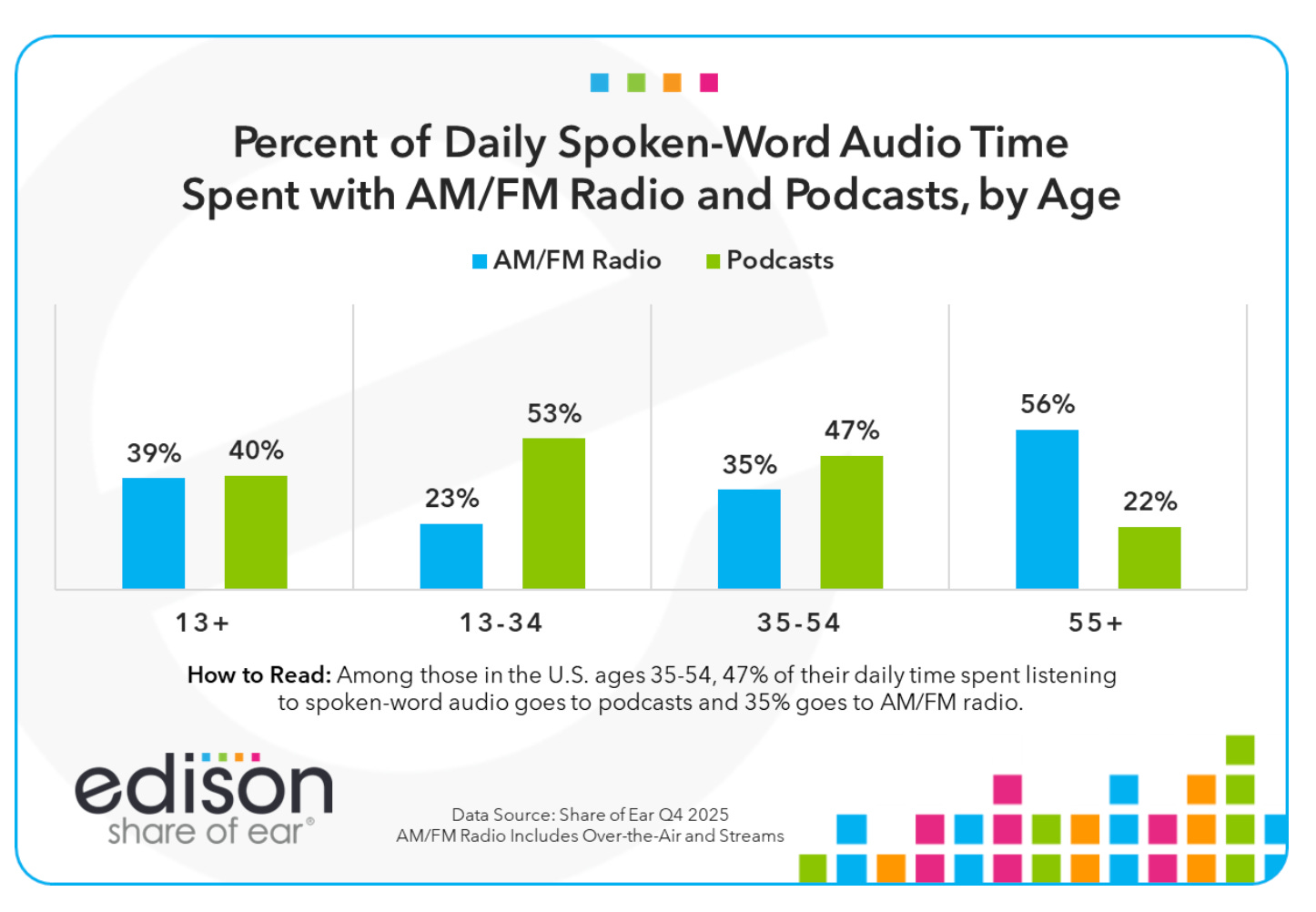
Among Americans 13+, 40% of spoken-word audio time goes to podcasts vs. 39% to AM/FM radio — podcasting’s narrowest-possible lead at the aggregate level
Americans ages 13–34 spend 53% of their spoken-word listening time with podcasts and just 23% with AM/FM radio
The 35–54 cohort still favors podcasts at 47% vs. radio at 35% — radio closes the gap but never catches up
Americans 55+ flip the script entirely: 55% of their spoken-word time goes to AM/FM radio, with podcasts capturing less than 22%
Edison attributes younger listeners’ podcast dominance to on-demand consumption habits and the preference for content with visual elements — qualities radio structurally cannot replicate
Why It Matters
The aggregate number — podcasting barely edging radio at 40% vs. 39% — sounds like a photo finish. But that framing obscures what’s actually a demographic cliff. Podcasting doesn’t just lead among young listeners — it laps radio by more than two-to-one in the 13–34 cohort. Radio’s overall competitiveness in the aggregate exists almost entirely because of its dominance with the 55+ audience. Let that sink in. The platform holding radio’s market share together is aging out of the workforce — and out of the primary advertiser demographic. For podcast publishers and ad buyers alike, this isn’t a trend to monitor. It’s a structural transition already underway.
The Big Picture
For podcasters: The 13–34 data is your strongest sales argument and your biggest strategic warning in the same chart. You’re winning the audience that advertisers most want—but you’re also competing in a space where on-demand and visual expectations are table stakes. Shows that aren’t thinking about video and searchable, snackable formats are winning a demographic that will eventually demand both.
For podcast producers: Age segmentation should be informing production decisions, not just marketing decks. A show built for a 55+ audience faces a genuinely different competitive environment than one targeting 25–34-year-olds. The former is still competing with AM/FM radio habits, established routines, and linear audio loyalties. The latter is competing with YouTube, short-form video, and a dozen other on-demand audio options. Implementing a production and distribution strategy that is universally applicable can be detrimental to the industry.
For the industry: The radio industry will point to the 55+ numbers as proof of its staying power. They’re correct in some ways, but they’re missing the generational trajectory. Every year, the 35–54 cohort ages into the 55+ bucket — and that group currently favours podcasts at 47%. The pipeline runs in one direction. Podcast publishers should resist complacency in the face of a narrow overall lead and instead treat the demographic breakdown as a mandate: the window to lock in habitual listeners before they’re contested is right now.
IAB AUSTRALIA
IAB Australia Launches Advertising Measurement Overhaul as Cross-Channel Complexity Reaches Tipping Point

Podwires Rundown: Australia’s Measurement Reckoning Is Coming. Podcasting Should Be Paying Attention.
The measurement conversation isn’t just a US problem. IAB Australia has officially launched a major industry-wide initiative—the Future of Measurement project—and the scope of it signals that the entire Australian advertising ecosystem is acknowledging what the more honest people in the room have known for years: the way the industry currently measures advertising delivery, audience exposure, and business outcomes is no longer fit for purpose. For podcast publishers and buyers operating in the Australian market, this announcement isn’t a background development. It’s a direct challenge to every CPM conversation you’re having right now.
Source Note: This piece is based on an IAB Australia press release dated March 19, 2026, distributed via PR firm Einsteinz Communications. IAB Australia is a peak industry body with legitimate research credibility, though its initiatives are shaped by member interests—which include media owners, platforms, agencies, and measurement vendors with varying stakes in how measurement evolves. Treat the framing as constructive industry consensus-building, not independent research.
The Key Points:
IAB Australia has commenced work on the Future of Measurement initiative, examining audience measurement systems, advertising exposure signals, and outcome attribution frameworks across the Australian market
The project will deliver three outputs: a current state assessment of the measurement landscape, best practice guidance on incrementality testing, attribution, and marketing mix modeling, and a forward view of how measurement will evolve in Australia
The initiative draws on IAB US’s Project Eidos, which is developing next-generation advertising measurement principles globally — signaling deliberate alignment with international frameworks
AI’s influence on measurement model design is specifically called out as a focus area, with IAB Australia noting that transparency and methodology will remain non-negotiable even as AI-based approaches enter the mix
First findings will be presented at IAB Australia’s MeasureUp conference in Sydney on September 2, 2026—giving the industry roughly six months before public accountability kicks in
Why It Matters
The honest version of this announcement is that Australian advertising measurement is fragmented, inconsistently applied, and under pressure from every direction simultaneously — more platforms, more devices, and less signal fidelity as tracking technologies erode. IAB Australia’s research director Natalie Stanbury put it plainly: the challenge is how incrementality testing, attribution, and marketing mix modelling work together, and whether the industry can maintain comparable measurement across channels. For podcasting specifically, this is the core tension. Audio has always struggled in cross-channel measurement frameworks — the medium is portable, often consumed without persistent identifiers, and routinely undervalued in attribution models that favour last-click and visual-first metrics. If this initiative establishes new baseline standards without explicit audio and podcast representation in the consultation, the frameworks that emerge will reflect the biases of whoever showed up to the table.
The Big Picture
For podcasters: The consultation process is open. Stanbury has invited industry stakeholders to participate directly. If Australian podcast publishers don’t engage, measurement standards affecting your inventory value will be dictated by those focused on video, display, or programmatic rather than audio. Show up or accept the outcome.
For podcast producers: Attribution and marketing mix modelling have historically been the proof points that unlock bigger brand budgets. If the Future of Measurement project creates ways to better include audio in marketing mix modelling and incrementality testing, it will directly help producers earn more money from clients who have had a hard time showing the return on investment of podcasts to their chief marketing officers. Watch the MeasureUp outputs closely.
For the industry: The global alignment with IAB US’s Project Eidos is the detail that matters most at scale. Measurement frameworks don’t stay regional. If Australia builds infrastructure aligned with the US’s next-generation principles, the standards that emerge have the potential to influence how podcast advertising is planned, bought, and evaluated across the Asia-Pacific market. The September MeasureUp conference is the first real checkpoint — and the industry should treat it as one.
SOUNDS PROFITABLE
Podwires Launches Industry Marketplace for Podcast Professionals
Podwires, the podcast industry’s strategic intelligence newsletter for executives, founders, producers, and advertisers, today announced the launch of the Podwires Marketplace — a dedicated industry platform hosted at podwires.com designed to connect podcast professionals with the services, tools, and talent they need to grow.
The Marketplace represents the next evolution of Podwires’ mission: moving beyond analysis and intelligence into active infrastructure for the podcast industry’s commercial ecosystem.
“The podcast industry has world-class research, world-class creators, and world-class technology—but no dedicated trade environment where serious buyers and sellers actually find each other,” said Miko, founder of Podwires. “The Podwires Marketplace is built to close that gap. We’re not building a directory. We’re building the deal floor the industry has been missing.”
STRATEGIC OVERVIEW
The Podwires Marketplace is purpose-built for the business layer of podcasting — the executives, agencies, producers, and platforms driving commercial decisions across the industry. The platform provides a curated environment where podcast service providers, production companies, technology vendors, and advertising partners can reach a qualified, senior audience actively looking to transact.
Unlike general media marketplaces or broad creator economy platforms, the Podwires Marketplace operates within an editorial context— backed by the same data-driven analysis and industry intelligence that Podwires readers rely on to make strategic decisions.
Key Highlights:
Purpose-built for podcast industry professionals — not general content creators or broad media buyers
Hosted within the Podwires editorial ecosystem, connecting listings directly to an engaged, senior readership
Designed to serve both buyers and sellers across production services, advertising technology, audience development, monetization tools, and talent
Accessible at podwires.com with newsletter distribution reaching podcast executives, founders, and decision-makers across global markets
Structured to support independent operators and enterprise-level vendors equally
The podcast industry is projected to surpass $4 billion in global advertising revenue in 2026, yet it remains remarkably fragmented at the transactional layer. Service discovery happens via word-of-mouth. Vendor selection relies on conference hallway conversations. Procurement decisions that should take days often take quarters instead.
The Podwires Marketplace is a direct response to that inefficiency—built on the recognition that the industry’s commercial infrastructure has not kept pace with its audience and revenue growth.
“We cover what’s happening in podcasting. “The Marketplace is where something actually happens,” said Miko. “Every vendor listed here is reaching an audience that already understands the industry, already trusts the Podwires editorial lens, and is already making decisions. That’s a different kind of attention than a banner ad.”
AVAILABILITY
The Podwires Marketplace is now live at podwires.com. Podcast industry vendors, service providers, and technology companies interested in listing on the Marketplace can submit enquiries directly through the platform.
Newsletter distribution of Marketplace listings reaches Podwires’ subscriber base of podcast industry executives, founders, producers, and advertising professionals across Australia, South-east Asia, the Philippines, and North America.
JOIN PODWIRES MARKETPLACE
If you’re building a podcast team, join Podwires Marketplace to access monthly curated lists of experienced podcast professionals—producers, audio engineers, scriptwriters, and hosts—actively seeking new opportunities in news, storytelling, and audio journalism.

If you’re a podcast professional seeking your next opportunity, join the PodWires talent directory to connect with podcast companies and media organizations.

🚨 Stay on top of your deadlines with our weekly-updated calendar of fellowships, grants, training opportunities and podcasting events. If your organisation has a fellowship, grant or event to share, just 👉 fill out this form or want to contribute an article 👉 0or reply to this message.
THAT’S WRAP
SPONSOR US
Reach over 1000 podcast producers with your product.
Thousands of podcast producers, audio/video editors, podcasters, executives, and business owners worldwide read our newsletter. Contact us now.

📖 I appreciate you taking the time to read! See you in the next issue. Got a question or criticism? Just click on Reply. We can talk while we are here.
Please provide a press release along with a suitable landscape photo. Make sure it’s newsworthy. Send press releases to editor@podwires.com or click here. Editorially, we may rewrite headlines and descriptions.
📬 Sponsor us and get your brand in front of thousands of independent podcast producers and podcasters. Email us at sales@podwires.com for more information or as personal supporters via Patreon, as your contributions help us enhance the experiences of all our users.
🖊️We are delighted to hear from our subscribers! If our newsletter helped you or you have a success story, we would love to publish your testimonial. 👉 Post a Testimonial: Click here
🚀 We are here to help you succeed! Fill out a 5-minute survey and tell us more about your business and yourself. These questions will help us better understand you and promote your business as part of our mission. It’s a win-win!
🚨 Did someone forwardthe informations to you?
Become one of the more than 1000 valued email subscribers. Find Out More 👈
We’d love to share what our Podwires readers have been saying!

We’re so grateful to our previous Podwires advertisers!

Podwires is here because of our incredible partners’ unwavering support. The Podwires readers receive journalism free of financial and political influence. If you found this valuable, consider Restacking so more people can see it. Get together with them today.