

🎙Podcasting Surpassed Radio in Spoken Word Before This Week's Data Showed It, Researcher Says

Did someone forward this to you?
Become one of the more than 1000 valued email subscribers. Find Out More 👈


If you love travel, check out our sister publication “Mencari’s Travel Wire”
👋 Hi, Podsky!
We’re asking our readers: continue supporting independent podcast creators. Subscribe, share their work, and help ensure vital community spaces like this one can thrive.
Your subscription to Podwires will help to fund our operations as an independent media organisation. Becoming a paid subscriber
First time reading? We would be delighted if you would join us – after all, we have over 1,000 intellectually curious readers already! Sign up here.
We want everyone to know about this, so please spread the word by sharing the email with your friends! (copy URL here)
And, as always, send us feedback at editor@podwires.com
Today’s reading time is 5 minutes. - Miko Santos (March 8, 2026 )
🎙️Today, we’ve got the inside scoop on:
Podtrac: Most Podcast Publishers Fail to Grow Audience in February as Rankings Show Broad Stagnation
90% of Gen Z Watches Video Podcasts as Format Shifts From Trend to Industry Standard, Data Shows
Podcast Creators Urged to Prioritize IP Ownership and Community Building Over Content Output, Summit Speakers Say
Podcast Insight: Podcasting Surpassed Radio in Spoken Word Before This Week's Data Showed It, Researcher Says
PodBusiness : Podcasting's Maturing Industry Puts Ownership, Community, and Platform Strategy at Center Stage
Job Board : Lemonada Media - Senior Producer, Video

PODTRAC | PODSCRIBE
Podcast Ad Spend Surges Even as Audience Growth Stalls, February Podscribe and Podtrac Data Show
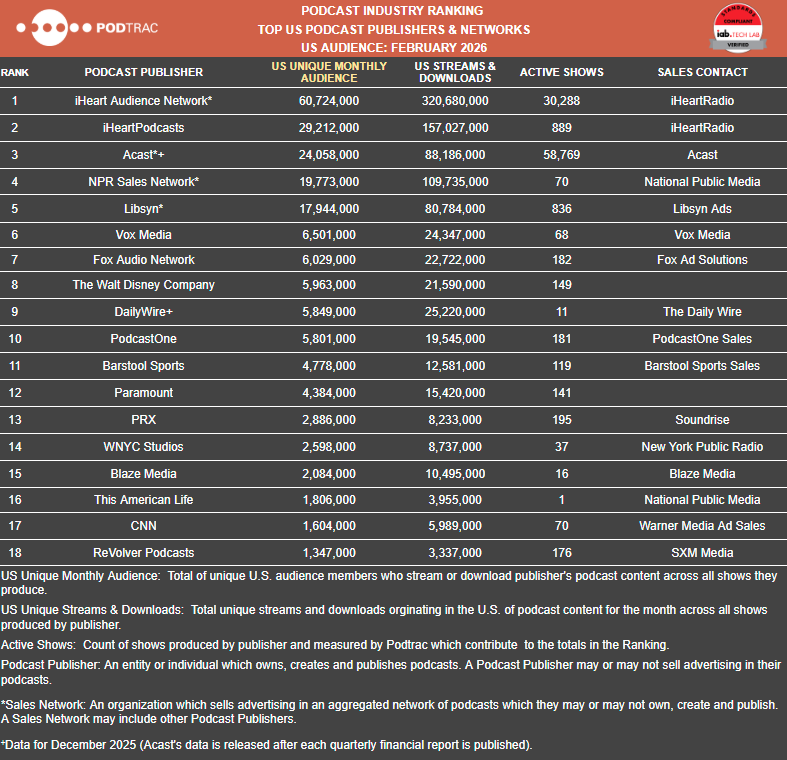
Podwires Rundown : February’s dual rankings reports paint a split picture of the podcast industry’s health: advertising spend is accelerating in meaningful ways, but audience growth remains concentrated among a small number of publishers while the majority hold flat or decline.
Sources This piece synthesizes two independent February 2026 data releases: the Podscribe Industry Ranker (covering February 1–28, 2026), which tracks top podcasts, publishers, and advertisers by audio reach, downloads, and estimated ad spend; and the Podtrac Top Publishers, Networks, and Podcasts rankings (released March 5, 2026), which measures Unique Monthly Audience (UMA) and downloads across US and Global participants. Together, they offer the most complete available snapshot of the industry’s February performance.
The Key Points
Nearly every Top 10 publisher saw a decline in reach in February according to Podscribe — the only exceptions were Spotify at #1 with approximately 52.8 million in audio reach and 206.7 million monthly downloads, and Red Seat Ventures at #8
Podtrac independently corroborates the stagnation: only two US ranking participants grew UMA month-over-month, and only two grew US downloads — suggesting the reach concentration story is real and consistent across measurement platforms
Money Rehab with Nicole Lapin was February’s standout performer, surging approximately 70% in audio reach to claim the #8 spot — the sharpest single-show growth in the Top 10
McDonald’s increased podcast ad spend 121% month-over-month, ramping to approximately $3.5 million and claiming the #6 advertiser spot — while Shopify climbed to #3 with $5.2 million in estimated spend, surpassing both Amazon and Mint Mobile
BetterHelp holds the #1 advertiser position, while Crime Junkie, The Daily, and The Mel Robbins Podcast continue to dominate the top three podcast spots by audio reach — underscoring how durable the upper tier of the rankings has become
Why It Matters
The February data presents two simultaneous realities that the industry needs to hold at the same time. Audience growth is narrowing — the gap between Spotify and the rest of the publisher field is widening, and most publishers aren’t growing their reach month-over-month. But advertiser confidence, as measured by estimated spend, is moving in the opposite direction. McDonald’s more than doubling its podcast investment in a single month is not a tentative test — it’s a signal that major consumer brands are finding measurable return in the channel even as the audience distribution picture tightens.
The Big Picture
For podcasters: The Money Rehab surge — 70% growth in a single month — is the exception that proves the rule. Breakout audience growth at the show level is still possible, but it is increasingly rare in the Top 10. For shows outside the established upper tier, the February data reinforces that discoverability and cross-platform distribution investment is non-negotiable. Flat is the new down in a concentration-driven market.
For podcast producers: The advertiser spend trajectory is the strongest near-term revenue signal in this data. McDonald’s entry at $3.5 million and Shopify’s climb past Amazon indicate that podcast advertising is pulling in category-leading brands with serious budgets. Producers helping clients position for advertiser conversations should be leading with the spend momentum story, even when the audience growth narrative is more complicated.
For the industry: The convergence of Podscribe and Podtrac data telling the same audience concentration story — independent methodologies, same conclusion — makes the finding harder to dismiss as a measurement artifact. Spotify is growing while most publishers aren’t. That’s a structural dynamic, not a monthly blip. The advertising market may be healthy, but the audience distribution challenge underneath it deserves the same attention.

TOGETHER WITH MENCARI NEWS (AU)
The News Powerful People Don’t Want You to Read
Between meetings, emails, and deadlines, who has time to stay properly informed? The Mencari News Australia solves this. Five minutes each morning gives you everything you need about Australian politics, technology, and finance.
No endless scrolling. No clickbait. Just the essential insights that impact your work and life. Smart professionals choose efficiency. Join hundreds of subscribers.
This section is a paid advertisement. If you are interested in advertising, let’s talk.
SOUNDS PROFITABLE | EDISON RESEARCH
Podcasting Surpassed Radio in Spoken Word Before This Week's Data Showed It, Researcher Says
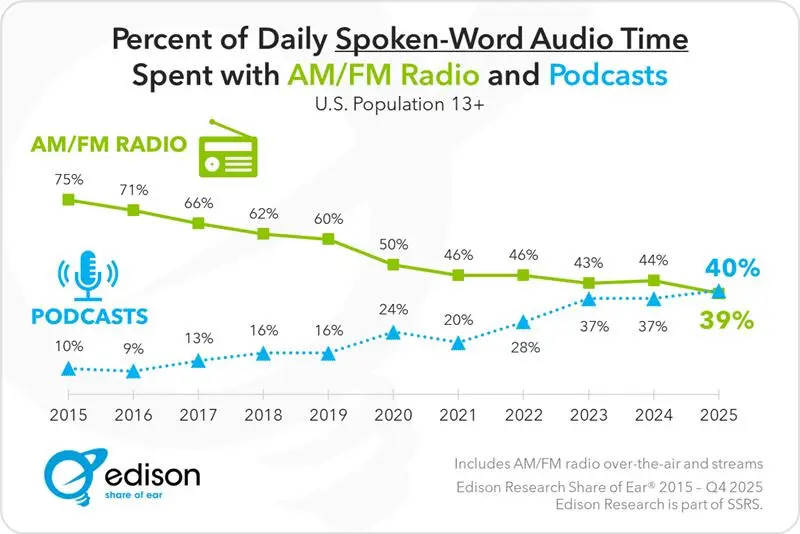
Podwires Rundown : The chart making rounds this week looks like a milestone. Edison Research’s Share of Ear data shows podcasting and AM/FM radio now essentially tied at roughly 40% each of all spoken-word listening time in America — down from radio’s 75% dominance a decade ago. The headline writes itself. Podcasting caught radio. Except it didn’t just catch radio. It passed radio a while ago. The measurement simply wasn’t built to see how.
Source This analysis draws from “The Real Shift In Spoken Word,” published March 4, 2026 by Tom Webster, Partner at Sounds Profitable and a 25-year veteran audio researcher who was part of the team that built Edison Research’s Share of Ear study — which makes his critique of its limitations here particularly pointed.
The Key Points
Edison Research’s Share of Ear now shows podcasting and AM/FM radio tied at approximately 40% each of all spoken-word audio time in America — down from radio’s ~75% share in 2015
The data structurally excludes video podcast consumption — meaning every hour someone watches Joe Rogan, Call Her Daddy, or SmartLess on YouTube is invisible to the measurement
Webster’s own Sounds Profitable research found that video podcast consumers spend roughly half their total podcast time watching rather than listening — a massive blind spot in audio-only measurement
The radio-to-podcast migration narrative is likely wrong: talk radio’s shrinking audience skews older and male, while podcast growth is drawing in new, younger, more diverse audiences who never had an AM dial habit
The competitive frame needs updating entirely — podcasting’s real rivals are YouTube, TikTok, Netflix, and social feeds, not the AM dial
Why It Matters
The “podcasting catches radio” story sounds like a win, but it quietly sets a false ceiling. If the industry accepts parity with a shrinking, aging, AM-defined category as the finish line, it misses what’s actually happening: spoken word is growing, going visual, and pulling in audiences who have never touched a podcast app. The measurement tool is working exactly as designed — the problem is that podcasting has outgrown the ruler.
The Big Picture
For podcasters: Your audience is likely bigger than any single measurement currently reflects. If you’re still benchmarking success purely against audio download numbers, you may be systematically undervaluing your own reach — particularly if your show has meaningful YouTube or video presence. Build your case to advertisers accordingly.
For podcast producers: Production workflows that treat audio and video as separate products are leaving audience data on the table. Webster’s research indicates video podcast consumers discovered the medium primarily through YouTube, TikTok, and Instagram. That’s not a distribution footnote — it’s a production and strategy mandate.
For the industry: The measurement infrastructure needs to catch up to where audiences already are. Share of Ear remains a valuable and rigorous instrument for audio — but spoken-word content now lives across earbuds and screens simultaneously. Until the industry develops a framework that captures both, every competitive analysis built on audio-only data is working with an incomplete picture. The real shift in spoken word already happened. We’re just now starting to measure it properly.
PRESENTED BY PODWIRES MARKETPLACE
Hire Top Independent Podcast Producers for Your Business
Podcasting is a powerful way to grow business, and Marketplace Podwires is here to assist you in the easy hiring of top-rated independent podcast producers. Be it branded podcasts that share your products with the entire world or internal series aimed at engaging and energizing your teams, our expert producers can craft stories that meet any brief and bring more personality to your brand’s voice. Begin with Marketplace Podwires, and find a dream producer for your project today!
PODBEAN
90% of Gen Z Watches Video Podcasts as Format Shifts From Trend to Industry Standard, Data Shows
Podwires Rundown : Calling video podcasting a “trend” in 2026 is like calling the internet a “trend” in 2005. The format has crossed every meaningful threshold — audience size, platform infrastructure, advertiser interest, and consumption habit — to claim its place as a core pillar of the medium. The numbers aren’t pointing toward mainstream. They’re already there.
Source This piece draws from “The Rise of Video Podcasting: Statistics and Trends 2026,” published March 6, 2026 on the Podbean Blog, authored by Cherie Choi. Editorial note: Podbean is a podcast hosting platform with a commercial interest in video podcast adoption. However, the statistics cited throughout draw from third-party sources including Edison Research, Deloitte, Triton Digital, and YouTube — and align with data reported independently elsewhere in the industry.
The Key Points:
YouTube reported 1 billion monthly podcast viewers by early 2025, and roughly 70% of all podcast consumers now use YouTube to watch or listen to podcasts — making it the single most-used podcast platform on earth
90% of Gen Z podcast consumers engage with video podcast content at some level; only 10% say they never watch — a near-complete generational shift in format expectation
80% of podcast consumers both watch and listen, switching formats based on context, while only 7% are exclusively video viewers — meaning audio isn’t dead, it’s contextual
44% of video podcast viewers never multitask while watching, compared to 29% of audio-only listeners — a significant engagement differential that advertisers are beginning to price in
Global podcast advertising revenue — audio and video combined — is forecast to hit $5 billion in 2026, up nearly 20% year-over-year, with video driving new ad format possibilities including on-screen placements and product demonstrations
Why It Matters :
Every major podcast platform — YouTube, Spotify, and now Apple Podcasts — treats video as a core feature. That’s not a coincidence; it’s infrastructure following audience behavior. For anyone still treating video as an optional add-on to their audio strategy, the 2026 data suggests that position is becoming harder to defend, both creatively and commercially.
The Big Picture:
For podcasters: The discoverability gap between audio and video platforms is real and widening. YouTube’s recommendation algorithm surfaces content to people who have never heard of you. Apple Podcasts has no equivalent. If audience growth is a priority, video isn’t just about engagement — it’s about reach. A single recording session can produce a full episode, YouTube content, and a week’s worth of short-form social clips. The production investment case is stronger than it’s ever been.
For podcast producers: The 1.5x content consumption figure — video podcast viewers consume roughly 50% more content than audio-only listeners — should be central to every client conversation about format strategy. Producers who can build efficient dual-format workflows, and who understand how to optimize content for both deep viewing and short-form clip distribution, are delivering measurably more value. That’s a competitive advantage worth pricing accordingly.
For the industry: The format question is settled. The infrastructure question is largely settled. What remains unresolved is measurement — as Tom Webster noted just days ago, audio-only metrics still can’t fully capture video podcast consumption. An industry projecting toward $5 billion in ad revenue needs measurement frameworks that reflect where audiences actually are. The money will follow the data. Right now, some of that data is still off the books.
PODGLOMERATE
Podcast Creators Urged to Prioritize IP Ownership and Community Building Over Content Output, Summit Speakers Say
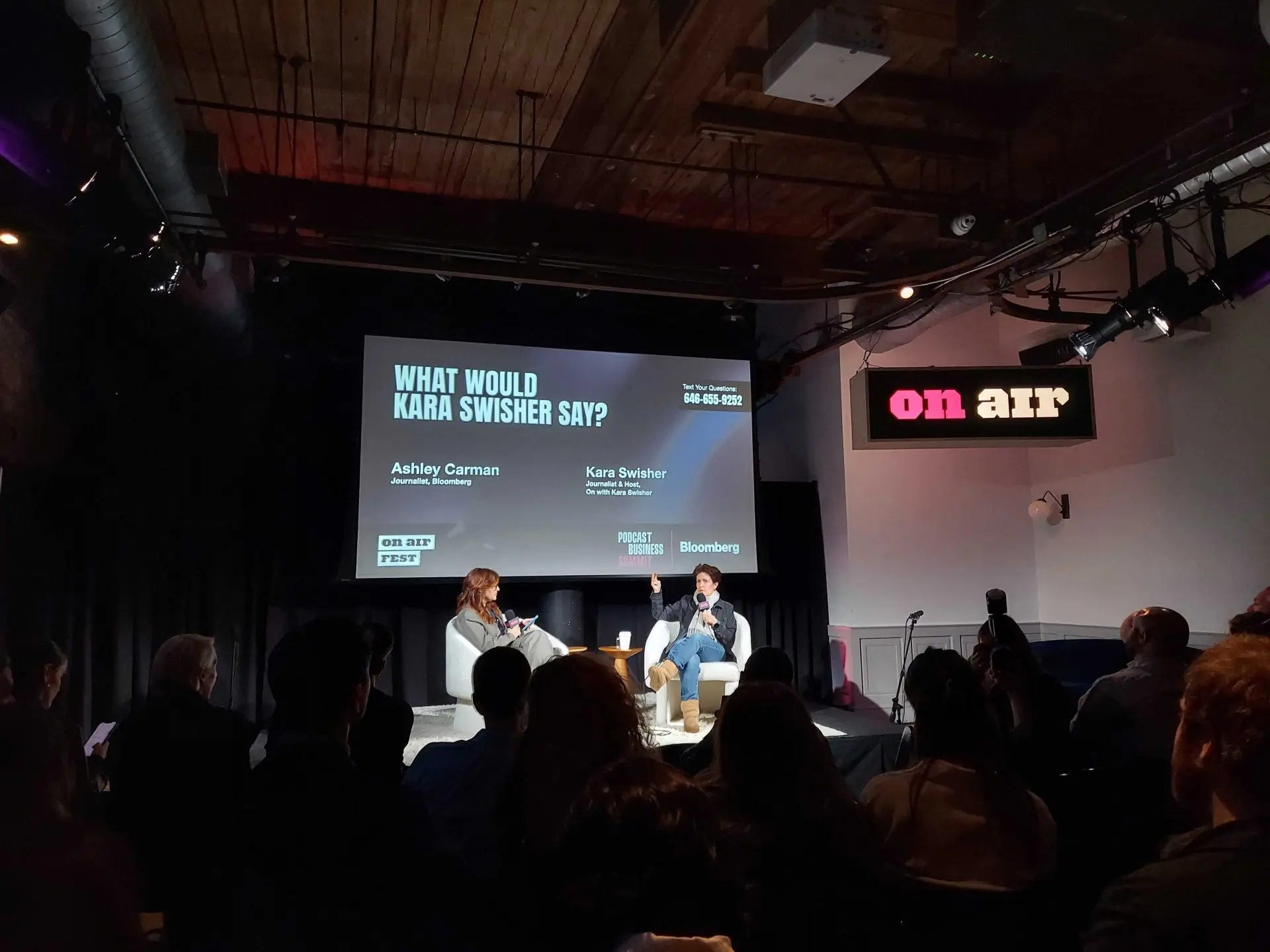
Podwires Rundown: The conversations that defined the On Air Fest Podcast Business Summit 2026 weren’t about whether podcasting is growing. That question has been answered. The conversations were about what separates the creators and companies building durable businesses from those chasing short-term wins — and the answers coming from the stage at Brooklyn’s Wythe Hotel on February 24 were notably direct.
Source This piece draws from “On Air Fest Podcast Business Summit 2026: Trends and Key Takeaways,” published by The Podglomerate, authored by Joni Deutsch, SVP of Marketing & Audience Development.
Editorial note: The Podglomerate is a podcast production and marketing agency that attended the event in a professional capacity. The takeaways reflect their editorial synthesis of the day’s proceedings. The Summit was co-hosted by On Air Presents and Bloomberg, with support from Spotify, ART19, and Supporting Cast, and featured speakers including Kara Swisher, Pablo Torre, Adam Friedland, and investors from Slow Ventures and The Chernin Group.
The Key Points
Kara Swisher’s live podcast tour sold out every venue and grossed $2.5 million in a single week — a concrete data point for the argument that community, not just content, is podcasting’s most undervalued asset
Venture capital is shifting its criteria: both Slow Ventures and The Chernin Group — investors in Audiochuck and Goalhanger respectively — said follower counts matter less than community traction, with one investor stating creators must “think of themselves as a founder just as much as a creator”
Futuro Media reported 200% audience growth through video, while the session consensus pushed back on high-production assumptions — smartphone recordings from remote guests outperformed shipped webcams in audience response testing
Goalhanger owns the IP on all of its shows; Talkhouse turns down 98% of shows it considers — two very different models arriving at the same conclusion: selectivity and ownership build long-term commercial value
Pablo Torre made the case that “audio doesn’t go viral” and that leaning into video to show the journalism process — not just the output — is what’s driving audience growth for his independently operated newsroom podcast
Why It Matters
The Summit’s through-line was maturity. Podcasting has moved past the phase where having a microphone and a good idea is enough. The creators and companies winning in 2026 are treating podcasts as business infrastructure — owning their IP, investing in editorial depth, optimizing platform strategy with data, and building communities with identities beyond the show itself. That’s a higher bar than it was five years ago, and the investment community is now explicitly screening for it.
The Big Picture
For podcasters: Kara Swisher’s framework — be useful, be interesting, make something people can’t get anywhere else — sounds simple until you apply it rigorously. The “irreplaceability” standard she outlined is the same filter venture investors are using. If your show’s value proposition can be replicated by another host, another format, or eventually an AI-generated summary, the business case weakens. Ownership of IP is the floor, not the ceiling.
For podcast producers: The video strategy session’s most actionable finding cuts against conventional production wisdom. Audiences responded better to smartphone-recorded remote guests than to webcam setups, and NPR had to actively unlearn its instinct toward high-end production. The implication for producers is clear — intimacy and presence outperform polish. Diary of a CEO’s approach of generating 200 to 300 thumbnail variations per episode using AI optimization tools signals that packaging strategy is now as resource-intensive as production itself.
For the industry: The investor framing from both Slow Ventures and The Chernin Group points to where the next phase of podcast consolidation is headed. Capital is moving toward “media plus plus” models — shows where the podcast fuels a broader business ecosystem rather than standing alone as a content product. That’s a structural shift in how podcast companies will need to position themselves to attract serious investment, and it raises real questions about where independent creators fit in a landscape increasingly shaped by founder-first, community-driven, IP-owning operators.
CUMULUS MEDIA
Podcast, Radio Listeners Outspend Social Media Users on Auto Parts as Industry Shifts Ad Budgets Toward Digital
Podwires Rundown: Social media has captured the lion’s share of auto aftermarket advertising budgets. That may be exactly the wrong place for those dollars to land. New research commissioned by Cumulus Media’s Westwood One Audio Active Group finds that the heaviest auto parts spenders in America aren’t heavy social media users — they’re heavy audio listeners.
Source This piece draws from “Auto Aftermarket Retailers: New Study Reveals AM/FM Radio And Podcasts Are Ideal To Reach Auto Parts Shoppers,” published March 2, 2026 by Pierre Bouvard, Chief Insights Officer at the Cumulus Media | Westwood One Audio Active Group. The findings are drawn from the seventh annual auto aftermarket category study, conducted by Quantilope, surveying 1,000 auto parts shoppers in September 2025. Editorial note: Cumulus Media and Westwood One are audio advertising companies with a commercial interest in audio ad spend reallocation. The third-party data cited — including Edison Research Share of Ear, MediaRadar, and Nielsen — lends the core findings independent credibility.
The Key Points
Heavy podcast listeners spend 22% more annually on auto parts than the average shopper — and heavy AM/FM radio listeners spend 26% more — while heavy social media users spend only $714 annually compared to $790 for radio listeners and $765 for podcast listeners
Social media now commands the largest share of auto aftermarket ad spend — surpassing both TV and AM/FM radio — despite audio listeners being the category’s biggest spenders by a measurable margin
51% of ultra-heavy auto parts shoppers listen to NFL play-by-play AM/FM radio broadcasts; 48% tune into NCAA College Football — making sports radio disproportionately valuable for reaching the category’s most active buyers
Nielsen determined AM/FM radio generates $21 in return for every dollar invested in radio ads for auto aftermarket brands — a ROI figure that should be difficult to ignore during media planning conversations
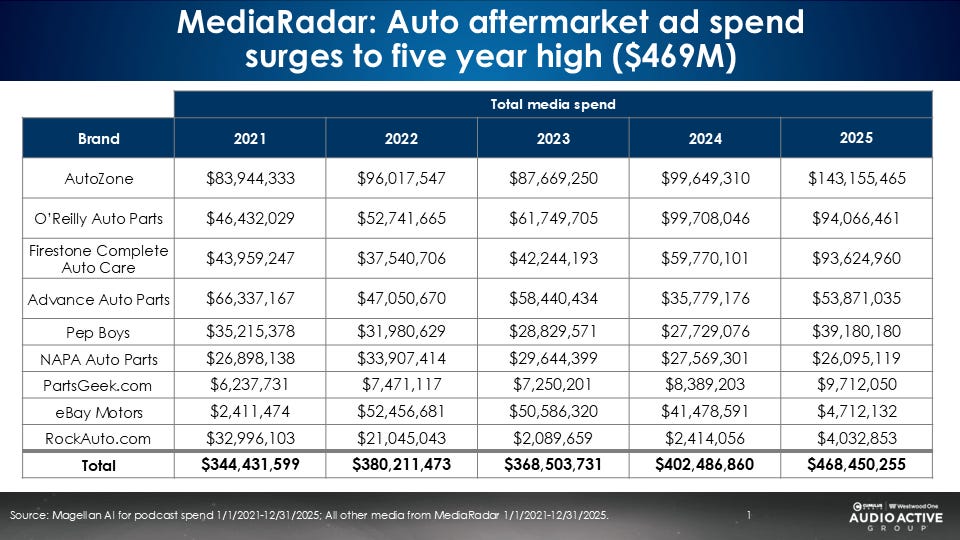
2025 auto aftermarket advertising spend hit a record high of $469 million according to MediaRadar, with AutoZone reclaiming the share-of-voice lead and social platforms absorbing budget previously allocated to audio
Why It Matters
Here’s the uncomfortable part: the auto aftermarket industry has been chasing audiences on social media while its best customers — mega-milers, do-it-yourselfers, and ultra-heavy shoppers — are disproportionately consuming audio. This isn’t a niche finding. It’s a category-wide misalignment between where ad dollars are going and where high-value buyers actually are. For podcast advertising specifically, the 22% spending premium among heavy podcast listeners is a data point worth putting in front of every auto-adjacent advertiser still treating the channel as experimental.
The Big Picture
For podcasters: The auto aftermarket category represents a significant and currently underdeveloped advertising opportunity for podcast publishers with audiences that skew toward drivers, sports fans, and DIY consumers. The data makes a direct case: podcast listeners spend more in this category than social media users. Publishers with relevant audience profiles should be proactively building category-specific pitch materials around this research rather than waiting for auto advertisers to find them.
For podcast producers: Client conversations about advertiser mix should now include auto aftermarket as a priority vertical — particularly for shows with sports, automotive, or home improvement audiences. The Westwood One data provides third-party justification for category targeting conversations that producers can bring directly to the table. The Nielsen $21 ROI figure is particularly useful in overcoming objections from advertisers conditioned to evaluate audio through lower-funnel metrics.
For the industry: The broader measurement problem this study surfaces is one the podcast industry has been grappling with for years. Advertisers are concentrating spend on platforms where measurement is easiest — not necessarily where their best customers are. The eMarketer finding cited earlier this month — that advertisers struggle to measure audio ROI — and this study’s data sit in direct tension with each other. The industry’s job is to close that gap with better attribution tools and category-specific spending evidence. This study is a useful piece of that argument.
Spotify Awards 500 Million Stream Milestone to Morbid as Q4 2025 Creator Honors Span Nine Countries

Podwires Rundown: Spotify’s quarterly Creator Milestone Awards have become one of the clearest windows into the platform’s podcast streaming scale — and the Q4 2025 class, announced March 5, offers a revealing look at which shows are breaking through, and where.
Source This piece draws from Spotify’s official Creator Milestone Awards announcement, published March 5, 2026 on the Spotify Newsroom. The awards recognize podcasts reaching specific cumulative streaming thresholds on Spotify and are distributed quarterly. Recipients receive physical plaques, on-platform editorial features, social media spotlights, and out-of-home campaign recognition in Los Angeles.
The Key Points
Morbid claimed the Gold tier by surpassing 500 million streams on Spotify — one of the most significant streaming milestones in true crime podcasting and a marker of just how dominant the genre remains on the platform
Three shows reached the Silver tier at 250 million streams: The Bill Simmons Podcast, Rotten Mango, and This Past Weekend with Theo Von — spanning sports, true crime, and comedy, the three genres consistently driving platform engagement
The Bronze tier’s 11 honorees span nine countries including Germany, Japan, Poland, the Philippines, the Netherlands, and Australia — a geographic spread that underscores Spotify’s increasingly global podcast footprint
Good Hang with Amy Poehler, from Spotify’s The Ringer, won the inaugural podcast award at the Golden Globes — the first time podcasting has received recognition at the ceremony, which Spotify cited as context for the awards announcement
The emerging markets Bronze threshold sits at 50 million streams rather than 100 million — a two-tier structure that acknowledges the different growth dynamics across Spotify’s international markets while still formally recognizing non-US creators
Why It Matters
Spotify’s milestone framework is more than a celebration mechanism — it’s a public scoreboard for streaming performance at scale. When a true crime show like Morbid crosses 500 million streams, and when Bronze honorees are coming from Poland, Japan, and the Philippines in the same quarter, the data is telling a story about where podcast consumption is growing globally and which genres are sustaining audience loyalty at the highest levels. For advertisers and publishers benchmarking platform performance, these thresholds are directionally meaningful even without granular monthly figures.
The Big Picture
For podcasters: The geographic diversity of the Bronze tier is the most actionable signal in this announcement. Shows from nine countries reaching 100 million streams — or 50 million in emerging markets — in a single quarter confirms that non-English language podcast audiences on Spotify are no longer a secondary consideration. For English-language creators eyeing international growth, the platform infrastructure is clearly there. The question is whether content strategy reflects it.
For podcast producers: The genre concentration at the top — true crime, sports, comedy — continues to hold. Morbid at Gold, Rotten Mango and Bill Simmons at Silver, Theo Von at Silver. These aren’t surprises. What’s worth noting for producers advising clients on format and positioning is that the upper tier remains highly genre-specific, while the Bronze tier shows considerably more genre diversity. Breakout growth is still possible across a wider range of formats — but the ceiling appears to favor a narrow set of categories.
For the industry: The Golden Globes recognition Spotify cited as backdrop is worth pausing on. Podcasting receiving its first award at a mainstream entertainment ceremony — however nascent — is a cultural legitimacy marker that the industry has been working toward for two decades. Combined with Spotify’s continued investment in creator recognition infrastructure, the direction of travel is clear: podcasting is being treated as a peer medium to television and film, not a digital audio footnote. The awards ecosystem is catching up to the audience reality.
JOIN PODWIRES MARKETPLACE
If you’re building a podcast team, Join Podwires Marketplace to access monthly curated lists of experienced podcast professionals—producers, audio engineers, scriptwriters, and hosts—actively seeking new opportunities in news, storytelling, and audio journalism.
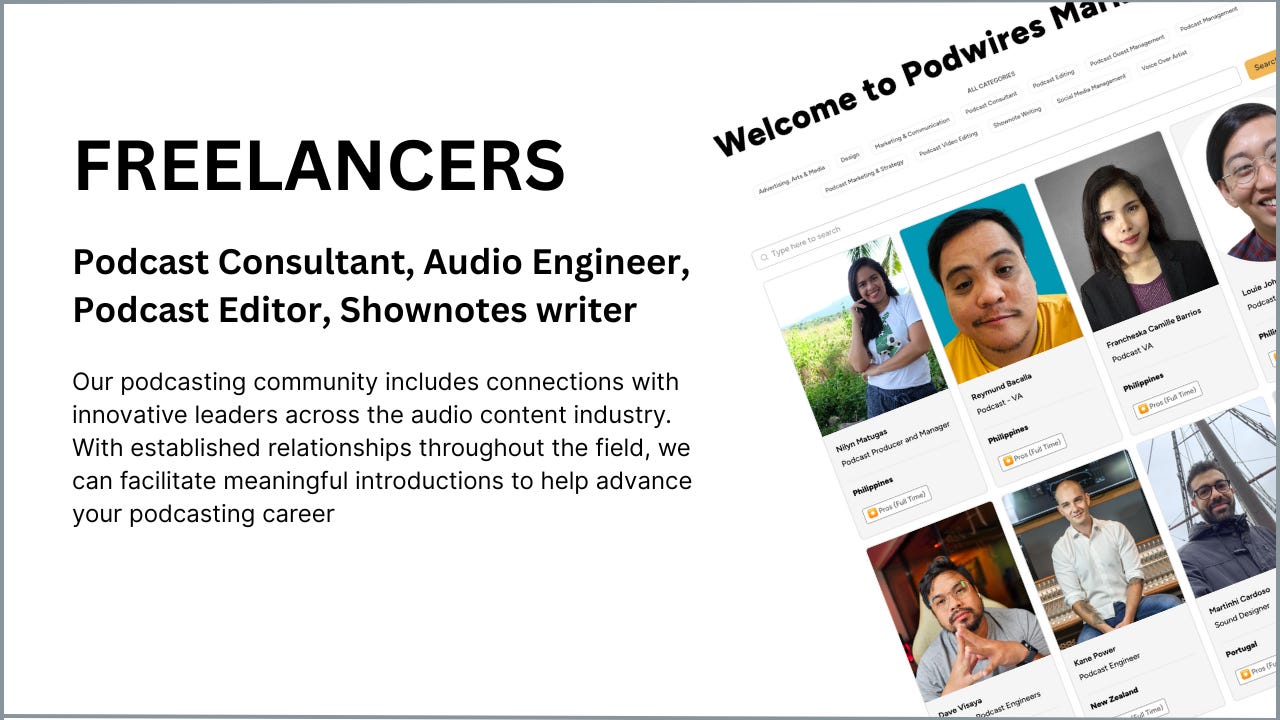
If you’re a podcast professional seeking your next opportunity, join the PodWires talent directory to connect with podcast companies and media organizations.
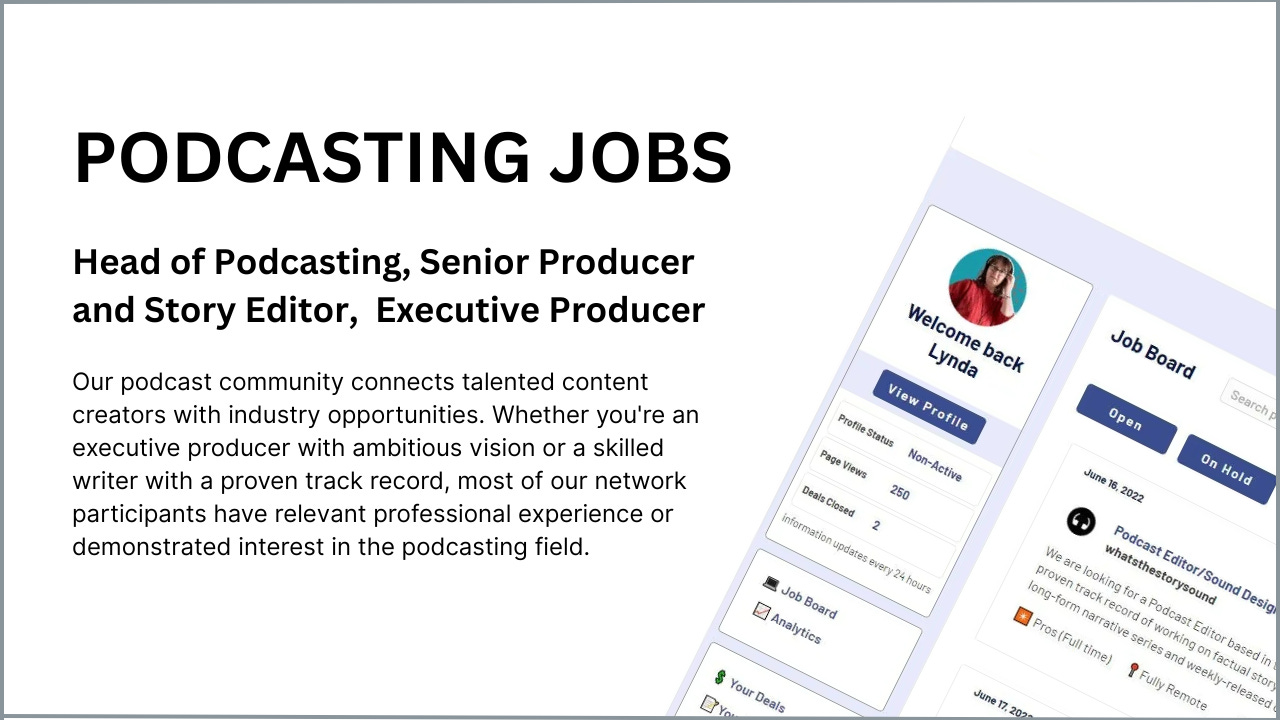
📣 Featured job opportunities 📣
WISE - Paid Audio Manager
ARN - On Air Digital Content Producer
Lemonada Media - Senior Producer, Video
🚨 Stay on top of your deadlines with our weekly-updated calendar of fellowships, grants, training opportunities and podcasting events. If your organisation has a fellowship, grant or event to share, just 👉 fill out this form or want to contribute an article 👉 click here or reply to this message.
THAT’S WRAP
SPONSOR US
Reach over 1000 podcast producers with your product.
Thousands of podcast producers, audio/video editors, podcasters, executives, and business owners worldwide read our newsletter. Contact us now.

📖 I appreciate you taking the time to read! See you in the next issue. Got a question or criticism? Just click on Reply. We can talk while we are here.
✍️ Give us a press release and a good-sized landscape photo. Make sure it’s newsworthy. Send press releases to editor@podwires.com or click here. Editorially, we may rewrite headlines and descriptions.
📬 Sponsor us and get your brand in front of thousands of Independent Podcast Producers and podcasters. Email us at sales@podwires.com for more information or as personal supporters via Patreon, as your contributions help us enhance the experiences of all our users.
🖊️We are delighted to hear from our subscribers! We would be happy to publish your testimonial if you have found our newsletter to be helpful or if you have a success story to share. 👉 Post a Testimonial: https://testimonial.to/podwires
🚀 We are here to help you succeed! Fill out a 5 minute survey and tell us more about your business and yourself. These questions will help us better understand you and promote your business as part of our mission. It’s a win-win!
🚨 Did someone forward this to you?
Become one of the more than 1000 valued email subscribers. Find Out More 👈
We’d love to share what our Podwires readers have been saying!

We’re so grateful to our previous Podwires advertisers!

Podwires is here because of our incredible partners’ unwavering support. The Podwires readers receive journalism free of financial and political influence. If you found this valuable, consider Restacking so more people can see it. Get together with them today.