

🎙Infinite Dial 2026: Monthly Podcast Consumption Hits All-Time High of 58%, But YouTube Now Dominates Platform Share

Did someone forward this to you?
Become one of the more than 1000 valued email subscribers. Find Out More 👈


If you love travel, check out our sister publication “Mencari’s Travel Wire”
👋 Hi, Podsky!
We’re asking our readers: continue supporting independent podcast creators. Subscribe, share their work, and help ensure vital community spaces like this one can thrive.
Your subscription to Podwires will help to fund our operations as an independent media organisation. Becoming a paid subscriber
First time reading? We would be delighted if you would join us – after all, we have over 1,000 intellectually curious readers already! Sign up here.
We want everyone to know about this, so please spread the word by sharing the email with your friends! (copy URL here)
And, as always, send us feedback at editor@podwires.com
Today’s reading time is 5 minutes. - Miko Santos (March 15 2026 )
🎙️Today, we’ve got the inside scoop on:
Reallocating 5% of TV Ad Spend to Podcasts Delivers 41% Reach Lift, Nielsen Data Shows
Apple Podcasts HLS Support Reframes Video Podcasting Debate — Industry Analysis Points to Infrastructure Ownership, Not Format, as the Real Story
Podcast Insight: Record 58% of Americans Consume Podcasts Monthly, But Infinite Dial 2026 Data Reveals YouTube as the Medium's Dominant Platform
PodBusiness : Acast Podcast Pulse: Singapore Emerges as Global Benchmark for Podcast Trust, With 97% of Listeners Reporting Host-Driven Opinion Change
Job Board : Lemonada Media - Senior Producer, Video

EDISON RESEARCH
Reallocating 5% of TV Ad Spend to Podcasts Delivers 41% Reach Lift, Nielsen Data Shows
Podwires Rundown : Five percent. That’s all it took.
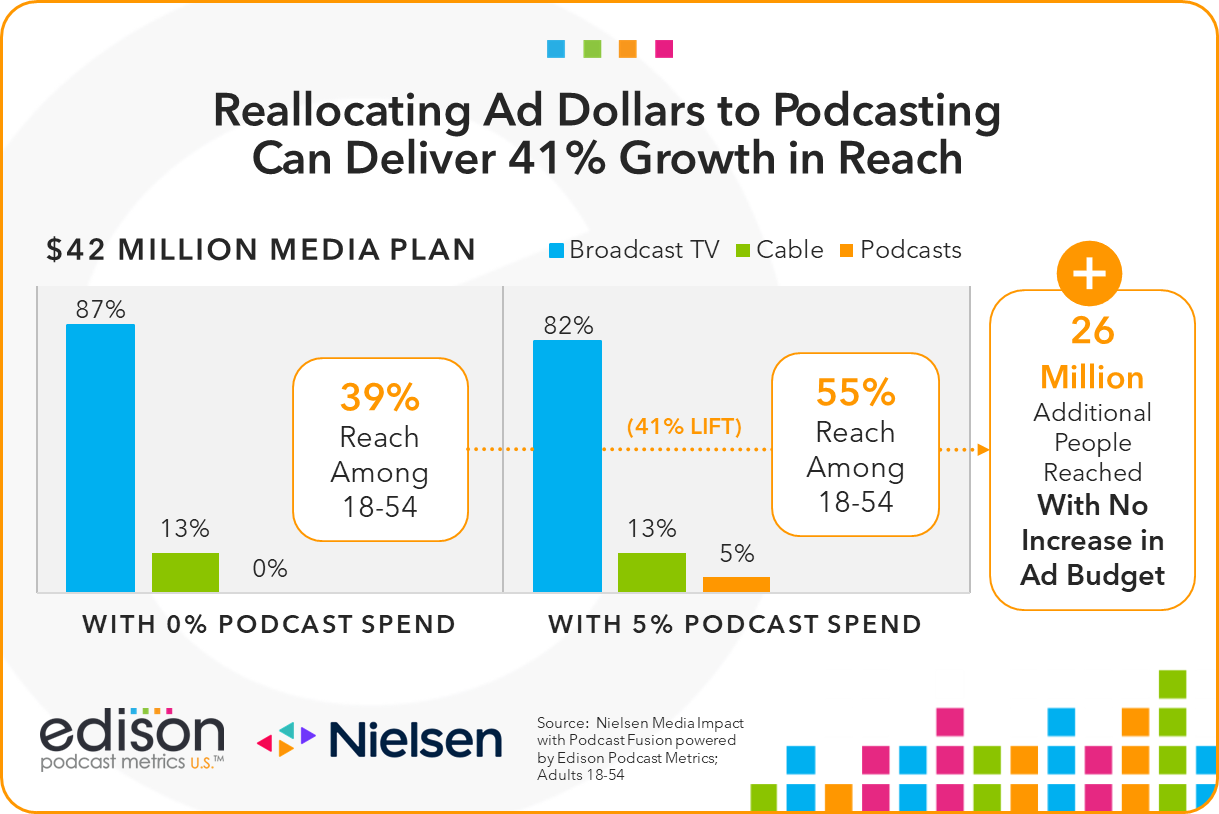
A major pharmaceutical brand didn’t increase its advertising budget. Didn’t overhaul its media strategy. Didn’t hire a new agency. It just moved five cents of every dollar — away from television, into podcasts — and reached 26 million more people. Let that sink in.
Source: Nielsen Media Impact case study, powered by Nielsen Podcast Fusion and Edison Podcast Metrics. This data originates from a real-world media plan analysis commissioned by Nielsen, with Edison Research underpinning the podcast audience measurement. It’s worth noting: Nielsen and Edison Research both have commercial interests in promoting multi-platform planning tools, so read this as directionally significant rather than vendor-neutral research.
The Key Points:
A 5% budget reallocation from television to podcasts drove a 41% lift in reach among adults 18-54 — with zero additional spend
The original TV-only plan (87% broadcast, 13% cable) achieved a reach of 39% among the target demographic
The podcast-integrated plan pushed that reach to 55% — an increase of 26 million additional people
Nielsen Podcast Fusion is positioned as the first multi-media planning tool to model podcast audience data alongside traditional TV buys
The underlying measurement infrastructure is Edison Podcast Metrics — the same dataset powering Podtrac and industry-standard podcast audience benchmarks
Why It Matters
The advertising industry has spent years treating podcasts as a supplementary line item — a nice-to-have bolted onto the bottom of a TV-first media plan. This data argues something more disruptive: podcasts aren’t additive reach, they’re efficiency. The audiences that television is increasingly missing — particularly adults 18-54 who have cut the cord, reduced linear TV consumption, or simply tuned out — are reachable through podcasts. The uncomfortable implication for broadcast television is baked right into the math: the same dollars, redistributed, reached 41% more people. That’s not a rounding error. That’s a structural argument for portfolio rebalancing at scale.
The Big Picture
For podcasters: This is the kind of data that wins budget conversations. When a major pharmaceutical brand — one of the most conservative, compliance-heavy advertiser categories in existence — can demonstrate this level of reach efficiency, every advertiser in every category has reason to ask the same question about their own media mix. More budget conversations opening up means more opportunity flowing into the ecosystem.
For podcast producers: The measurement infrastructure matters as much as the case study. Nielsen Podcast Fusion running on Edison Podcast Metrics means the data your shows generate through Podtrac-affiliated tracking is feeding the planning tools that agencies and brands now use to make buying decisions. Clean, consistent, audited audience data isn’t just a compliance checkbox — it’s the foundation that makes deals like this possible.
For the industry: The argument that podcasting can’t compete with television on reach has just been handed a significant counter-example. Thirty-one million podcast listeners in a single campaign. No new dollars. The industry’s challenge now is getting this case study in front of every media planner still defaulting to a TV-first allocation — and making sure the measurement tools can sustain the scrutiny that will follow when budgets start moving.

TOGETHER WITH MENCARI TRAVEL WIRE
Your Next Adventure Starts Here

Mencari Travel Wire is the go-to travel newsletter for Australia and New Zealand — delivering destination guides, travel intel, and trip-planning essentials curated for readers who move with purpose. Whether you're chasing weekend escapes or planning your next big journey across the Tasman, we've got you covered.
Subscribe Free → TRAVEL WIRE
This section is a paid advertisement. If you are interested in advertising, let’s talk.
EDISON RESEARCH
Record 58% of Americans Consume Podcasts Monthly, But Infinite Dial 2026 Data Reveals YouTube as the Medium's Dominant Platform
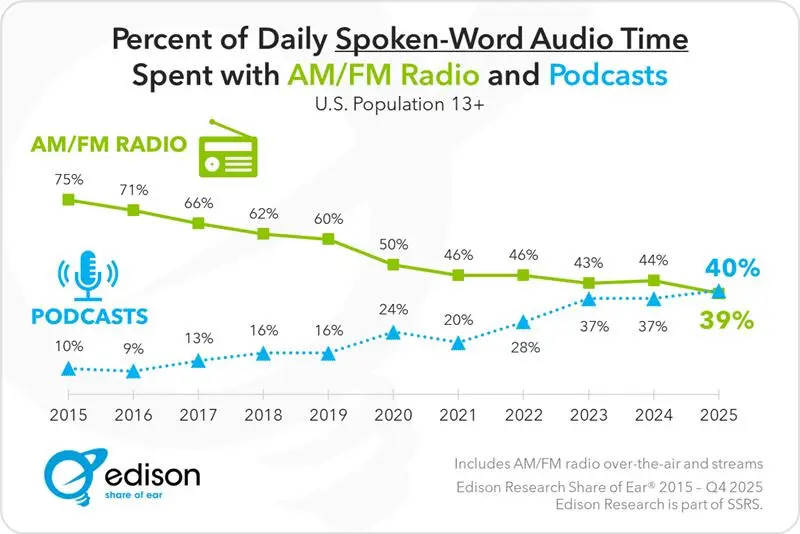
Podwires Rundown : Fifty-eight percent. That’s the new monthly podcast consumption number. An all-time high. One hundred and sixty-seven million Americans. The industry is celebrating, and fair play — these are genuinely impressive numbers.
But here’s the uncomfortable part. Read deeper into the same report, and you’ll find the real story buried four slides past the applause. YouTube now commands 32% of daily podcast consumption time. Among weekly podcast consumers, 39% say YouTube is the service they use most often for podcasts. Spotify is at 20%. Apple Podcasts — the platform that literally invented the modern podcast ecosystem — is at 11%. Let that sink in.
Podcasting’s biggest distribution channel is a video platform that doesn’t call itself a podcast platform. And that gap is only getting wider.
Source: The Infinite Dial 2026, produced by Edison Research at SSRS, sponsored by SiriusXM Media. The survey was conducted in January 2026 among 2,050 Americans aged 12+, with data weighted to the national 12+ U.S. population. The methodology is robust and longitudinal — this is the gold standard of U.S. audio research — but read the platform data with that context in mind.
The Key Points:
Monthly podcast consumption hit an all-time high of 58% of Americans 12+, representing an estimated 167 million people — up from 55% in 2025
Weekly podcast consumption reached 45% (130 million people), with the gap between monthly and weekly consumption continuing to close — a strong signal of habitual listening
YouTube leads all platforms with 32% share of daily podcast consumption time, and 39% of weekly podcast consumers say YouTube is their primary podcast service — nearly double Spotify’s 20%
57% of Americans have both listened to AND watched a podcast — the “audio-only” framing of podcasting is now a minority experience among consumers
AI users consume podcasts at a rate 67% higher than non-AI users — 55% of AI users consumed podcasts in the last week versus just 33% of non-AI users — signalling who tomorrow’s core audience will be
Why It Matters
The record audience numbers are real and worth celebrating. But the platform concentration story underneath them is what executives need to sit with. The medium is growing, but the growth is happening on YouTube — a platform with its own monetisation stack, its own discovery algorithm, and its own relationship with creators that bypasses traditional podcast infrastructure entirely. Meanwhile, Apple Podcasts — still the bedrock of open RSS podcasting — is being used most often by just one in nine weekly podcast listeners. The industry is building an audience it increasingly doesn’t control. That’s not a reason to panic. But it is a reason to think very carefully about where you’re investing in distribution.
The Big Picture
For podcasters: The dual-format reality is now confirmed at scale. 57% of your potential audience has engaged with both audio and video podcasting. That’s not a future trend — it’s the current audience. If you’re audio-only and not on YouTube, you’re invisible to the platform commanding a third of all podcast listening time. You don’t have to build a production studio. But you do need a presence. Start there.
For podcast producers: The AI user data deserves your full attention. People who use generative AI tools consume podcasts at nearly twice the rate of those who don’t. These are educated, digitally engaged, high-income skewing consumers — exactly the audience your advertising clients most want to reach. Build that case into your next media plan pitch. The data is right there.
For the industry: The Infinite Dial has been tracking digital media behaviour since 1998. In that time, it has charted the rise of smartphones, smart speakers, and streaming audio. What it’s now charting — quietly, without much fanfare — is the gradual transfer of podcast consumption to a platform the podcast industry did not build and does not govern. The audience numbers look great. The platform dependency numbers should keep you up at night.
PRESENTED BY PODWIRES MARKETPLACE
Hire Top Independent Podcast Producers for Your Business

Podcasting is a powerful way to grow business, and Marketplace Podwires is here to assist you in the easy hiring of top-rated independent podcast producers. Be it branded podcasts that share your products with the entire world or internal series aimed at engaging and energizing your teams, our expert producers can craft stories that meet any brief and bring more personality to your brand’s voice. Begin with Marketplace Podwires, and find a dream producer for your project today!
PODSCRIBE
Podscribe Q1 2026 Benchmark Report: Podcast Ads Deliver Superior Purchase Incrementality as Simulcast Adoption Reaches 79% of Episodic Campaigns
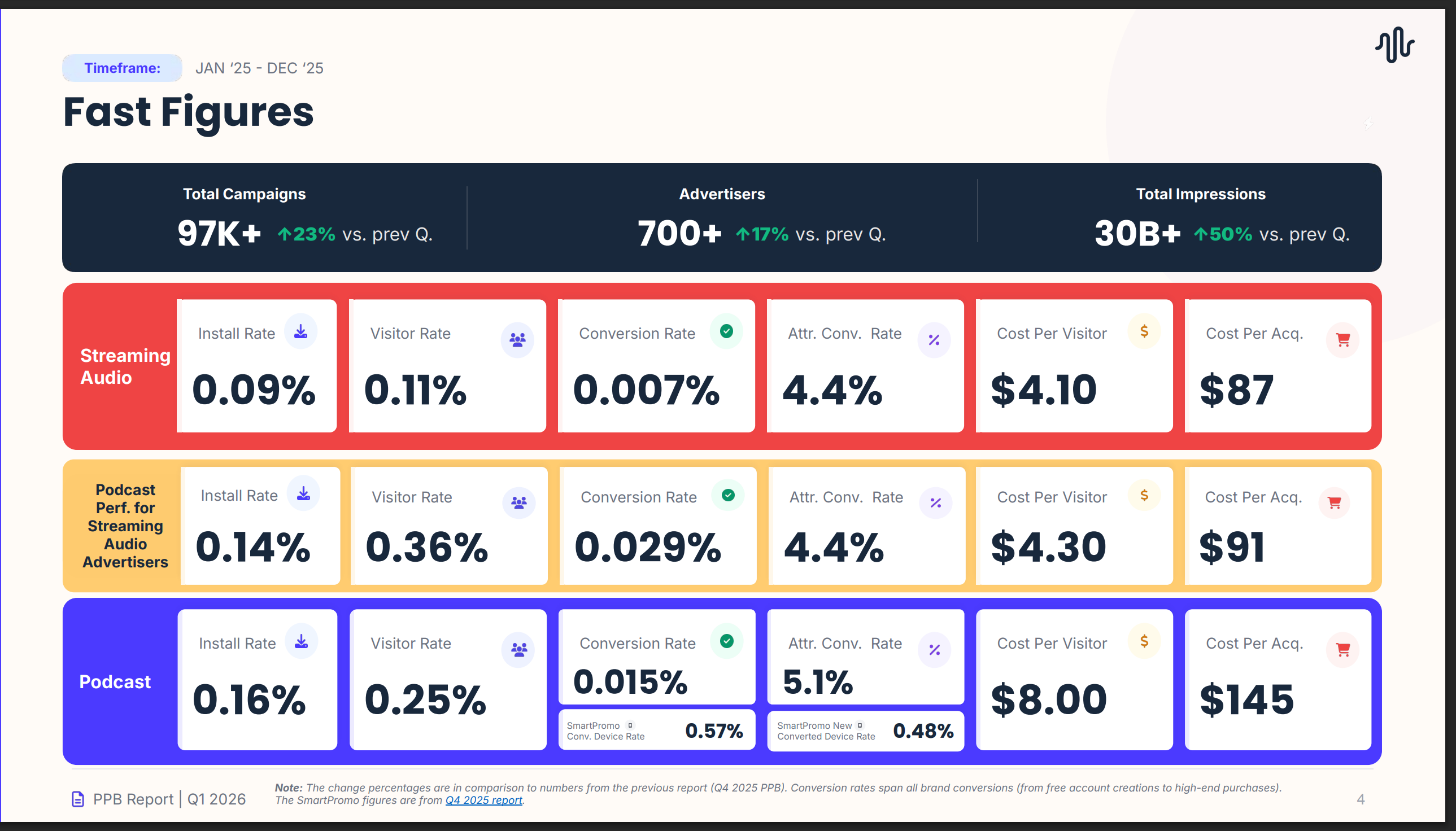
Podwires Rundown : The numbers don’t lie. But they do require translation. Podscribe’s Q1 2026 Performance Benchmark Report lands with 30 billion impressions of proprietary data behind it — and if you’re buying, selling, or planning audio advertising right now, there are things in here that should change how you operate.
The headline finding isn’t the one they put on the cover. It’s buried in the incrementality data. Podcast ads deliver measurably higher purchase incrementality than streaming audio. Full stop. Not marginally. Significantly. The reason is uncomfortable for streaming advocates: streaming audiences are easier to reach everywhere else, which dilutes the unique impact of the audio exposure. Podcast listeners, by contrast, are harder to find on other channels — which makes every podcast impression more valuable, not less. That’s the efficiency argument the industry has been trying to make for years, and now there’s a clean dataset behind it.
Source: Podscribe Q1 2026 Performance Benchmark Report (PPB), covering January–December 2025 data across 700+ advertisers and 30 billion+ impressions. Podscribe is a paid measurement platform with commercial relationships across the buy and sell sides of podcast advertising. Read this as directionally authoritative — the dataset is large and methodologically rigorous — but note that Podscribe benefits commercially from encouraging more sophisticated attribution spend. The incrementality and reach curve data in particular are worth independent validation.
The Key Points:
Podcast ads deliver significantly higher purchase incrementality than streaming audio — the gap is consistent across advertiser sizes and industries, with smaller brands (under 1M monthly site visitors) seeing incremental lift of 45% from podcast advertising versus 34% from streaming
79% of all episodic campaigns measured through Podscribe are now simulcast — YouTube represents nearly two-thirds of all simulcast impressions, making it the de facto video layer of podcast advertising whether the industry acknowledges it or not
Only 13% of the top 100 shows and 16% of the top 500 shows have opted into Spotify Video — creating a significant attribution gap for baked-in ads on the platform, with user-level IP attribution currently impossible for opted-in shows
The geography of your YouTube audience materially affects performance — channels with a higher share of US-based subscribers drive meaningfully stronger promo code redemption rates, a finding Podscribe has now built into its YouTube Smart Modeling system
Podcast and streaming audio audiences are approximately 80% unique from each other — meaning combined buys can reach up to 85% of the U.S. adult population, but the two channels are not interchangeable and should not be planned as substitutes
Why It Matters
The persistent myth in podcast advertising is that streaming audio and podcasting compete for the same budget because they’re both “audio.” This report systematically dismantles that idea. They reach different people in different places with different income profiles — podcast listeners over-index heavily on disposable income and education, while streaming skews toward ad-supported consumers who have actively declined premium subscriptions. Those aren’t the same buyers. Treat them the same way in your media plan and you’re leaving efficiency on the table. The incrementality data makes this concrete: when you buy podcasts, you’re moving the needle on purchases that wouldn’t have happened otherwise. That’s the measurement conversation the industry needs to be having with every brand still defaulting to a streaming-first audio allocation.
The Big Picture
For podcasters: The show genre data has direct revenue implications. Business podcasts lead in visitor rate and rank second in purchase rate — if you’re in that category and not actively marketing those benchmarks to potential advertisers, you’re underselling your inventory. Leisure and Kids & Family genres are punching above their weight on CPA efficiency. These aren’t categories advertisers instinctively gravitate toward. Help them find the data.
For podcast producers: The Spotify Video attribution problem is real and getting more urgent. Only 13% of the top 100 shows are opted in, but that number will grow — and when it does, shows without a measurement strategy for Spotify Video will have a gap in their campaign reporting that advertisers won’t tolerate. Get ahead of this conversation now. Understand what your hosting and measurement stack can and cannot track before your next renewal conversation.
For the industry: The reach curve data should reshape how the industry talks about scale. 99% of podcast advertisers today are reaching at most a third of the podcast audience. Saturating the medium requires upwards of 2 billion impressions per month — a threshold virtually no buyer approaches. That’s not a limitation. That’s an opportunity. The inventory exists. The audience is there. The measurement infrastructure is maturing. The gap between what’s being bought and what’s available to buy is the single most underleveraged commercial story in audio advertising.
ACAST
Acast Podcast Pulse: Singapore Emerges as Global Benchmark for Podcast Trust, With 97% of Listeners Reporting Host-Driven Opinion Change
Podwires Rundown: 97%. That’s the percentage of Singaporean podcast listeners who say a podcaster has changed their mind about a topic. The global median is 84%. Let that sink in for a moment — because what Acast is describing here isn’t just an audience metric. It’s a persuasion engine. And Singapore is running it at full throttle.
The implications for brands advertising in Southeast Asia are significant. The implications for the global media industry are bigger.
Source: Acast Podcast Pulse dataset, released March 2026. Data covers Singaporean podcast listeners with global comparisons across surveyed markets. Transparency note: Acast is a podcast advertising marketplace with direct commercial interest in positioning podcasting as the superior advertising channel. The findings directionally align with independent research on podcast trust and ad receptivity — but treat the specific percentage claims as Acast-commissioned data rather than independent measurement.
The Key Points:
97% of Singaporean listeners say a podcaster has changed their mind about a topic — against a global median of 84% — with 86% simultaneously saying they do not consider podcasters to be “influencers,” creating what the data calls a trust paradox: influenced without feeling influenced
Podcasters outrank journalists on credibility in Singapore, with 52% rating podcasters as credible sources versus 50% for journalists and 48% for YouTubers — a meaningful threshold in a market that has historically deferred to institutional media
Trust converts to commerce: 69% of listeners have considered a brand for the first time because of a podcast, 67% have made a purchase, and 74% say podcasters have successfully shifted their perception of a brand
Active ad attention is high: 60% of Singaporean listeners pay active attention to ads and 45% find them authentic — a metric that will resonate with every media planner tired of fighting viewability fraud in programmatic digital
The format is fluid but trust is audio-anchored: 4 in 5 Singapore listeners now consume both audio and video podcasts, with 75% saying their trust in a brand grows when they encounter it across multiple platforms — validating simulcast strategies for advertisers operating in the region
Why It Matters
Singapore punches well above its population weight in this dataset, and that’s not a coincidence. It’s a sophisticated, digitally mature, high-income market with consumers who have developed strong filters against inauthenticity. That 97% mind-change figure isn’t just a headline — it’s a signal that the trust deficit plaguing digital advertising has a viable alternative. When nearly all of your listeners report being genuinely persuaded by the content, you have something that social platforms have spent a decade trying to manufacture and largely failed to deliver. For brands operating across Southeast Asia, Singapore is the proof-of-concept market. If podcast advertising is working there at this level of trust and conversion, the regional playbook writes itself.
The Big Picture
For podcasters: The credibility-over-influence framing is your most powerful commercial argument. Singapore listeners don’t think of their favourite hosts as influencers — they think of them as trusted peers. That positioning is extraordinarily valuable to brands exhausted by influencer marketing’s declining returns and authenticity problems. Own that distinction explicitly in your pitch materials.
For podcast producers: The multi-platform data matters for how you structure talent and content deals in the region. 59% of listeners follow their favourite podcast creators on YouTube and 46% on Instagram — the relationship starts in audio but lives across the ecosystem. Productions that are engineered for cross-platform presence from day one will command stronger advertiser interest than audio-only formats, regardless of where the core trust is built.
For the industry: Singapore is the canary. A high-trust, high-attention, high-conversion market showing podcasters outranking journalists on credibility is not a regional curiosity — it’s a preview of where mature podcast markets trend as audiences become more discerning. The brands that recognise this early and build genuine podcast advertising strategies in Southeast Asia — rather than bolting on audio as a programmatic afterthought — will have a structural advantage as the region’s podcast audience continues its rapid growth.
SOUNDS PROFITABLE
Apple Podcasts HLS Support Reframes Video Podcasting Debate — Industry Analysis Points to Infrastructure Ownership, Not Format, as the Real Story

Podwires Rundown: Apple just handed podcasting something it hasn’t had in a very long time. A reason to believe the open ecosystem can still win.
The Apple Podcasts HLS announcement isn’t really about video. It’s about infrastructure ownership. And if the industry reads it correctly, it could be the most consequential technical development in podcasting since RSS itself. Bryan Barletta of Sounds Profitable has laid out the clearest analysis of what this actually means — and it deserves your full attention.
Source: Sounds Profitable, analysis by Bryan Barletta, published March 2026. Barletta is co-founder of Sounds Profitable, a podcast trade association and research organisation with deep relationships across the hosting, ad tech, and publishing ecosystem. This is informed editorial analysis, not a vendor press release — but note that Sounds Profitable has commercial relationships with several companies named in the piece, including early HLS adopters Acast, ART19, Omny Studio, and SiriusXM Media/AdsWizz.
The Key Points:
Apple Podcasts is rolling out HTTP Live Streaming (HLS) support for video, audio, and dynamic ad insertion via HLS Interstitials — critically, HLS is an open standard governed by Apple, meaning the same multivariant playlists sent to Apple Podcasts can work in other podcast players without modification
IAB certification carries over: certified hosting platforms supporting HLS can report on downloads and ad delivery across both HLS video and audio, meaning your prefix analytics, ad delivery pixels, and existing ad stack can work the same — a deliberate preservation of the open measurement infrastructure
The ad serving cost structure is changing: Apple is charging hosting platforms a CPM-based tech fee for HLS Interstitials on dynamically served ads, though baked-in ads incur no Apple-side cost — the full downstream impact on CPMs and publisher revenue remains unquantified
Infrastructure costs scale sharply: HLS delivery requires approximately 450 server requests per listener versus one for RSS, creating a meaningful cost advantage for larger hosting platforms and raising real questions about viability for smaller operators
Early adopters include Acast, Amazon’s ART19, Triton’s Omny Studio, and SiriusXM Media — notably, Acast and Omny Studio also appear on Spotify’s recent announcement, suggesting an emerging coalition of hosting and ad tech players building toward cross-platform HLS compatibility
Why It Matters
Here’s the uncomfortable part that most coverage has missed. This isn’t primarily a video story. It’s an ownership story. What Apple has done — intentionally or not — is reinforce that the centre of a creator’s universe should be their hosting platform, not a walled garden. The HLS multivariant playlist standard means a show uploading video through a certified hosting platform can distribute that content across any player that adopts HLS, without rebuilding the ad stack or fragmenting the measurement. That’s a direct counter-argument to the closed-platform gravity pulling creators toward YouTube and Spotify’s proprietary ecosystems. Whether the industry seizes that opportunity is another question entirely — but the infrastructure to do so now exists in a way it didn’t before.
The Big Picture
For podcasters: The immediate practical question is whether your hosting platform supports HLS and what the cost implications look like for your show. If you’re video-first and currently routing everything through YouTube because Apple Podcasts didn’t support video properly — that calculation just changed. The audience size on Apple Podcasts relative to YouTube still matters enormously, but the technical barrier is gone. Ask your host what their HLS timeline looks like.
For podcast producers: The ad serving transition is the operational priority. HLS Interstitials require ads to serve both video and audio versions. If your programmatic stack is only providing one format, you will serve ad-free inventory on a platform that is about to get a significant video upgrade. This is a solvable problem — DSPs can create audio from video and vice versa — but it requires active conversations with demand partners now, not after you’ve gone live.
For the industry: Barletta’s framing is the right one. The question isn’t who will watch podcasts on Apple Podcasts. The question is whether this moment — Apple, Spotify, and a coalition of hosting and ad tech players all moving toward compatible open standards simultaneously — represents a genuine inflection point in the fragmentation story that has slowed video adoption for years. Two of Apple’s named early adopters are also on Spotify’s announcement. That overlap is not accidental. It suggests the infrastructure for a genuinely interoperable video podcast ecosystem is closer than the industry’s usual fragmentation would suggest.
JOIN PODWIRES MARKETPLACE
If you’re building a podcast team, Join Podwires Marketplace to access monthly curated lists of experienced podcast professionals—producers, audio engineers, scriptwriters, and hosts—actively seeking new opportunities in news, storytelling, and audio journalism.

If you’re a podcast professional seeking your next opportunity, join the PodWires talent directory to connect with podcast companies and media organizations.

📣 Featured job opportunities 📣
WISE - Paid Audio Manager
ARN - On Air Digital Content Producer
Lemonada Media - Senior Producer, Video
🚨 Stay on top of your deadlines with our weekly-updated calendar of fellowships, grants, training opportunities and podcasting events. If your organisation has a fellowship, grant or event to share, just 👉 fill out this form or want to contribute an article 👉 click here or reply to this message.
THAT’S WRAP
SPONSOR US
Reach over 1000 podcast producers with your product.
Thousands of podcast producers, audio/video editors, podcasters, executives, and business owners worldwide read our newsletter. Contact us now.

📖 I appreciate you taking the time to read! See you in the next issue. Got a question or criticism? Just click on Reply. We can talk while we are here.
✍️ Give us a press release and a good-sized landscape photo. Make sure it’s newsworthy. Send press releases to editor@podwires.com or click here. Editorially, we may rewrite headlines and descriptions.
📬 Sponsor us and get your brand in front of thousands of Independent Podcast Producers and podcasters. Email us at sales@podwires.com for more information or as personal supporters via Patreon, as your contributions help us enhance the experiences of all our users.
🖊️We are delighted to hear from our subscribers! We would be happy to publish your testimonial if you have found our newsletter to be helpful or if you have a success story to share. 👉 Post a Testimonial: https://testimonial.to/podwires
🚀 We are here to help you succeed! Fill out a 5 minute survey and tell us more about your business and yourself. These questions will help us better understand you and promote your business as part of our mission. It’s a win-win!
🚨 Did someone forward this to you?
Become one of the more than 1000 valued email subscribers. Find Out More 👈
We’d love to share what our Podwires readers have been saying!

We’re so grateful to our previous Podwires advertisers!

Podwires is here because of our incredible partners’ unwavering support. The Podwires readers receive journalism free of financial and political influence. If you found this valuable, consider Restacking so more people can see it. Get together with them today.